Bells of Revelation Myth Meaning & Symbolism
A celestial myth of seven bells whose ringing heralds the final unveiling of truth, calling humanity to ultimate judgment and transformation.
The Tale of Bells of Revelation
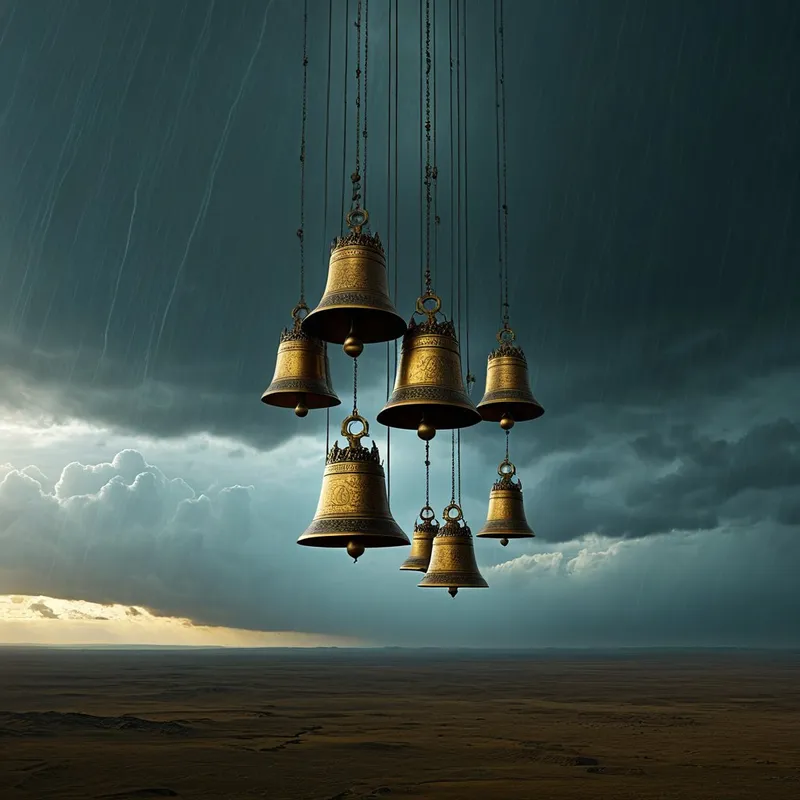
Listen, and hear the tale that is written not on parchment, but on the fabric of time itself. In the hall of the Throne, beyond the veil of the seven stars, there hangs that which was forged before the foundations of the world. Not swords, nor crowns, but seven bells. They are not of common metal, but of a substance that sings with the memory of the first light and weeps with the knowledge of the last tear.
They are silent. An eternal, waiting silence that is heavier than any sound. Below, the world turns through its ages—kingdoms rise like tides of ants and fall into dust, hearts love and break, prophets cry out, and the innocent suffer. All of it is known. All of it is gathered, every secret thought, every hidden deed, every whispered prayer and stifled curse, accumulating like dew upon the cold, silent surfaces of the bells.
Then comes the hour when the silence can hold no more.
A figure approaches the Throne, a being of fire and eyes, given a censer of incense which is the prayers of the saints. The smoke rises, acrid and sweet, and fills the hall. It is the signal. From the east, a wind begins to blow, a wind that has journeyed from the dawn of creation. It touches the first bell.
Dong…
The sound is not a sound. It is the cracking of the cosmic egg. It rolls across the heavens, and on the earth, every ear hears it within the marrow of the soul. It is the sound of a door, irrevocably opened. Hail and fire, mingled with blood, are cast upon the earth. The first seal of the world’s scroll is broken.
One by one, the winds of destiny stir. The second bell tolls, and the sea becomes as the blood of the dead. The third, and the rivers and fountains follow suit. The fourth, and the sun is smitten, the moon turned to blood. Each peal is a wave of absolute truth, stripping away the comforting lies of epochs. There is no place to hide from the resonance. It vibrates in the stone, in the water, in the very air that must be breathed.
The fifth bell is a sound of lamentation, for the light of the sky is taken, and in the darkness, humanity gnaws its tongue in anguish. The sixth bell tolls, and at its terrible voice, the great river Euphrates is dried up to make a road for kings from the east. Armies gather, numberless as the sand, under a sky now torn like a scroll.
Then… a silence more terrible than all that came before. The seventh bell hangs, a dormant star. All of creation holds its breath. The prayers of all who have ever whispered “How long?” are condensed into this single, aching moment of suspense. Then, from the Throne, a voice like many waters says, “It is done.”
And the seventh bell does not merely toll. It shatters.
Its breaking is not an end, but a beginning. It is the sound of every veil torn in two, of every mystery laid bare, of time itself completing its circuit. Voices in heaven cry out, “The kingdom of the world has become the kingdom of our Lord and of his Christ.” In that final, all-consuming resonance, there is no more sea—no more separation, no more chaos. Only the unveiled presence, and the eternal reckoning of what was built, in light or in shadow, during the long, echoing silence.

Cultural Origins & Context
This narrative is woven from the threads of the Book of Revelation, specifically the sequences surrounding the seven trumpets. In the symbolic language of apocalyptic literature, the trumpet and the bell serve analogous functions: they are instruments of announcement, of alarm, and of sacred summons. The “Bells of Revelation” as a distinct mythological motif is a later, folkloric crystallization of this biblical imagery, emerging from medieval Christian mysticism and eschatological thought.
It was passed down not as formal doctrine, but as a powerful story in sermons, illuminated manuscript marginalia, and the oral traditions of communities facing plague, war, and famine. The myth functioned as a cosmic anchor. It presented a universe where moral causality was absolute and ultimately audible. The seeming chaos and injustice of history were not random but were leading to a final, resonant clarity. This provided a framework for enduring suffering—the present trials were the silent tension before the tolling. It was a myth for the end of things, yes, but more importantly, for the meaning of things.
Symbolic Architecture
The bells are not instruments of punishment, but of revelation. Their primary function is to make the unseen seen, the unheard heard. They symbolize the inevitable moment when the consequences of inner states—both personal and collective—manifest in the outer reality with undeniable force.
The bell does not create the sound; it releases what has been held within its form. So too does revelation not create judgment, but unveils the judgment we have already authored in our hidden hearts.
Each bell represents a distinct archetypal layer of consequence or awakening. The first bells often correlate with elemental and environmental upheaval, symbolizing the shaking of the foundational, unconscious structures of the psyche or society. The middle bells speak to the darkening of the luminaries—the guiding lights of reason, faith, and intuition becoming obscured, forcing a navigation by inner truth alone. The final, shattered bell is the symbol of apocalypse in its truest sense: an unveiling so complete it destroys the very vessel of the old mystery, giving way to a new, integrated state of being. The Four Living Creatures and the elders who oversee the process represent the archetypal, transpersonal order of the psyche that administers this profound and terrifying law of return.
The Dreamer's Resonance
When this myth stirs in the modern dreamscape, it rarely appears as biblical pageantry. The dreamer may hear a distant, resonant tolling that fills them with both dread and awe. They may find a single, immense bell in a familiar yet alien landscape—a childhood home, an office tower—cracked and silent, or vibrating silently. They may be tasked with ringing it, or desperately trying to stop its peal.
Somatically, this is the psyche signaling a point of no return in a psychological process. The “bell” is often a core complex, a lifelong pattern, or a buried truth whose time of manifestation has come. The dream embodies the somatic anxiety and profound gravity of facing what has long been repressed or ignored. The ringing is the psychic energy that can no longer be contained; it will express itself, disrupting the dreamer’s inner and outer world. This dream pattern accompanies life crises, major decisions, or the culmination of therapeutic work where a central, defining self-narrative is about to be irrevocably challenged and changed.
Alchemical Translation
The alchemical journey mirrored here is the opus contra naturam—the work against nature, which is to say, the work against unconscious, automatic living. The long silence of the bells is the stage of nigredo, the blackening, where material (life experiences, choices, shadows) accumulates unnoticed in the vessel of the self.
The tolling is the fierce, necessary stage of separatio and calcinatio. The resonant truth burns away the dross, separates the essential from the trivial. Each peal is a painful but liberating insight: “This part of your life must end. This identity is an illusion. This pain holds your key.” It is a distillation by vibration.
The shattering of the seventh vessel is the solutio—the dissolution of the very form that contained the mystery. The old self-concept, the old worldview, cannot survive the full integration of truth. It must break.
From that breaking comes the albedo and rubedo: the whitening and reddening. The unveiled state, the “kingdom” realized within. The process models individuation as a series of resonant awakenings, each more comprehensive than the last, initiated by an archetypal call (the wind, the angel) that the ego does not control. The ultimate goal is not to build a better ego, but to have the ego-structure so thoroughly confronted by the Self that it becomes a transparent vessel—a bell that has finally, fully, sounded its note and now rests in the silence of what is known.
Associated Symbols
Explore related symbols from the CaleaDream lexicon: