The Dream Theme of Healing: The Alchemy of the Wound
The Somatic Echo
Before the mind can articulate the concept of healing, the body knows it as a deep, tectonic ache. It is not a sharp pain, but a profound, resonant fatigue in the marrow—a feeling of structural compromise. You carry it as a low hum in the joints, a subtle brittleness in the breath, a sense that your internal architecture is bearing a weight it was not designed to hold. This is the somatic echo: the ghost of an impact, a loss, or a betrayal that has settled into your very form. It is the feeling of a foundation that has shifted, leaving every room in the psyche slightly off-plumb. The dream of healing begins here, in this visceral, wordless knowing that something fundamental requires not just repair, but transmutation.
The Dreamer's Log
I am in a vast, derelict factory. The air is cold and smells of ozone and old rust. In the center of an empty concrete bay sits a single, exquisite porcelain teacup, cracked clean through. From the fracture, a thick, silver-black substance, like liquid mercury mixed with ink, drips slowly onto the floor. As it pools, I feel not despair, but a fierce and tender attention. I know, with dream-certainty, that this leaking is not a loss, but a necessary release—the first step in a process I cannot yet see.
This dream speaks of the alchemical solve: the conscious, sacred dissolution of a cherished but broken form, allowing its essence to flow out and begin its transformation.

The False Lead
Healing is not the erasure of a scar. It is not a return to a pristine, unmarked state that never existed. To mistake it for mere "feeling better" or "getting over it" is to commit a profound error. This theme is not about covering the wound with the pretty plaster of positive thinking, nor is it the passive hope that time alone will bleach the memory. That is forgetting, not healing. True healing is an active, often brutal, engagement with the fracture line itself. It is the recognition that the wound has become a structural feature, and sovereignty is found not in pretending it away, but in learning to build a more resilient, more conscious self around its truth.
Psychological Architecture
The architecture of healing is built in the shadowlands. It begins when the protective exile—that part of you that walled off the pain, the memory, the shattered belief—finally feels the pressure of being held in silence. This internal family, this system of selves, has a manager that insists "I'm fine," and a firefighter that numbs or flees, all to protect the exiled one who holds the raw terror. The work of healing is the slow, courageous approach to that inner exile. It is sitting in the psychic basement with the part of you that is still five, or fifteen, or any age that knew the rupture. It is not analyzing it, but listening to its story until the story loses its radioactive charge and becomes simply a story—tragic, yes, but integrated into the tapestry of you. This is the individuation process: not becoming perfect, but becoming whole, which means bringing the forsaken fragments home.
Mythic Resonance
Consider the myth of the Fisher King, guardian of the Grail, who lies wounded in the groin, his kingdom withering into a wasteland mirroring his inner state. His healing does not come from a simple surgery, but from a question—"Whom does the Grail serve?"—that reorients his entire being from passive sufferer to active participant in a sacred mystery. His wound and its cure are inseparable; the wasteland blooms only when the wound is acknowledged as the very center of the quest. Similarly, in the Japanese art of Kintsugi, broken pottery is repaired with lacquer mixed with gold, silver, or platinum. The philosophy is clear: the breakage and repair are part of the object's history, to be highlighted rather than hidden. The flaw is not a cause for shame, but the source of unique beauty and increased value. The vessel becomes more itself for having been broken.
Symbolic Nodes
- Mending/Knitting: Hands weaving light, thread, or roots; stitching skin to earth or sky.
- Cleansing Waters: Pools, showers, rains that wash away not dirt, but a clinging psychic residue.
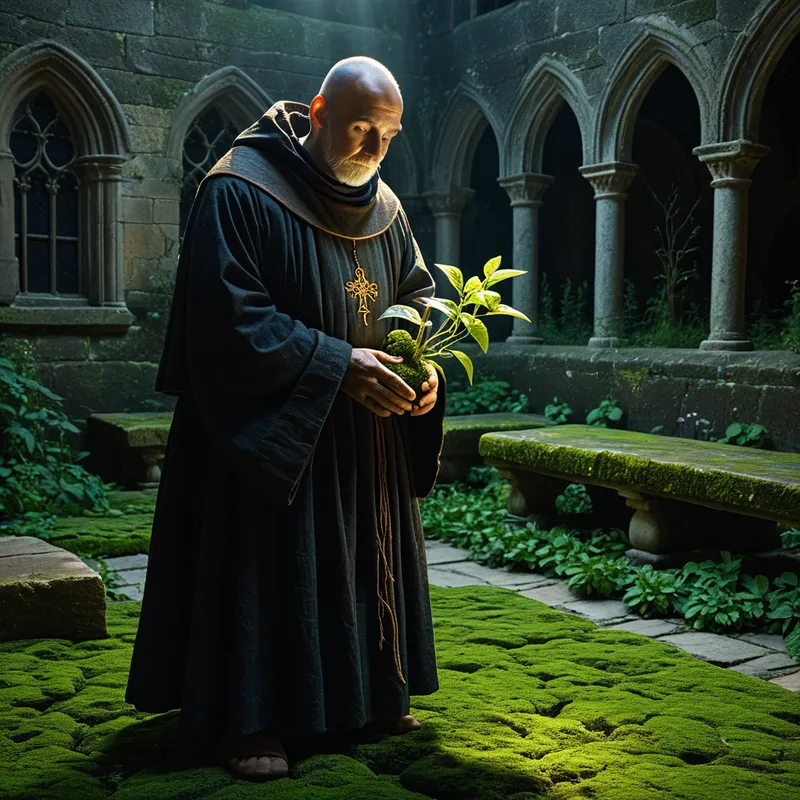
- Regrowing Forests/Lichen: Life slowly reclaiming a scorched or industrial landscape.
- Fractured Objects Being Fused: Not with invisible glue, but with a luminous, visible substance.
- Architectural Restoration: Rebuilding a ruined house, often with a new, more beautiful material.
- Swallowing Light/Being Filled with Warm Liquid: An internal, somatic experience of infusion.
Archetypal Resonance
The most active force in the theme of healing is The Magician Archetype. Not the flashy illusionist, but the deep alchemist. The Magician’s core energy is transformation—the conscious application of will and awareness to change the fundamental nature of a substance or situation. This resonates perfectly with healing’s somatic echo: the Magician feels the base material of the pain, the leaden weight of grief, and knows it contains a latent potential. The alchemical potential here is the Magician’s greatest work: transmutation. It is the archetype that does not seek to discard the wound, but to subject it to the intense heat of attention and the pressure of compassion, performing the inner operation that turns trauma into wisdom, fragmentation into a more complex unity. The Shadow Magician, the manipulator, would try to bypass the pain or use it for power over others; the true Magician uses it for the sovereignty of the self.
The Alchemical Process
The alchemy of healing is calcinatio followed by coagulatio—fire and recombination. First, the intense heat. This is the often-terrifying process of fully feeling what was numbed. It is allowing the grief, the rage, the shame to burn through the insulation of denial. This fire is not punishment; it is purification. It reduces the complex, tangled narrative of the wound down to its essential, elemental truth. Then, under the pressure of sustained, non-judgmental awareness, the coagulatio begins. The scattered, ash-like particles of the self do not simply reform as they were. They recombine with the gold of earned insight, the silver of self-compassion, and the platinum of hard-won boundaries. The new structure that coagulates is not the old one repaired. It is a new compound, a new psychological substance that is more resilient, more conscious, and uniquely beautiful because it contains the trace elements of its own breaking. Sovereignty is born from this precise, inner laboratory work.

The Integration Protocol
Question 1: If the wound or ache in my somatic echo had a voice, what single sentence does it most need to say, not to the world, but to me?
Question 2: What small, daily ritual or structure in my life currently acts as a "bandage"—a temporary covering that prevents true engagement? What would happen if I removed it for one conscious hour?
Question 3: Imagine the healed state not as the "end of pain," but as a landscape. Describe its weather, its architecture, its light. What is growing there that could not grow before?
Action 1 (Somatic Mapping): For one week, carry a small notebook. When you feel the somatic echo—the ache, the brittleness, the low hum—stop for 60 seconds. Do not analyze. Instead, write three words that describe its texture (e.g., "gritty, cold, dense"), its location (e.g., "behind sternum, in jaw"), and its color in your mind's eye. This grounds the abstraction in bodily data.
Action 2 (Unstructured Writing): Set a timer for 15 minutes. Write a letter from the perspective of the "cracked teacup" or the "fractured object" from your dream or imagination. Let it speak of its breaking, but also of what it contains, what is leaking out, and what it secretly hopes it might become. Do not edit for sense.
Action 3 (Ritual of Transmutation): Find a small, discarded object that feels symbolically "broken" (a stone, a piece of wood, a dead leaf). Spend time with it. Then, using paint, gold leaf, wire, or simply by placing it in a spot of beautiful light, perform an act upon it that honors the break while altering its nature. The act is not to "fix" it, but to acknowledge its history and change its context. Bury it, float it away, or place it on an altar as a testament to the process.
Final Validation
This work is not linear. It is cyclical, like seasons over a damaged land. There will be days when the wound feels fresh, when the internal exile wails, and the Magician within feels like a fraud. This is not failure; it is the weather of healing. Validate the profound difficulty. You are not merely tidying a room; you are slowly, carefully, rebuilding the house of your soul around a sacred fault line. The sovereignty that emerges is not an impervious fortress, but a resilient, knowing, and deeply compassionate ecology—a self that has metabolized its own darkness and learned to grow strange, beautiful flowers in the very soil of its breaking. You are not repairing a past self. You are alchemizing the materials of your experience into a self that is finally, authentically, your own.