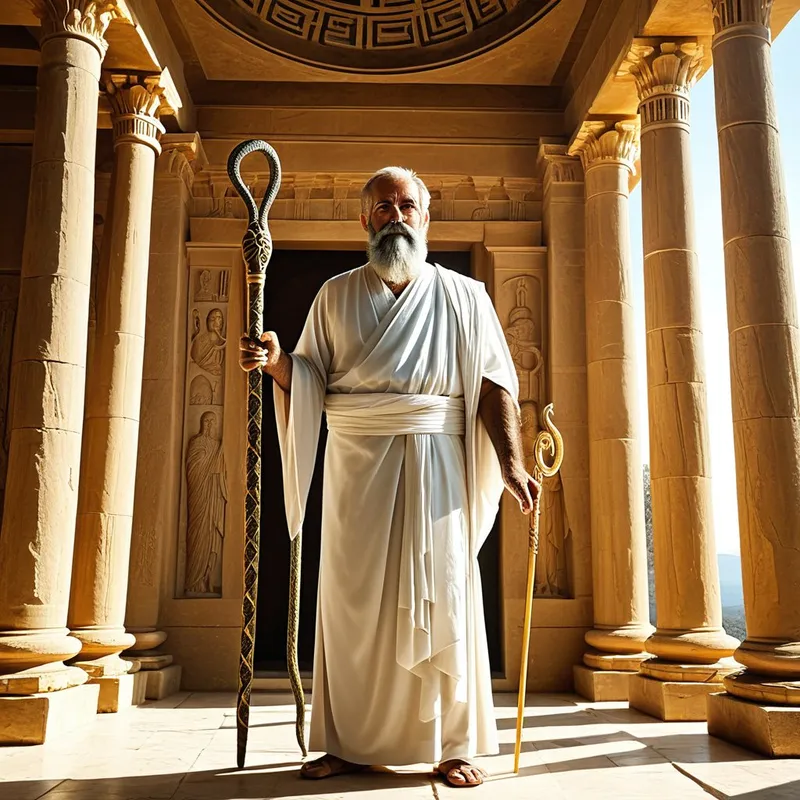
Aesculapius Myth Meaning & Symbolism
The son of Apollo, a mortal healer who learned to resurrect the dead, was struck down by Zeus and later reborn as a god of medicine.
The Tale of Aesculapius
Hear now the story of the man who touched the veil of death and pulled it aside. It begins not in the halls of men, but in the secret, sun-drenched grove where the nymph Coronis lay with Apollo. From their union, a child was conceived—a child of divine radiance and mortal clay. But Coronis’s heart strayed, and Apollo, the all-seeing, knew. His silver arrow flew true, and the nymph fell. As her pyre was lit, as the flames licked her mortal form, Apollo’s grief pierced his divine wrath. He reached into the very fire, and from his dying lover’s womb, he plucked the unborn child.
This child was Aesculapius. Apollo gave him to Chiron, the gentle centaur of the wild Pelion mountains. In Chiron’s cave, among drying herbs and starlit charts, the boy learned. He learned the language of roots and the song of bones. He learned to stitch flesh with thread and mend spirit with presence. His hands became instruments of a sacred art, guided by his father’s light but grounded in the earth-wisdom of his mentor.
Aesculapius grew, and his fame spread like a healing wind across the land. He walked among the plague-stricken and the wounded, his staff a steady beacon. But his art evolved. He did not merely treat illness; he began to challenge its final master. He learned the secret of the Gorgon’s blood, given by Athena—blood from the left vein brought death, but from the right, a shocking return to life. With this dread knowledge, he ventured further. He saw death not as a closed door, but as a threshold. When Glaucus lay drowned in a jar of honey, Aesculapius saw a serpent bring an herb to its dead mate. Mimicking this divine clue, he placed the herb on Glaucus’s cold lips, and the boy drew breath.
This was his triumph and his transgression. The line between healer and usurper blurred. The dead began to walk again, and the natural order—the bitter, necessary cycle ordained by Zeus—began to fray. Hades, lord of the underworld, stood before his thinning halls and thundered his complaint to Olympus. The balance of the cosmos was at stake. Zeus, guardian of the great laws, listened. A choice lay before him: allow a mortal to unravel the fabric of life and death, or uphold the eternal decree.
The sky darkened. The air crackled with the scent of ozone. There was no malice in Zeus’s act, only the terrible, impartial necessity of cosmic law. A single, blinding bolt of thunder-fire descended from the clear sky. It found Aesculapius in his sanctuary, and in a flash of purifying light, it struck the healer down. His mortal form was ash.
But the story does not end in ash. Apollo raged, yet even his fury could not reverse the will of Zeus. Yet from that rage and from the universal lament for the lost healer, a resolution was born. Zeus, in his sovereign wisdom, did not consign Aesculapius to the gloom of Hades. Instead, he lifted the healer’s essence from the pyre of his mortality. He placed him among the stars and granted him a new form—a divine form. Aesculapius was reborn, not as a mortal man, but as a god. His temples, the Asclepieia, became places of sacred incubation, where healing was a collaboration between the divine, the natural, and the human soul.

Cultural Origins & Context
The myth of Aesculapius is woven from threads of pre-Greek chthonic (earth) worship and the evolving Olympian pantheon. His origins are likely rooted in a historical figure—a master physician of such profound skill that his memory was deified over centuries. The primary sources are the Homeric Hymns, Pindar’s odes, and later accounts from poets like Ovid and the travel writings of Pausanias.
The myth was not merely entertainment; it was a foundational narrative for a central societal institution: the healing temple. At sites like Epidaurus, Kos, and Pergamon, the myth provided the sacred charter for the practice of incubation. Pilgrims would come, perform purifications, and sleep in the abaton (the sacred dormitory), believing Aesculapius would visit them in dreams to diagnose or cure them. The myth explained the god’s authority (son of Apollo), his profound knowledge (tutored by Chiron, aided by Athena), and his ultimate limit (the law of Zeus). It established healing as a divine gift with mortal responsibilities, a sacred art bounded by cosmic law.
Symbolic Architecture
At its core, the myth of Aesculapius is a profound meditation on the healer archetype and its inherent paradox. He represents the ultimate human aspiration: to conquer suffering and death itself. His journey maps the evolution of consciousness from skilled craft to transcendent, dangerous wisdom.
The true healer must first be wounded by the knowledge of mortality, and their ultimate power lies in accepting the wound, not in seeking to erase it.
His symbols are deeply telling. The Rod of Asclepius is not a weapon but a walking staff, a symbol of support and journeying. The serpent, a creature that sheds its skin, is the universal symbol of regeneration, renewal, and the chthonic wisdom of the earth—the very wisdom Chiron imparted. The myth presents a trinity of divine influence: Apollo (divine inspiration and light), Athena (practical wisdom and strategic application), and Chiron (the embodied, earthy mentorship that translates divinity into actionable care).
Psychologically, Aesculapius embodies the archetype of the Wounded Healer. His origin is in the death of his mother; his life is dedicated to confronting the wound of mortality that defines the human condition. His fatal error—hubris—is not born of arrogance, but of an overflowing of the healing impulse itself. It is the shadow of the caregiver: the inability to let go, to accept limits, to allow for necessary endings. His apotheosis represents the integration of this shadow. He does not become a god who endlessly resurrects; he becomes the god of sanctified process, of healing within the great cycle.
The Dreamer's Resonance
When the pattern of Aesculapius stirs in the modern unconscious, it often surfaces in dreams of profound healing or terrifying medical overreach. One might dream of discovering a miraculous cure, of having healing hands, or of working in an endless, labyrinthine hospital where patients never die but never truly recover—a sterile underworld.
Somatically, this can correlate with a period of intense caregiving, medical anxiety, or a "savior complex" where one’s identity is fused with fixing others. The dream may present a wise serpent, not as a threat, but as a silent guide. Alternatively, it might manifest as a sudden, shocking failure—a lightning bolt of insight that one’s efforts have overstepped, that one has been trying to heal what must, for the health of the whole system, be allowed to pass away. The dream is the psyche’s Asclepieion, a place of incubation where the individual confronts their own relationship with care, limit, and the ultimate authority of nature’s laws within their personal psyche.

Alchemical Translation
The alchemical journey of Aesculapius is a perfect model for the process of individuation, particularly the stage of mortificatio and subsequent sublimatio. The initial nigredo (blackening) is his traumatic birth from the funeral pyre. His education under Chiron is the albedo (whitening), the purification and acquisition of conscious skill. His successful healings represent the blossoming of the conscious ego, the citrinitas (yellowing).
The crisis comes with the attempt at resurrection—the rubedo (reddening) pushed too far, becoming not enlightenment but inflation. The lightning bolt of Zeus is the necessary mortificatio: the brutal, absolute death of the ego’s identification with divine, limitless power.
The lightning bolt is not punishment, but the swift, surgical incision that separates the mortal identification from the immortal essence. The ash is the prerequisite for the phoenix.
This is where the alchemical miracle occurs. The ash of the mortal healer does not scatter; it is gathered by Zeus himself for sublimatio—the raising to a higher plane. The individuated Self is not the mortal ego that tried to cheat death; it is the transcendent function that understands its role within the greater order. The modern individual undergoing this process must move from being a "fixer" of their own or others’ psyches to becoming a vessel for a healing presence that respects the autonomy and destiny of the soul. One integrates the healer not by eradicating all wounds, but by honoring the sacred boundary between life and death, between intervention and acceptance, thus achieving a wholeness that includes the reality of limit. The god is born when the mortal ambition dies.
Associated Symbols
Explore related symbols from the CaleaDream lexicon: