The Secret Tunnel to Carbonek Myth Meaning & Symbolism
A knight's perilous journey through a hidden tunnel to the Grail Castle, facing the shadows of the self to restore a wounded king and land.
The Tale of The Secret Tunnel to Carbonek
Listen, and hear a tale not of open fields and clashing steel, but of a silence so deep it has a voice, and a path so hidden it can only be found by the lost. In the twilight years of Logres, when the bloom was fading from the rose of Camelot, a sickness lay upon the land. Springs ran slow, crops grew thin, and a grey mist of sorrow clung to the hearts of men. It was whispered that this blight flowed from the wound of the Fisher King, he who languished in the unseeable castle of Carbonek.
But Carbonek is not found on any map. It exists in the folds between worlds, visible only to the purest fool or the most desperate soul. For those knights who sought it in pride, it vanished like a mirage. Yet, the oldest whispers spoke of another way—not over the guarded bridge or through the enchanted forest, but under. A secret tunnel, forgotten by the sun, whose entrance was known only to the earth itself and those who had utterly given up hope of finding it.
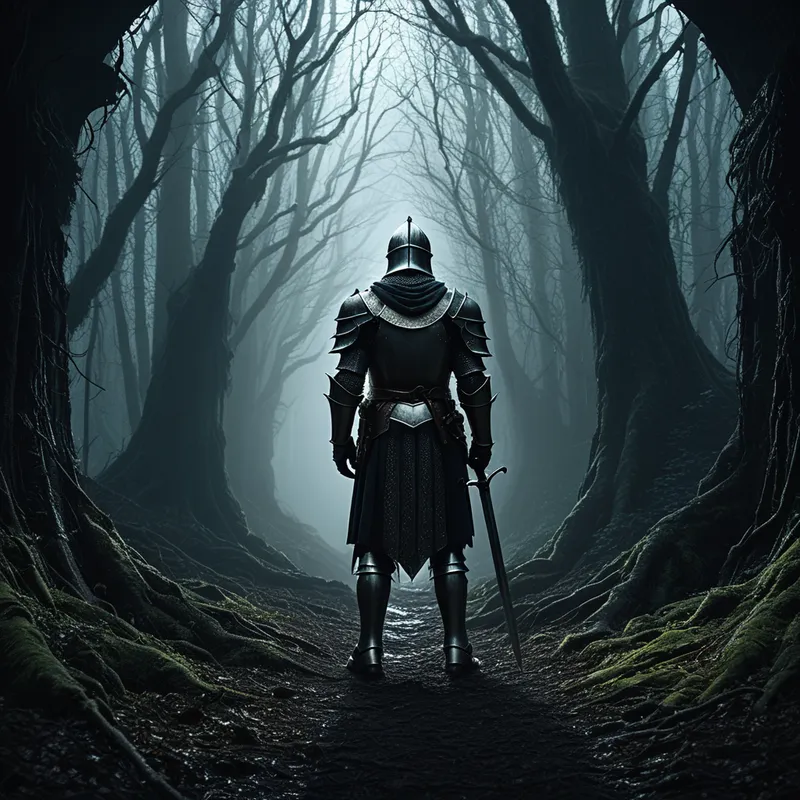
It was said that after the failed quests of the great knights, a lesser-known knight, one marked more by quiet perseverance than shining glory, was drawn to a desolate part of the forest. He was not following a vision, but a hollow feeling, a pull in the marrow of his bones. Exhausted, his questing armor a burden, he stumbled and fell into a thicket of thorns that tore not at his cloak, but at his certainty. As he lay there, defeated, he saw it: not an arch or a door, but a yawning. A cleft in an ancient, moss-covered rock, so dark it seemed to drink the very daylight around it. The air that sighed from it was cold and carried the scent of damp stone and something older—myrrh, iron, and forgotten prayers.
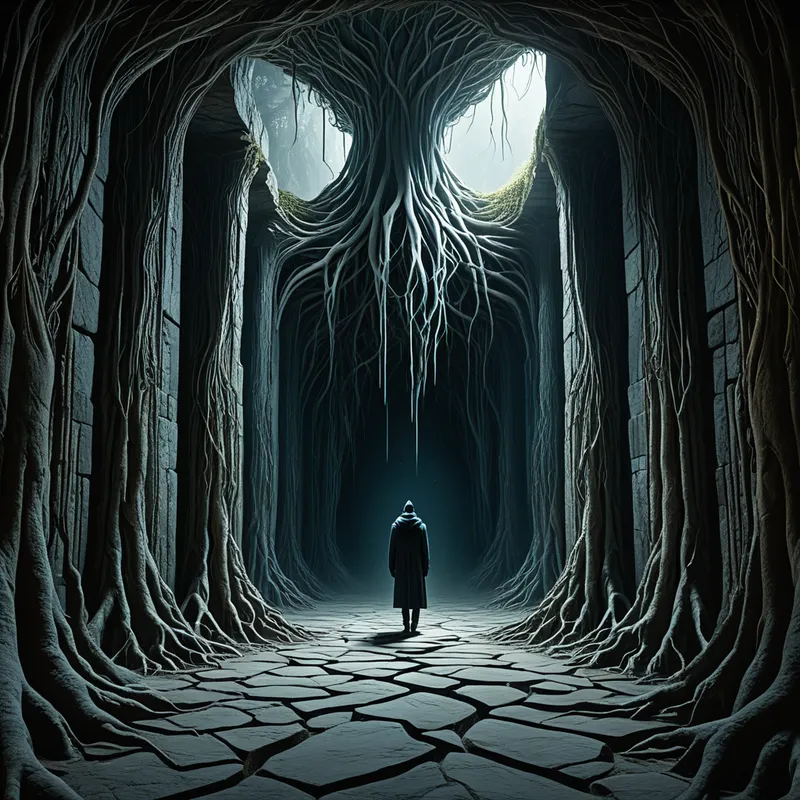
This was the mouth of the tunnel. With a final surrender of knightly pride, he entered the belly of the world. The passage was not hewn by man; it was a vein of the earth, cramped and twisting. Roots brushed his face like skeletal fingers. The only light was a faint, phosphorescent glow from strange lichen, illuminating carvings not made by chisel, but by time and water—faces in the stone that wept, hands that reached. He heard echoes not of his own steps, but of distant lamentations, the drip of water like a slow heartbeat, and his own fears given voice in the dark.
He did not fight specters; he endured the specter of his own solitude. He confronted not a dragon, but the crushing weight of the earth above him, the terror of being buried alive in his own quest. Time dissolved. He was crawling not through rock, but through the accumulated strata of his own failures and unasked questions. Just as the silence threatened to become his only companion, he saw a pinprick of light—not sunlight, but a soft, silver, liquid radiance. He followed it, the tunnel widening, until he emerged not into a courtyard, but directly into the silent, vast hall of Carbonek itself.
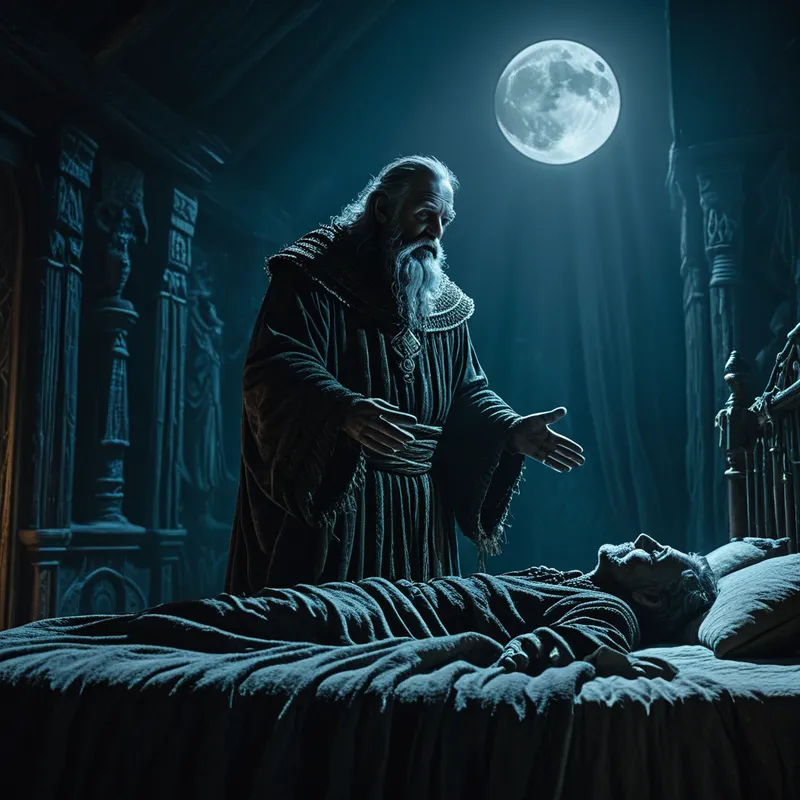
There, upon a bed of sorrow, lay the Fisher King, his wound still open, the air around him thick with a sacred stagnation. And there, in a recess, glowed the Grail, veiled in its own unbearable light. The knight had arrived not as a conqueror, but as a witness who had passed through the underworld of the self. His journey through the secret tunnel was the question the castle required. And in that moment of awestruck arrival, the ancient ritual of healing could, at last, begin.
Cultural Origins & Context
The motif of the secret tunnel to Carbonek is a late and deeply psychological strand within the vast tapestry of Arthurian romance, primarily found in the intricate, symbol-laden works of the Post-Vulgate Cycle and Le Morte d'Arthur. Unlike the more chivalric and action-oriented Grail quests, this path speaks to a different audience and serves a different function.
These stories were refined in the courts of the high and late Middle Ages, a time of increasing introspection, mystical Christianity, and a growing fascination with interiority. The tunnel narrative was not a tale for the tournament field but for the quiet chamber. It was likely told by scribes and poets who were themselves influenced by monastic traditions of contemplative descent—the via negativa—where God is approached not through assertion but through emptying and unknowing. Its societal function was subtle: it validated the experience of failure, of the dark night of the soul, and proposed that the most sacred destination might be reached not by strength of arms, but by a courageous vulnerability, by consenting to be led by one's own profound disorientation.
Symbolic Architecture
The tunnel is the central, overwhelming symbol. It is not a shortcut; it is the long way round, through the center of the self.
The hero does not climb the mountain to meet the god; he descends through the mountain's roots to find the god that has always been waiting within the foundation of the world.
Carbonek Castle itself symbolizes the Self, the psychic center of wholeness that is perpetually wounded (the Fisher King's ailment) and perpetually healing (the Grail's presence). It is inaccessible to the conscious ego (the knight as Lancelot or Gawain) in its usual state of ambition. The castle only becomes reachable when the ego surrenders its direction and enters the shadow realm—the tunnel.
The tunnel is the embodied journey through the personal and collective unconscious. Its claustrophobic darkness, the eerie sounds, and the suggestive rock formations are the contents of the psyche made sensory: repressed memories, ancestral fears, and the raw, unformed material of being. The knight's persistence is not active battling, but passive endurance, a form of psychological digestion. He must metabolize the darkness to earn the light.

The Dreamer's Resonance
When this myth stirs in the modern dreamer, it often manifests as dreams of exploration in confined, subterranean spaces: discovering hidden basements, crawling through air ducts, navigating endless, dark corridors, or finding secret rooms in one's own house. The somatic experience is key—a feeling of constriction, of being buried, coupled with a compulsive curiosity or a desperate need to find an exit.
Psychologically, this signals a critical phase of shadow-work. The dreamer is being compelled by the psyche to venture into ignored or denied aspects of themselves. The "Carbonek" at the end of the tunnel is the promise of integration—a core truth, a forgotten talent, a buried trauma that needs acknowledgment to release its frozen energy (the wounded Fisher King). The anxiety in the dream is the ego's resistance to this necessary descent. To dream of emerging into a calm, sacred space after such a journey indicates the psyche is successfully navigating a profound inner restructuring, moving from a state of fragmentation (the Wasteland) toward potential wholeness.
Alchemical Translation
The alchemical process mirrored here is nigredo—the blackening, the descent into the prima materia, the chaotic first matter. The knight's shiny, conscious identity (his armor) is rendered useless and tarnished in the dark tunnel. He is reduced to his essence, a crawling, seeking creature. This is the necessary dissolution of the old, outworn persona.
The Grail cannot be taken; it can only be received by one who has become empty enough to contain it.
The journey through the tunnel is the mortificatio, a symbolic death of the ego's ambitions. The emergence into Carbonek is the beginning of albedo, the whitening, where the purified spirit beholds the conjoined opposites: the wound and the healing vessel, the lance and the grail, death and life in eternal relation. For the modern individual, this myth models the path of individuation. It teaches that our deepest healing and purpose (our personal Carbonek) are not achieved by adding more achievements to our conscious resume, but by a willing, terrifying subtraction. We must enter the secret tunnel of our own avoided pain, our shame, our loneliness, and traverse it not as a heroic conqueror, but as a humble, faithful witness. Only by integrating this shadowy material can the inner Fisher King—the ruler of our psychic realm who has been wounded by life—begin to heal, allowing the waters of life and creativity to flow once more into our personal wasteland.
Associated Symbols
Explore related symbols from the CaleaDream lexicon: