
Bear Spirit Myth Meaning & Symbolism
A myth of descent into the earth's womb for sacred medicine, teaching the power of solitude, healing, and the fierce courage of introspection.
The Tale of Bear Spirit
Listen. In the time before memory, when the world was still singing its first songs, there was a people who walked lightly upon the earth. They knew the language of the rivers and the secrets whispered by the wind through the pines. Yet, a great silence had fallen upon them. A sickness of the spirit, a weariness that no herb could cure, had settled in their bones. Their laughter was thin, and their dreams were empty.
In this time of quiet despair, a young woman named Kaya walked apart from the village. Her heart was a heavy stone. She followed the fading trail of the autumn elk, her steps leading her high into the sacred mountains, into the realm of stone and ancient silence. The air grew cold, and the world narrowed to the sound of her own breath and the crunch of frost underfoot.
It was then she saw them: immense tracks pressed deep into the soft earth by the stream. They were the tracks of Mato, the Bear. Her people spoke of Bear with a hushed reverence. He was the keeper of the deep earth, the one who slept in the womb of the world and knew the roots of all things. A compulsion, older than fear, took hold of her. She did not follow the tracks; she was drawn by them, as a leaf is drawn by a current.
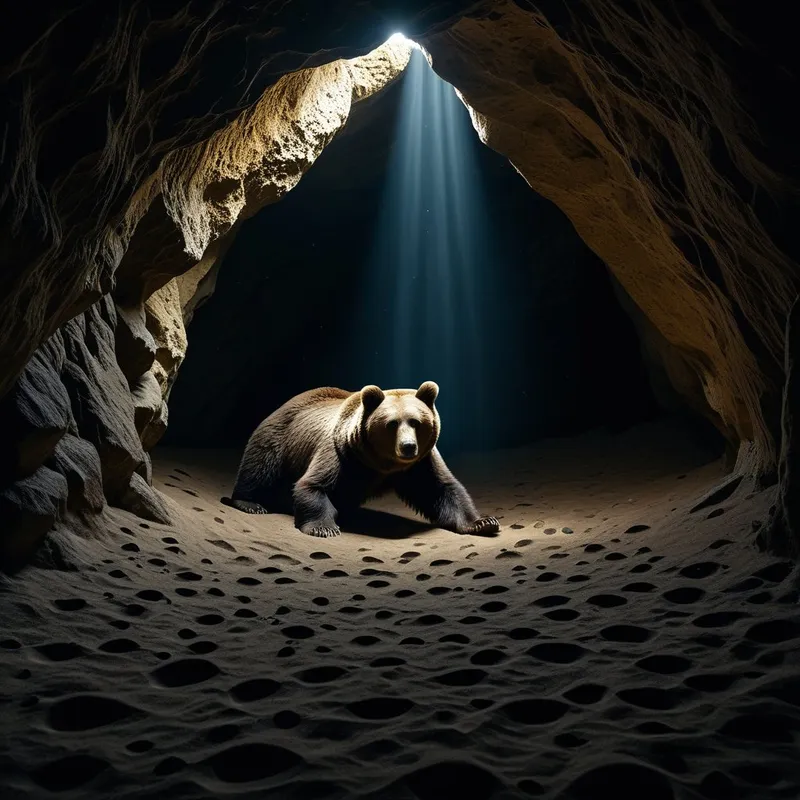
The trail led not across the mountain, but into it. Before her yawned the dark mouth of a cave, exhaling an air rich with loam and mystery. The bear tracks vanished into that darkness. Her human mind trembled, but her spirit-foot stepped forward. She entered the earth.
Inside, the world was inverted. The silence was not empty, but full—a pressing, listening silence. She crawled for what felt like days, guided only by a faint, musky scent and a deepening sense of being known. Finally, the passage opened into a vast cavern. In the center, on a bed of dried fern and sage, lay the Great Bear. He was not merely an animal; he was a presence that filled the space, his fur silvered in the faint phosphorescence of glowing moss. His eyes, when they opened, held the patient darkness of the soil itself.
He did not speak in words. He showed her. He showed her the slow, patient turning of the seasons within his own body. He showed her how to find the hidden medicine roots that coiled in the dark. He taught her the song of her own breath, how to draw strength from solitude, and how to listen to the deep pulse of life beneath fear. In that underworld lodge, she died as the weary girl and was remade. She learned the art of going inside.
When the world above turned again toward spring, Bear led her back to the cave’s mouth. As she emerged, blinking in the sun, she found she was not alone. The people, led by her absence, had come seeking. They saw her not as the one who left, but as one who had returned from a place they had forgotten. From her hands, which now knew the shape of roots in the dark, she offered the healing herbs. From her spirit, which had known the profound peace of the bear’s den, she offered a new kind of courage—the courage to turn inward.
Cultural Origins & Context
The figure of Mato Wakan is not a single, monolithic myth from a singular "Native American" culture, but a powerful, recurring pattern woven through the spiritual traditions of numerous Indigenous nations across North America—from the Lakota and Cheyenne of the Plains to the Algonquian peoples of the forests and the tribes of the Pacific Northwest. This is not a story owned by one tribe, but a truth recognized by many who live in relationship with the bear.
The myth was traditionally transmitted orally, often by elders or medicine people during specific times—perhaps in the deep winter, when Bear himself was asleep, or in ceremonies preparing individuals for vision quests or healing rites. Its function was multifaceted: it was a teaching story about respecting the power and wisdom of the natural world, a procedural myth for those called to be healers, and a cosmological map of the journey into the self. It served to validate the necessity of solitude and introspection in a communal society, framing it not as abandonment, but as a sacred service to the whole. The one who goes into the cave, like Bear, returns with medicine for the people.
Symbolic Architecture
At its core, the Bear Spirit myth is a profound allegory for the descent into the unconscious—the fertile, dark, and instinctual ground of being. Bear is the archetypal guide to this realm.
- The Cave as the Womb of the Psyche: The cave is not a place of terror, but of gestation. It represents the shadow and the collective unconscious—the dark, rich soil from which consciousness springs. To enter it is to willingly engage with what we have repressed or forgotten.
- Bear as the Instinctual Sage: Bear is the embodied union of immense physical power and deep, passive wisdom. He is the instinct that knows when to act with ferocity and when to retreat into hibernation. He symbolizes the healing power of cyclical withdrawal, a necessary death for rebirth.
- The Medicine Roots: These are the hidden connections, the psychic mycelium that links our superficial ailments to their roots in the unconscious. Healing is not a surface application, but a retrieval from the depths.
The true medicine is not the herb, but the knowledge of where it grows—in the dark, silent places we have been taught to fear.
The myth presents a complete alchemical cycle: the nigredo (descent into darkness/despair), the albedo (purification and learning in the cave), and the rubedo (return with the "red" medicine, the transformed life-blood for the community).
The Dreamer's Resonance
When the pattern of the Bear Spirit emerges in modern dreams, it often signals a profound somatic and psychological imperative: the need for a time of introverted hibernation. The dreamer may be on the brink of burnout, dealing with illness, or feeling a deep, inarticulate longing for meaning.
Dreams of following a bear, finding a bear cave, or being in a dark, earthy place can feel unsettling yet magnetically compelling. Somatically, this can correlate with feelings of heaviness, fatigue, or a desire to literally "curl up." Psychologically, it is the Self (the total, integrated psyche) insisting on a period of non-productive incubation. The ego is being called to stop its outward striving and to "go inside." This is not depression in the pathological sense, but what psychologist James Hillman might call a "necessary descent," a soulful regression required for the next stage of growth. Resistance to this call can manifest as anxiety, insomnia, or a sense of hollow agitation.
Alchemical Translation
For the modern individual navigating a world of constant external stimulation and productivity, the Bear Spirit myth models the radical, counter-cultural act of psychic transmutation: the turning of leaden exhaustion into golden wisdom.
The process begins with the Call of the Emptiness—the "sickness" that no external remedy can cure. This is the invitation. The Descent is the conscious, courageous decision to withdraw: to turn off the noise, cancel non-essential engagements, and enter a self-created "cave" of solitude. This is the mortificatio, the ego's death to its social persona.
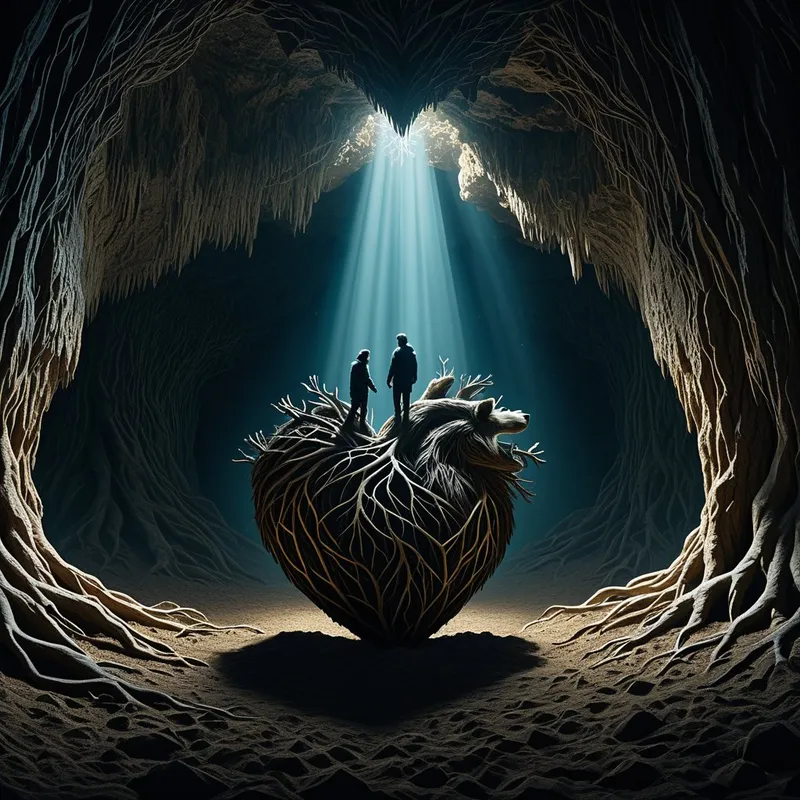
In the cave—the space of meditation, journaling, therapy, or simple, unadorned being—one encounters the Instinctual Guide. This is the deep, somatic intelligence of the body (the bear's physicality) coupled with a patient, non-linear knowing (the bear's wisdom). Here, one learns the "medicine roots": the hidden connections between childhood wounds and adult patterns, between repressed anger and physical pain, between lost dreams and current despair.
Individuation is not about becoming perfect, but about becoming whole. It requires retrieving the parts of ourselves we left behind in the dark.
The final, crucial stage is the Return. This is where the alchemy is sealed. The transformed individual does not stay in the cave. Like the mythic heroine, they bring back the "medicine"—not as a grandiose proclamation, but as a grounded, embodied offering. This might be a new boundary held with gentle firmness (bear's power), a creative insight born of silence (bear's dream-knowledge), or simply a presence that is more integrated and calm (bear's groundedness). The cycle of descent and return becomes an inner compass, a way to navigate life’s winters without fear, knowing that the cave of the self holds not a monster, but a sage.
Associated Symbols
Explore related symbols from the CaleaDream lexicon: