
Artemisia Myth Meaning & Symbolism
A sacred plant of Artemis, embodying the goddess's wild, healing, and fiercely protective nature, bridging the mortal and divine realms.
The Tale of Artemisia
Listen, and let the scent of mountain thyme and cold stone carry you. The tale is not of a hero, but of a whisper—a green breath in the shadow of the divine. It begins not with a birth, but with a presence: Artemis, she who runs with the hounds, whose arrows fly truer than fate. Where her bare feet touch the earth, the ground does not yield; it awakens.
In the high places, where the air is thin and the stars feel close enough to pluck, she walked. The mortal world below was a tapestry of fever and pain, of women crying out in the dark hours of birth, of wounds festering under a jealous sun. Artemis heard them. Her heart, often pictured as cold as the moon, was not indifferent. It was precise. It was a heart that knew the exact moment to release the arrow, the precise point where life could be taken or spared. This precision turned to compassion, a fierce, unsentimental love for the creatures in her domain.
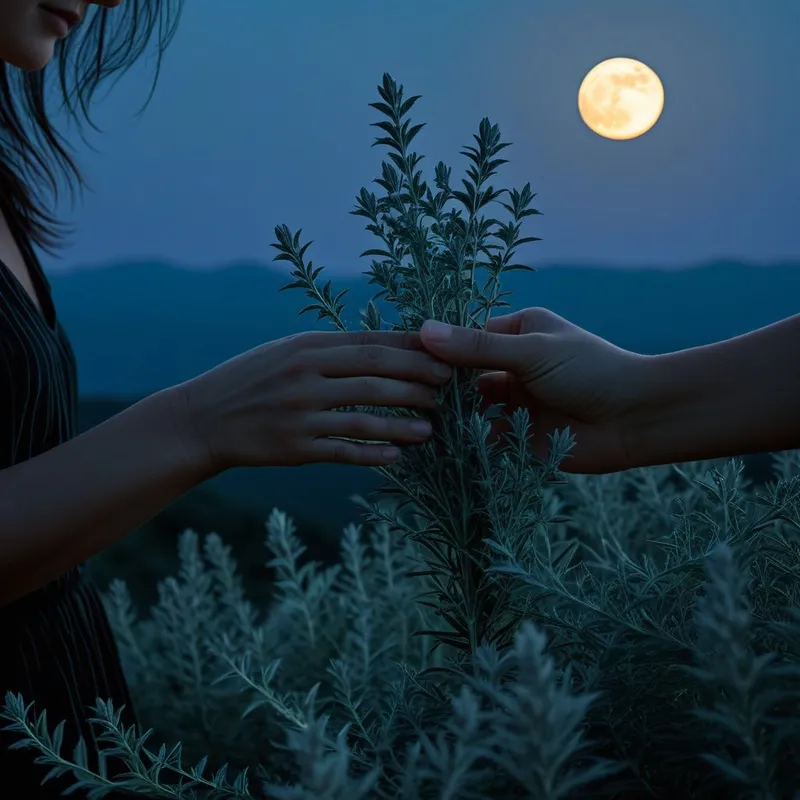
One evening, as the sun bled into the sea and her silver chariot began its ascent, she paused by a rocky outcrop. There, growing stubbornly from a crack in the stone, was a plant. It was not showy. Its leaves were a dusty, silvery green, as if touched by moonlight even at noon. She knelt—a rare gesture for the ever-erect goddess—and crushed a leaf between her fingers. A pungent, clean, bitter fragrance erupted, cutting through the mountain air like a clarion call. It smelled of clarity. It smelled of boundaries. It smelled of healing so potent it bordered on a threat.
She breathed it in. And in that breath, she bestowed a portion of her own essence. “You,” she whispered to the plant, her voice the sound of wind through reeds, “will be my hand where I cannot touch. Your bitterness will drive out the heat of fever. Your scent will clear the clouded mind. For the women who call upon me in their terror and their power, you will ease the passage, guarding the threshold between worlds. You will be their protector, as I am yours.”
From that moment, the plant—Artemisia—was no longer just a weed of the high hills. It was a covenant. Mortals learned to seek its silvery clusters. Midwives bound it into birthing beds. Healers brewed it into teas to break the hold of malaria, that burning ague they called the “bad air.” Travelers tucked sprigs into their sandals, believing its fierce aroma would ward off fatigue and evil spirits on the long road. It became a tangible thread connecting the wild, untamed power of the goddess to the vulnerable, aching needs of the human body and spirit. The myth is not an epic of conflict, but a silent infusion—the story of how a goddess planted a piece of her own sacred autonomy in the earth, for anyone brave enough to taste its bitter medicine.
Cultural Origins & Context
The story of Artemisia is a myth of function, woven into the daily fabric of ancient Greek life rather than the grand cycles of epic poetry. It falls into the realm of aition, an origin tale that explains the properties and sacred status of a natural object. This myth was likely passed down not by bards in royal halls, but by women—mothers, healers, and priestesses—in the intimate spaces of the home, the herb garden, and the sanctuary.
Its societal function was profoundly practical and spiritual. In a world without modern medicine, the line between pharmacy and temple was thin. Plants like Artemisia (encompassing species we call mugwort, wormwood, and southernwood) were verified allies against very real threats: childbirth mortality, parasitic infections, and malarial fevers. By attributing its power to Artemis, the culture did two things. First, it sanctified empirical knowledge, elevating the healer’s craft to a divine art. Second, it placed this healing power firmly under the domain of a fiercely independent goddess, reinforcing the idea that the processes of women’s bodies (menstruation, childbirth) and the health of the community were under the protection of a potent, untamable feminine force. The myth served as both a practical guide and a theological framework, ensuring the plant’s use was respected and its harvesting perhaps accompanied by prayers or rites to the goddess who gifted it.
Symbolic Architecture
Artemisia is not a gentle symbol. It is an emblem of sacred, defensive power. Its symbolism is triune, mirroring the goddess herself.
First, it symbolizes Wild Autonomy. The plant thrives in marginal, rocky, “unproductive” places. It is not cultivated in orderly rows but foraged at the edges. This represents the part of the psyche—and particularly the feminine psyche—that refuses domestication, that belongs to itself alone. It is the untamed intuition, the fierce “no” that protects integrity.
Second, it embodies Threshold Medicine. Its primary mythical uses are for childbirth (a literal passage between worlds) and for breaking fevers (a transition from sickness to health). Artemisia governs liminal states.
The most potent medicine grows at the border, where one state dies and another is born. Its bitterness is the taste of the transition itself.
Third, it represents Clarity and Purification. Its sharp, penetrating aroma mythically wards off confused spirits and psychic malaise. Psychologically, this symbolizes the ability to cut through illusion, emotional fog, and parasitic influences. It is the mental clarity that establishes boundaries, distinguishing self from other, health from sickness, truth from deception.

The Dreamer's Resonance
When Artemisia emerges in the modern dreamscape, it rarely appears as a simple plant. It may manifest as a silvery light protecting the perimeter of a dream house, a bitter taste that suddenly clears a fog of confusion, or a recurring motif of gathering wild herbs at dusk. Such dreams often surface during life passages: on the eve of a major decision that requires personal integrity, during recovery from illness or emotional manipulation, or when one is preparing to “give birth” to a new project or identity.
Somatically, the dreamer may be processing a need to establish healthier boundaries or to reconnect with an instinctual, self-sufficient part of their nature that has been neglected. The appearance of Artemisia in a dream can signal that the psyche is actively engaging in a cleansing operation—attempting to “break the fever” of a toxic situation, thought pattern, or relationship. It is the unconscious offering the bitter but necessary medicine of self-reclamation, urging the dreamer to seek out their own “high places” of inner clarity and to protect the vulnerable, nascent aspects of their being with fierce determination.

Alchemical Translation
The alchemical process mirrored in the Artemisia myth is that of Separatio and Sanctificatio—separation and sanctification. The core psychic transmutation is not about becoming something new, but about isolating, purifying, and empowering what is already authentically there, yet clouded.
The first stage is Withdrawal to the Margins (the rocky outcrop). For the modern individual, this is the conscious move away from the over-cultivated fields of collective expectation and persona. It is seeking the “bitter” truth of one’s own nature, however unconventional or difficult it may be. This is an act of fierce self-honesty.
The second stage is Infusion with Purpose (Artemis bestowing her essence). This is the moment of recognizing that one’s unique, perhaps “wild” traits are not flaws, but sacred attributes. The bitterness of past suffering or the sharp edges of one’s personality are re-framed as medicinal, protective, and imbued with a higher function. The individual learns to see their own autonomy as a gift to be offered, a healing presence.
Individuation is not merely self-discovery; it is the solemn appointment of the self as the guardian of its own sacred precincts.
The final stage is Application of the Medicine. This is the lived result: the establishment of clear boundaries (the warding off of “evil spirits”), the healing of old psychic wounds (the breaking of fevers), and the courageous midwifery of one’s own new potentials into the world. The individual becomes both the Artemis and the Artemisia—both the source of divine, protective authority and the tangible, earthly medium through which that healing, clarifying power operates in the world. The myth teaches that true wholeness comes not from smoothing out our bitter edges, but from understanding them as the very instruments of our sovereignty and our service.
Associated Symbols
Explore related symbols from the CaleaDream lexicon: