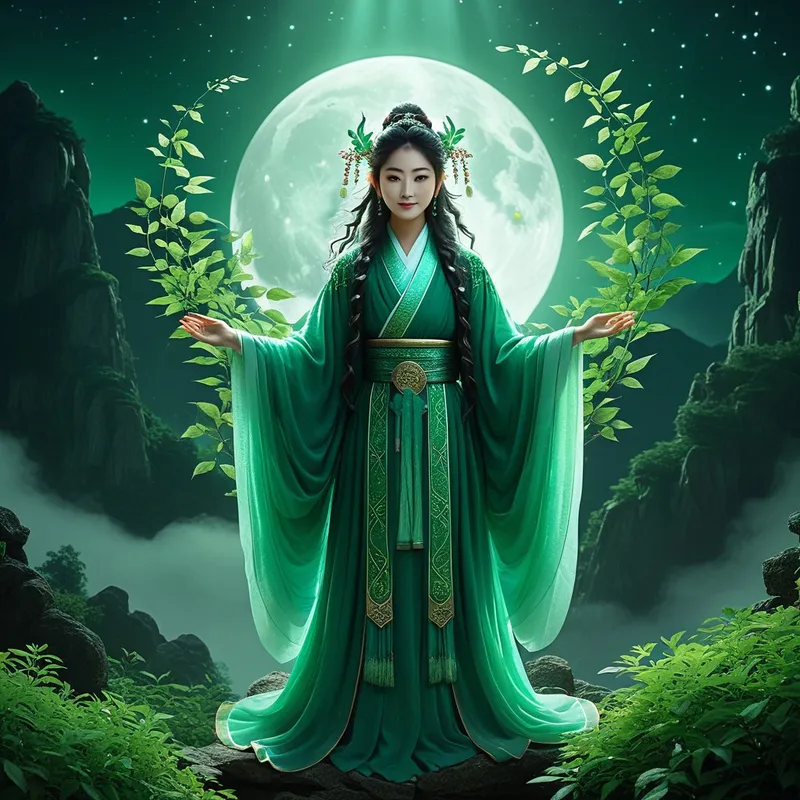
Bo He Myth Meaning & Symbolism
The myth of Bo He, a deity born from tragedy, who transforms into the healing herb mint, embodying the soul's resilience and the alchemy of suffering.
The Tale of Bo He
Listen, and let the mists of time part. In an age when the mountains were the vertebrae of the earth and rivers were its lifeblood, there lived a family on the slopes of a great, cloud-wreathed peak. A father, a mother, and their beloved daughter, whose laughter was like the chime of jade in a clear stream. They called her He, for her gentle spirit.
One summer, a plague of heat and pestilence descended upon the land. It was a sickness that dried the throat, scorched the mind, and stole the breath from the chest. The father, a man of humble means but boundless love, watched helplessly as his wife was taken by the fever. His heart, once a warm hearth, became a cold stone in his breast. Only his duty to his daughter, He, kept him from lying down beside his beloved.
Driven by a desperate hope, the father climbed the treacherous paths of the great mountain, seeking a legendary spring whose waters were said to hold the moon’s coolness and could cure any fever. For days he climbed, his sandals tearing, his hands bleeding on the sharp rock. He found the spring, a silver disc of water nestled in stone, and filled his gourd with trembling hands.
The descent was a race against the setting sun and the sickness he knew was claiming his daughter. In his haste, a loose stone betrayed him. He stumbled, and the precious gourd flew from his grasp, shattering on the rocks below, the moon-cooled water vanishing into the thirsty earth. A cry tore from his soul—a sound of such profound despair that the very wind stilled to hear it. He crawled to the spot, gathering the shards, and there, his tears fell upon the damp earth where the healing water had been lost.
He did not return home. His spirit, weighed down by the double loss of his wife and now his failed mission, could not bear to see his daughter succumb. He remained on the mountainside, a figure of pure grief, weeping until he had no more tears, praying until he had no more words.
And where his tears—the physical manifestation of his love, his failure, and his sacrifice—mingled with the last vestiges of the lost healing spring, something miraculous occurred. From the barren rock, tender green shoots pushed forth. They grew with astonishing speed, unfurling into leaves of a vibrant green, releasing into the air a scent that was sharp, clean, and profoundly cooling. It was a scent that cut through the miasma of fever, that cleared the clouded mind and soothed the burning throat.
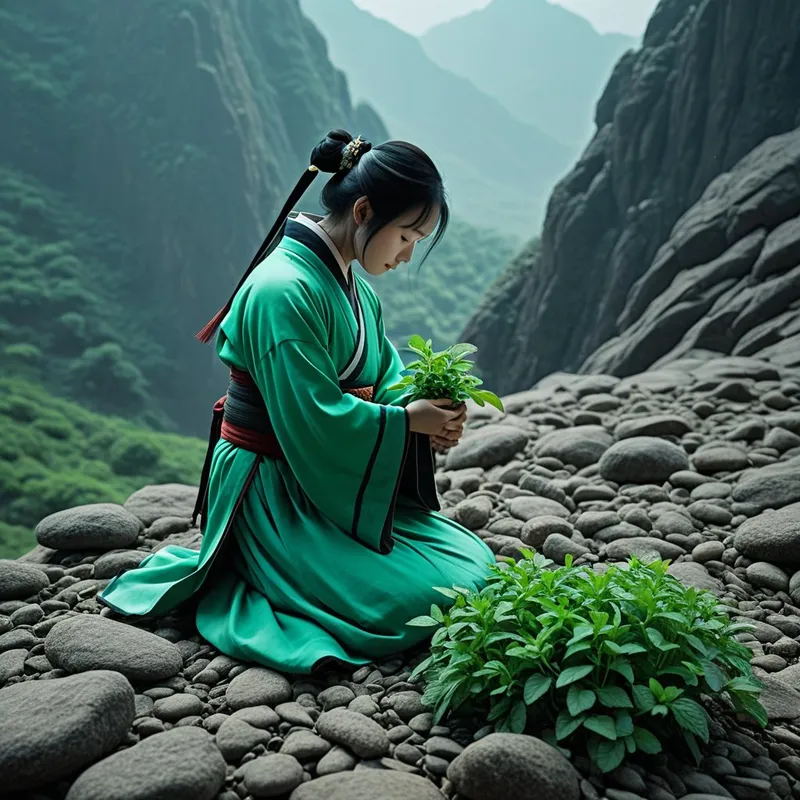
The daughter, He, searching for her father, found not his body, but this thriving patch of fragrant greenery. Guided by an instinct deeper than knowledge, she gathered the leaves, brewed them, and drank. The cooling essence flowed through her, breaking the fever’s hold. She brought the leaves to her village, and the plague was halted. The people, in their gratitude, named the plant Bo He, honoring the father (Bo) and the daughter (He) whose story was now woven into its very essence.
Cultural Origins & Context
The myth of Bo He is a folk narrative deeply rooted in the practical and spiritual world of traditional Chinese medicine (TCM). Unlike the grand state myths of emperors and cosmic deities, this is a story of the earth, of the folk, and of the intimate relationship between human suffering and the natural world’s response. It was not preserved in imperial courts but was passed down through generations of herbalists, healers, and village elders—often told while preparing remedies, imparting not just the properties of the herb, but its shen or spirit.
Its societal function was multifaceted. Primarily, it was a mnemonic device, encoding the herb’s key medicinal property—its cooling, febrifugal nature—within an emotionally resonant story. To remember the tale was to remember the herb’s use. Secondly, it served an ethical and pedagogical purpose, embedding values of parental sacrifice, filial piety, and the belief that profound good can emerge from profound despair. It framed the healer’s vocation as a sacred trust, born from a lineage of loss and redemption. The myth personifies the herb, transforming Bo He from a simple plant into a compassionate deity, a Cao Shen, making the act of healing a communion with a conscious, benevolent force.
Symbolic Architecture
At its core, the myth of Bo He is an alchemical parable of transmutation. The raw materials are unbearable emotional states: grief, guilt, and perceived failure. The catalyst is the act of heartfelt sacrifice, and the resulting product is a healing agency for the world.
The most potent medicine does not grow in fertile soil, but is distilled in the barren places of the heart, where tears water the stone of failure.
The father represents the archetypal Caregiver whose love is so absolute it transcends his own physical form. His "failure" to deliver the spring water is not an end, but a necessary dissolution. His ego, his identity as a successful protector, must be shattered (like the gourd) for a new, more universal form of care to emerge. He does not simply find a plant; he becomes the plant through the alchemy of his sorrow. The mint is his love, his intention to heal, made physically manifest and liberated from the limitations of his single human body.
The daughter, He, symbolizes the receptive consciousness necessary to complete the cycle. She is the one who recognizes, gathers, and applies the transformed essence. She represents the next generation, the community that inherits the gifts born from ancestral struggles. Together, father and daughter embody a complete psychic circuit: the unconscious, sacrificial transformation (father) and the conscious, life-affirming application (daughter).
The Dreamer's Resonance
When this myth stirs in the modern unconscious, it often surfaces in dreams of potent, overlooked greenery growing in unlikely places: mint sprouting through cracks in urban concrete, a forgotten houseplant thriving explosively in an abandoned room, or a cool, green light emanating from a personal wound.
Such dreams signal a profound somatic and psychological process: the body-mind’s innate intelligence working to transmute a core experience of failure, grief, or caregiving burnout into a personal resource. The dreamer may be in a state of emotional exhaustion, feeling they have "spilled" their vital energy in a futile endeavor. The appearance of the mint—especially if it is discovered, touched, or its scent is vividly recalled—is the psyche’s announcement that the process of alchemy is already underway. The "tears" have been shed; the dissolution has occurred. Now, the latent, healing essence is taking form. The dream is an invitation to recognize this nascent growth within oneself, to "gather" this new-found resilience and clarity, and to apply its cooling, anti-inflammatory properties to the inflamed areas of one’s life.

Alchemical Translation
For the individual on the path of individuation, the myth of Bo He models the stage where one must confront the Shadow of the Caregiver. This is the shadow of martyrdom, of failed responsibility, and of love that feels it has been poured out onto barren ground. The conscious ego often clings to the identity of the effective healer, protector, or provider. The alchemical journey demands the shattering of this specific vessel.
The gourd must break. The conscious plan must fail, so that the soul’s deeper, more elemental remedy can be born from the marriage of intention and humbling circumstance.
The "mountain climb" is the dedicated, often arduous, effort of the conscious personality. The "spilled water" is the inevitable encounter with limitation, fate, and personal fallibility. The key is not to retreat from the site of this failure, but to fully inhabit the grief and despair there. This is the nigredo, the blackening, the necessary dissolution. The tears are the aqua permanens, the universal solvent of genuine feeling that makes transmutation possible.
The new identity that forms—the Bo He consciousness—is no longer the ego-centric "I who heals," but a transpersonal vehicle for healing itself. One becomes a conduit for a quality—clarity, refreshment, resilience—that exists beyond one’s personal story. The gift is no longer dependent on one’s constant, straining effort, but becomes a natural emanation of one’s transformed being. You are not carrying the healing water; you have become the spring from which it flows. In this, the myth guides us from the agony of personal failure to the grace of becoming an agent of the universal, healing principle, rooted in our own broken but fertile ground.
Associated Symbols
Explore related symbols from the CaleaDream lexicon: