
Asclepius Myth Meaning & Symbolism
A mortal healer, gifted by Apollo and Chiron, who dared to resurrect the dead, challenging the cosmic order and becoming a symbol of medicine's power and peril.
The Tale of Asclepius
Listen, and hear the tale of the one who walked the razor’s edge between life and death, who held the breath of mortals in his hands.
The story begins not with his birth, but with a cry of pain and a flash of divine fire. His mother, the mortal Coronis, lay dying, betrayed by her own heart and struck down by the silver arrows of Artemis. But from her funeral pyre, Apollo, her divine lover, snatched the unborn child from her womb. Thus, Asclepius entered the world, born from death, already marked by the twin forces of creation and destruction.
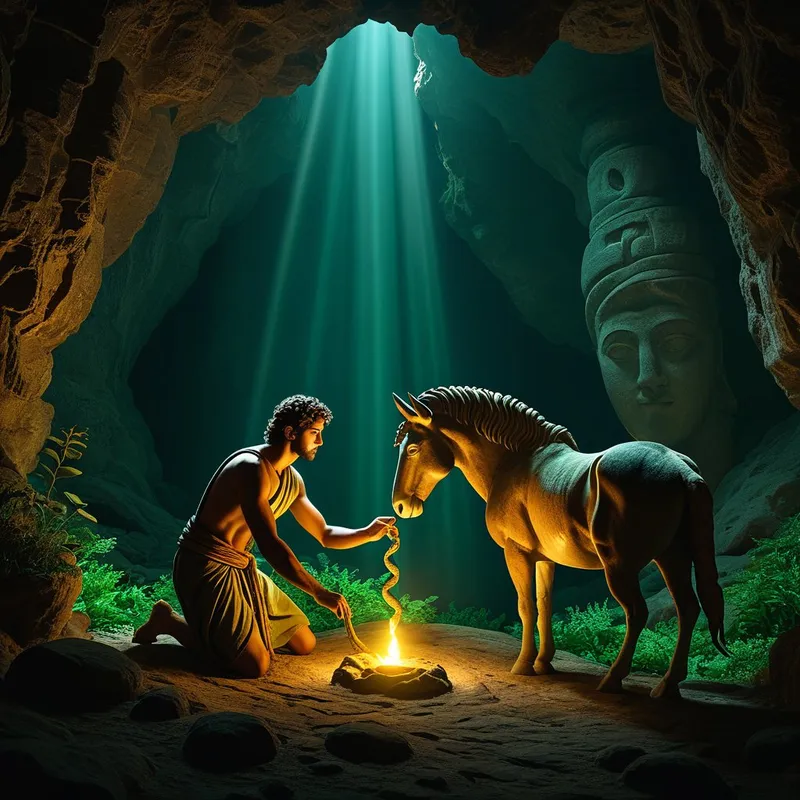
Apollo, seeing the spark of potential, entrusted the infant not to the halls of Olympus, but to the wild, wise solitude of the mountains. He gave him to Chiron, the gentle centaur whose cave was a library of earth’s secrets. Here, among drying herbs and the bones of ancient creatures, Asclepius learned. He learned the language of roots that soothe fever, the song of leaves that knit bone, and the secret names of veins that carry life’s dark wine. Chiron taught him the surgeon’s steady hand and the diagnostician’s piercing eye. But the greatest teacher came in silence, in the form of a serpent.
One day, as Asclepius pondered a mortal wound, a serpent—a creature of the deep earth, symbol of regeneration for its shedding skin—slithered into the cave. It carried in its mouth a herb unknown to him. He watched as another serpent, which he thought dead, found the same herb and was restored to vibrant life. In that moment, the secret was revealed: the earth itself held the cures, and the serpent was its priest.
His fame spread like a healing balm across the land. At his sanctuary in Epidaurus, the sick and the desperate came. They would sleep in the abaton, and in their dreams, the god would appear—sometimes as a man, sometimes as a serpent—to touch their wounds or whisper a cure. He healed with potions, with surgery, with incantations. But his power grew, fed by compassion and a daring that began to brush against the immutable laws of Moira.
The turning point came with Hippolytus, a youth torn apart by his own horses, a victim of divine vengeance. Moved by profound pity, Asclepius did the unthinkable. Using the arts learned from Chiron and the serpent, he called the scattered life-force back into the broken body. He resurrected the dead. The news was a tremor in the cosmos. In Hades, the shades grew restless; the rivers of the underworld ran shallow. The balance was broken.
Zeus, guardian of the world’s order, felt the foundation shake. The act was not one of malice, but of supreme overreach—a mortal hand rearranging the threads of the Fates. With a thunderbolt forged in necessity, not wrath, Zeus struck. Asclepius fell, his mortal form consumed by celestial fire. Yet, in the echoing silence that followed, even Olympus felt the loss. The healer’s spark was too vital to extinguish. From the ashes of transgression, Zeus lifted Asclepius and placed him among the stars, his essence transformed into the constellation Ophiuchus. The healer was gone, but the principle of healing was eternalized, a light in the night sky and a staff in the hand of every physician who dares to follow.
Cultural Origins & Context
The myth of Asclepius is rooted in the rich soil of ancient Greek religion and society, flourishing from at least the 6th century BCE onward. Unlike the distant, capricious Olympians, the cult of Asclepius addressed a fundamental, universal human need: the desperate desire for relief from suffering. His worship was not centered on grand temples for state ceremony, but on Asclepieia, the world’s first holistic medical centers.
These sanctuaries, most famously at Epidaurus, Cos, and Pergamon, functioned as places of pilgrimage, hospital, and spa. The practice of enkoimesis was central. Patients underwent purification rituals, made offerings, and then slept in the sacred dormitory. Their dreams were not mere fantasy; they were considered direct communications from the god, interpreted by his priest-physicians. Cures were recorded on stone stelae, a testament to the god’s power. This tradition positioned Asclepius as an accessible, compassionate figure—a divine doctor whose myth provided a narrative framework for the terrifying, mysterious process of illness and recovery. The myth was passed down through hymns, local cult practices, and later, the writings of poets like Pindar and the tragedians, solidifying his role as the archetypal healer whose story explained both the miraculous potential and the sacred limits of the medical art.
Symbolic Architecture
At its core, the myth of Asclepius is a profound meditation on the nature of healing as a sacred, transgressive, and ultimately transformative act.
True healing is an act of rebellion against entropy, a conscious realignment of a system towards wholeness, and thus always touches the domain of the gods.
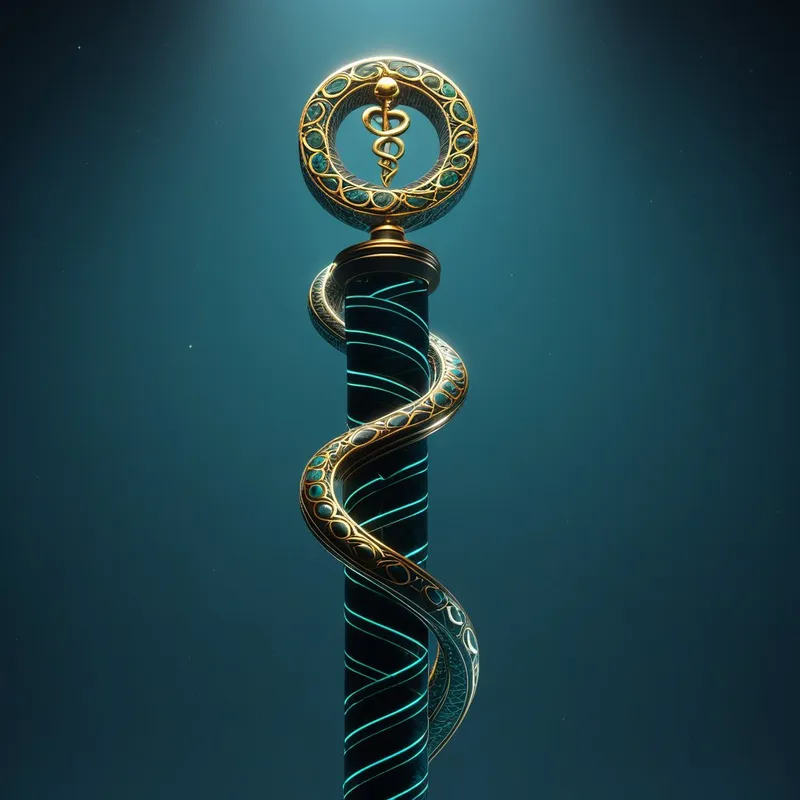
Asclepius himself symbolizes the wounded healer. Born from the death of his mother, his very origin is trauma. This grants him the empathy and the drive to confront suffering, not as an abstract Olympian, but as one who has intimately known loss. His education under Chiron represents the synthesis of instinctual, earthy wisdom (the centaur) with disciplined, intellectual knowledge (the arts taught by Apollo). The serpent, his constant companion, is the myth’s master symbol. It represents poison and cure, death and rebirth (through shedding), and the chthonic, unconscious knowledge that must be integrated for true healing to occur. The Rod of Asclepius is this integration made manifest: the structured, upright consciousness (the rod) entwined with the regenerative, instinctual life-force (the serpent).
His fatal act of resurrecting Hippolytus is the myth’s crucial tension. It represents the healer’s hubris, yes, but more deeply, it illustrates that healing, when taken to its absolute limit, becomes a challenge to the natural order of life, death, and fate. He does not fail as a healer; he succeeds too well, confronting the ultimate boundary. His apotheosis into Ophiuchus signifies that the essence of healing is not destroyed but sublimated. The personal healer dies, but the archetype of healing is immortalized, becoming a guiding principle.
The Dreamer's Resonance
When the pattern of Asclepius stirs in the modern dreamer’s psyche, it signals a profound process of psychic mending. This is not about a common cold, but a deep, soul-level illness—a depression, a creative block, a trauma, or a crisis of meaning.
Dreams may feature: a wise, non-threatening animal (often a snake or dog) leading the dreamer to a hidden place or object; encounters with a calm, authoritative doctor or guide figure in an unusual setting; vivid, somatic experiences of wounds being cleaned, bones being set, or toxins being drawn out; or surreal versions of hospitals or clinics that feel simultaneously sterile and sacred. The dreamer might experience the "incubation" itself—a feeling of being put into a restorative sleep or a healing trance within the dream.
Psychologically, this marks the activation of the inner healer archetype. The conscious ego has likely been overwhelmed by a "disease" it cannot cure with logic or willpower. The Asclepian dream is the psyche’s announcement that the deeper, symbolic healing process has begun in the unconscious. It is a somatic signal that the body-mind is attempting to regenerate, to shed an old skin of identity or pain, and to call upon inner resources (the Chironian wisdom, the serpentine instinct) that the waking self has forgotten or ignored.

Alchemical Translation
The myth of Asclepius provides a stark map for the alchemical process of individuation, where the goal is not physical perfection, but psychic wholeness.
The individuation journey is the ultimate healing, requiring us to resurrect parts of ourselves we believed were forever dead, and to accept the lightning-strike of transformation that such an act invites.
The first stage (nigredo) is the wound: the death of Coronis, our own personal trauma, illness, or brokenness from which our healing consciousness is painfully born. We are, like Asclepius, children of a catastrophe.
The education under Chiron represents the albedo, the whitening. This is the hard, careful work of therapy, introspection, and study—gathering the "herbs" of insight, learning the maps of our own psyche, and developing the discipline to tend our wounds. It is a withdrawal from the world into the "cave" of self-work.
The encounter with the serpent is the pivotal moment of coniunctio, the sacred marriage. This is when intellectual understanding marries deep, often frightening, unconscious instinct. It is the dream that shocks us into clarity, the sudden bodily intuition, the acceptance of a shadow aspect (the "poison") as the very source of the cure. We integrate our own serpentine wisdom.
The resurrection of Hippolytus is the dangerous, glorious peak of the rubedo, the reddening. This is the attempt to fully reclaim a lost, vital part of the Self—a murdered passion, a banished creativity, a frozen emotion. It is the healer in us daring to say, "This shall not remain dead." It is an essential, hubristic, and necessary step.
The thunderbolt of Zeus is the final, terrifying transmutation. The ego’s project of being the perfect, all-powerful healer of itself is shattered. This is not a failure, but a sublime death. The personal identification with the healing power is destroyed so that the healing principle itself can be elevated. The outcome is apotheosis: we are no longer merely a person trying to fix a problem. We become a vessel for the archetype. The healed wound becomes a source of wisdom for others; the personal struggle transforms into a universal understanding. We become Ophiuchus, the serpent-bearer, forever holding the tension between the earthly wound and the celestial order, a fixed point of meaning in the dark sky of the soul.
Associated Symbols
Explore related symbols from the CaleaDream lexicon:
- Hospital
- Doctor
- Dentist
- Ambulance
- Health
- Massage
- Medicine
- Vet
- Operation
- Medical
- Spa
- Treatment
- Clinic
- Condition
- Grandson
- Snake Slither
- Salad Bowl
- Serpentine Bangle
- Serpentine Wand
- Rhodonite Key
- Serpentine Stone
- Serpentine Twist
- Lithium Leaf
- Iodine Mist
- Colloidal Silver
- Joyful Foxglove
- Bee Balm
- Scent of Eucalyptus
- Eucalyptus Leaf
- Rattlesnake
- Snake Slithering
- Serpent's Fang
- Healer's Ring
- Pharmacist's Prescription Pad
- Surgeon's Scalpel
- Doctor's Stethoscope
- Veterinarian's Toolkit
- Pediatrician's Toys
- Hippocratic Oath
- Secret Stethoscope
- Digital Thermometer
- Heart Rate Monitor
- Luxurious Spa Room
- Votive Offering
- Serpent Statue
- Secluded Herbal Garden
- Herbal Remedy
- Water Cress
- Thyme Sprigs
- Dried Herb Bundle
- Pine Resin
- Serpent Wisdom
- Biofeedback
- Healing
- Defibrillator
- Surgery
- Prescription
- Antidote
- Placebo
- Healer
- Medicinal
- Licorice
- Iodine
- Antiseptic
- Snake