The Spirit Journey Myth Meaning & Symbolism
A shaman's perilous journey to the spirit world to retrieve a lost soul, facing cosmic guardians and inner shadows to restore balance.
The Tale of The Spirit Journey
Listen. The fire is low, and the world outside the birch-bark tent is a tapestry of stars and whispering pines. The air is thick with the scent of damp earth and smoldering juniper. This is not a story for the daylight mind. It is a map for the soul in darkness.
In a time when the world was younger and the veil between the realms was thin as a spider’s silk, there lived a people whose hearts beat in rhythm with the forest, the tundra, and the storm. Among them was one who heard the songs the wind carried from the other side—the shaman. But a shadow fell upon the people. A great sickness, not of the body alone, but of the spirit, stole the light from a child’s eyes. The child lay still, a hollow vessel; their soul had wandered and become lost.
The shaman knew the law of the worlds. A soul cannot be called back from a distance. It must be found, and brought home. So began the Spirit Journey.
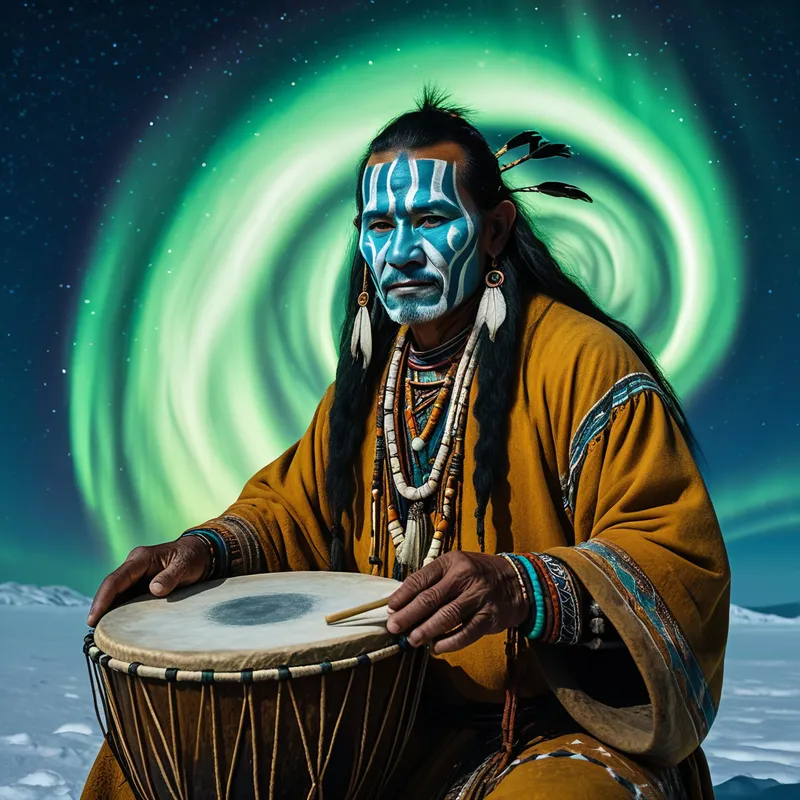
Clad in a cloak of hides and feathers, the shaman sat in the flickering gloom. The steady, heartbeat thrum of the drum began, a pulse that was also a summons. The shaman’s consciousness began to unravel from its earthly anchor. With a cry that was part song, part animal groan, the spirit leaped free. The tent pole became the World Tree, its roots plunging into blackness, its branches scraping the star-road.
Down the roots the shaman traveled, into the Underworld. It was a land of inverted forests, rivers that flowed with memory, and a sky of perpetual twilight. Here, the shaman was not a leader, but a supplicant. The first guardian was a great Power Animal, a bear of starlight and granite. It tested the shaman’s intent with a roar that shook the very fabric of dream. The shaman showed no fear, offering a song of respect. The bear snorted, and became a guide.
Deeper they went. The landscape shifted to reflect the inner turmoil of the lost soul—a maze of thorns, a lake of frozen tears. They faced trickster spirits, mirrors of doubt and distraction. Finally, in a cavern lit by glowing fungi, they found the soul-fragment of the child, shivering and small, trapped by a web of its own sorrow and fear.
This was the most delicate task. No force could be used. The shaman sat, and began to sing the child’s own song back to it—the song of its name, its first laugh, its mother’s touch. Slowly, the fragment recognized itself. The shaman, with infinite care, gathered the light into a pouch woven from breath and intention.
But the return was never guaranteed. The upward climb was a fight against gravity of the spirit. The world above pulled, but the underworld clung. The drumbeat from the distant tent was the lifeline, the umbilical cord back to the living. With the bear-guide clearing the path, the shaman surged upward, through the roots, through the soil, and with a gasping, physical shock, slammed back into the aching body before the fire.
The journey was written on the shaman’s face—exhaustion etched deep, but eyes blazing with a otherworldly light. Moving to the child, the shaman breathed the recovered soul back into its home. A shudder, a faint sigh, and the child’s eyes fluttered open, seeing the world anew. Balance was restored. The journey was complete.

Cultural Origins & Context
The Spirit Journey is not a single, codified myth from one text, but a living, breathing narrative pattern at the heart of shamanic traditions across Siberia, Central Asia, the Americas, and beyond. It is less a story told for entertainment and more a technical manual, a cosmological blueprint passed down through direct initiation and ecstatic experience. The primary teller is the shaman themselves, and the "performance" is the ritual enactment. The story is embedded in the chants, the drum rhythms, the costume, and the post-journey recounting.
Its societal function was paramount. It was a drama of crisis and resolution that modeled the community’s relationship with the unseen forces governing health, fortune, and the natural world. It explained misfortune (soul loss) and provided the procedure for its cure (the journey). It affirmed the shaman’s role as the community’s psychopomp—its guide to the territories of death and madness—and reinforced a cosmology where everything, even illness, had a spiritual location and could be engaged with, negotiated with, and transformed.
Symbolic Architecture
At its core, the Spirit Journey is a profound map of the psyche’s structure and its healing process. The ordinary world represents the conscious ego. The sickness and the lost soul symbolize a state of psychic fragmentation—a trauma, a deep depression, a loss of vital energy that the conscious mind cannot repair.
The descent is never a fall into damnation, but a deliberate dive into the soul’s own forgotten archives.
The World Tree or tent pole is the axis of the Self, the central channel connecting all levels of consciousness. The Underworld is not hell, but the unconscious—the realm of repressed memories, instinctual forces (the Power Animal), complexes, and the primal source of life and creativity. The guardians and tricksters are personifications of the psyche’s own defenses and the seductive power of unresolved complexes. The successful retrieval symbolizes the integration of a lost or disowned part of the personality back into the whole Self.
The Dreamer's Resonance
When this mythic pattern stirs in the modern dreamer, it signals a profound somatic and psychological process: a call for soul retrieval. Dreams of being lost in caverns, endless forests, or subterranean tunnels; of searching for a precious, fragile object or a lost child; of encountering powerful, numinous animals—all echo the Spirit Journey.
The somatic experience is often one of gravitational pull—a feeling of being drawn down or inward, accompanied by anxiety but also a strange necessity. Psychologically, the dreamer is in a state where conscious problem-solving has failed. The psyche is initiating its own healing ritual, orchestrating a descent into the underworld of the body and the unconscious to locate the energy, the memory, or the capacity that has been sealed away by pain or neglect. It is the unconscious itself acting as the shaman for the beleaguered ego.

Alchemical Translation
For the modern individual pursuing individuation—the conscious realization and integration of the Self—the Spirit Journey is the ultimate model of psychic alchemy. The "sickness" is the felt sense of incompleteness, the neurosis, the repeating pattern. The shaman’s role is taken up by the individual’s own observing consciousness, what Jung called the transcendent function.
The ritual drumbeat is replaced by the disciplined practices of active imagination, deep introspection, or therapy—the rhythmic, focused attention that allows the ego to loosen its grip and listen to the unconscious. The descent is the courageous confrontation with the shadow, the anima/animus, and the archetypal images welling up from within.
The retrieved soul-fragment is the gold of the alchemists: a previously unconscious content transformed into a conscious, vitalizing part of the personality.
The negotiation with inner guardians (fear, rage, grief) and the following of animal guides (instinct, intuition) are the core of the work. The final, critical phase is not just the discovery, but the return and integration. The recovered insight or energy must be breathed back into daily life, changing one’s behavior, relationships, and worldview. The journey’s end is not a return to the old normal, but the establishment of a new, more capacious wholeness, where the once-lost voice of the soul now speaks within the chorus of the Self.
Associated Symbols
Explore related symbols from the CaleaDream lexicon: