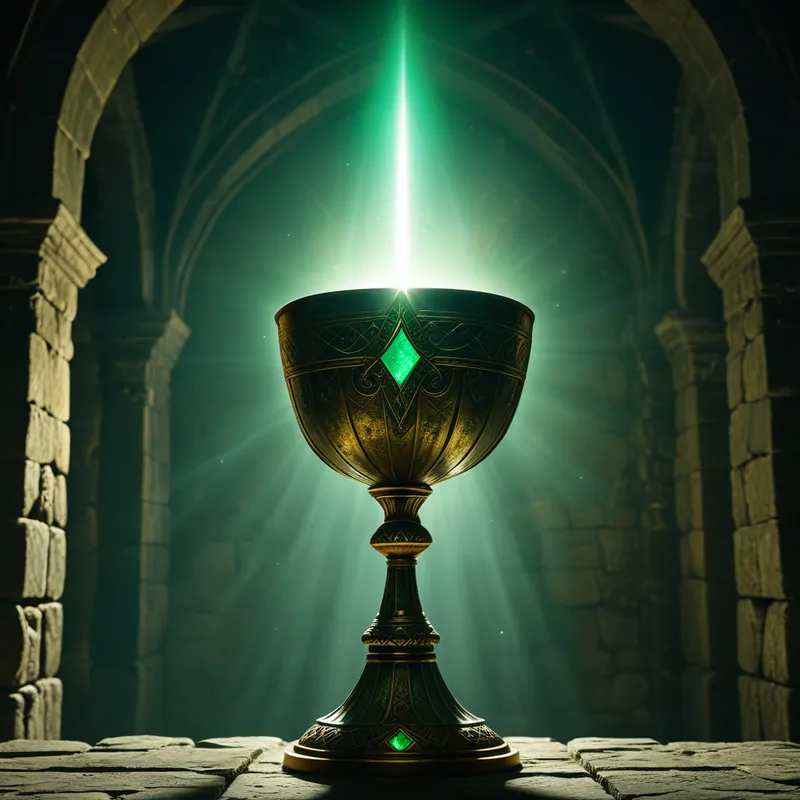
The Holy Grail in Arthurian le Myth Meaning & Symbolism
A wounded king, a wasteland, and a sacred vessel. The quest for the Grail is a journey into the self to heal a profound spiritual rupture.
The Tale of The Holy Grail in Arthurian le
Listen, and hear a tale not of a land, but of a wound. In the time of King Arthur, a shadow fell across the realm of Logres. It was not the shadow of an army, but of a sickness. The rivers ran thin and bitter, the fields refused their grain, and a chill silence lay upon the hearts of men. This was the Wasteland.
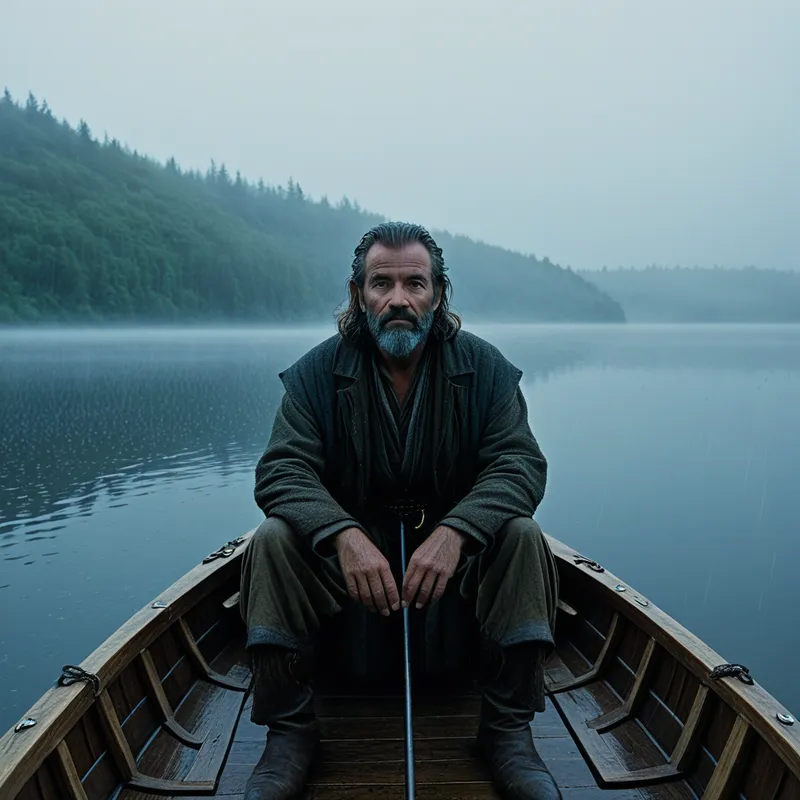
And at its heart, in a castle that seemed woven from sorrow and mist, sat the Fisher King. A lance, perpetually dripping a single bead of crimson blood, stood beside his throne. His wound, a grievous blow to the thigh, would not close. It festered, a mirror of the blight upon his kingdom. He could do nothing but fish in the waters near his castle, a king reduced to a solitary, aching vigil.
Into this pall of stillness rode the knights of the Round Table. At Pentecost, a vision struck them: the Holy Grail, veiled in samite, floated through the hall of Camelot, filling the air with the scent of spices and a light that had no source. In that moment, every knight swore a sacred oath: to seek the Grail, to behold it unveiled, and to bring its healing back to the world.
Thus began the great scattering. Knights rode into the deep, whispering forests, each following a path that seemed chosen not by map, but by the secret disposition of his own soul. Many were led astray by pride, by old vendettas, or by the sheer, bewildering strangeness of the Questing Grounds—a landscape where reality itself bent to test the spirit.
The greatest of them, the purest in heart but not without fault, was Sir Galahad. With him rode the noble Sir Percival and the holy man Sir Bors. Their journey was a gauntlet of symbols. They crossed the Bridge of the Sword. They resisted the temptations of a magnificent, empty castle. They came at last to the Castle of Corbenic.
There, in a chamber that was both chapel and throne room, they witnessed the Grail Procession. A maiden bore the bleeding lance. Another carried a silver platter. Then came the Grail itself, now uncovered, a simple vessel of gold that radiated a bliss so profound it was a kind of quiet agony. From it, a feast manifested, food and drink of such savor it nourished the soul directly.
But the test was not in seeing. It was in asking. Percival, on an earlier visit, had failed. He saw the suffering king and the wondrous procession but, bound by a false courtesy, remained silent. The question—"Whom does the Grail serve?"—died on his lips, and the castle vanished, leaving him in a barren field, the chance lost.
Now, with Galahad present, the question was asked. And in the asking, the wound of the Fisher King was known, acknowledged. The lance was taken, and with a touch, the king's flesh was made whole. The sigh that left his lips was the wind returning to the Wasteland. Outside, the sound of water returned to the rivers, and the scent of turned earth rose from the fields. The land and its king were one, and both were healed.
Galahad’s destiny was to go further. He was taken to the holy city of Sarras, where he looked into the very heart of the Grail. What he saw, no chronicle can tell, for it was a mystery beyond words. Having seen it, his soul was released from its earthly coil, and the Grail itself ascended to heaven, leaving the world to remember the quest, but never again to possess the vessel.
Cultural Origins & Context
The Grail myth is a profound fusion, a cultural alchemy that occurred in the fertile ground of 12th and 13th century Europe. Its earliest literary forms, by poets like Chrétien de Troyes and Wolfram von Eschenbach, wove together threads from pre-Christian Celtic cauldrons of plenty, ancient Middle Eastern mystery cults, and the central symbols of Christian liturgy. It was not a church doctrine, but a romance—a secular, yet deeply spiritual, narrative passed down in the courts by troubadours and scribes.
Its societal function was multifaceted. For the knightly class, it provided a new, interiorized chivalric ideal: the quest was no longer just for territorial glory, but for spiritual virtue. For a society navigating the tensions between earthly power and heavenly grace, it presented a tangible, yet elusive, symbol of divine immanence. The Grail was a story for a culture in transition, offering a map for an inner journey at a time when the outer world was being meticulously charted.
Symbolic Architecture
At its core, the Grail is not an object to be owned, but a state of being to be approached. It symbolizes the ultimate wholeness of the Self, the integrated psyche where divine and human, conscious and unconscious, are in harmonious relation.
The Wasteland is not a place, but a condition of the soul where life-giving symbols have dried up and meaning has retreated.
The Fisher King represents the wounded masculine principle—the ruling consciousness that is injured, often in its capacity for feeling and relatedness (the thigh wound). His immobility reflects a psychic stagnation. The knights are the various aspects of the ego setting out to engage the unconscious. Most fail because they project their own complexes onto the quest—seeking glory, vengeance, or personal validation. Galahad, often called the "perfect knight," represents the transcendent function, the aspect of consciousness capable of holding the tension of opposites long enough for a new, unifying symbol (the Grail vision) to emerge.
The critical question, "Whom does the Grail serve?" dismantles the ego's assumption of centrality. It reveals that the ultimate mystery serves itself, or the divine order; the seeker must align with it, not command it. Healing occurs not by seizing the symbol, but by asking the right question of the wound.

The Dreamer's Resonance
When this mythic pattern stirs in modern dreams, it signals a profound call from the Self. Dreaming of a desolate, empty landscape (the Wasteland) often coincides with depression, burnout, or a deep sense of meaninglessness. The dreamer may encounter a neglected, wounded, or regal figure in a place of decay—a symbol of their own injured inner authority or neglected creative life force.
The somatic experience is one of aching longing coupled with paralysis. There is a sense that something vital is missing, but the path to it is obscure. Dreaming of a radiant but elusive cup or light speaks to the nascent emergence of a healing symbol, but one the conscious ego cannot yet grasp. These dreams invite a shift from doing to asking, from striving to receptivity. They ask the dreamer: What in your life is wounded and causing a inner wasteland? What question are you afraid to ask?

Alchemical Translation
The Grail quest is the archetypal blueprint for individuation. It models the process of psychic transmutation for the modern individual with startling clarity.
The first stage is the Call: the vision at Camelot. This is the moment of painful awareness that the comfortable, collective identity (the fellowship of the Round Table) is no longer sufficient. The soul demands a unique, solitary journey. The Descent into the Perilous Forest is the engagement with the personal unconscious—facing one's shadows, complexes, and forgotten traumas. Many "knights" (ego-identifications) are lost here, seduced by power fantasies or old wounds.
The achievement of the Grail is not an acquisition, but a transformation of perception. One does not find the Grail; one becomes a vessel through which its meaning can flow.
The arrival at Corbenic and the witnessing of the Procession represents the confrontation with the archetypal, collective unconscious—the raw, numinous symbols of the psyche. The failure to ask the question is the ego's refusal to fully engage the mystery, to remain a passive spectator to one's own depth. Success—asking "Whom does the Grail serve?"—is the ego's humble submission to the greater authority of the Self. The healing of the Fisher King is the integration of the wounded, instinctual side of the personality into the conscious realm. The restored Wasteland signifies the enlivening of one's entire being; creativity, emotion, and spirit begin to flow again in the personality.
Finally, the Grail's ascent to heaven signifies that the ultimate wholeness is never permanently possessed. It is a state of alignment that must be continually sought and honored. The modern quest is not for a physical cup, but for that which the cup contains: the living water of authentic meaning, the capacity to ask the healing question, and the courage to bear the responsibility of one's own wholeness, thereby healing the little piece of the world within one's reach.
Associated Symbols
Explore related symbols from the CaleaDream lexicon: