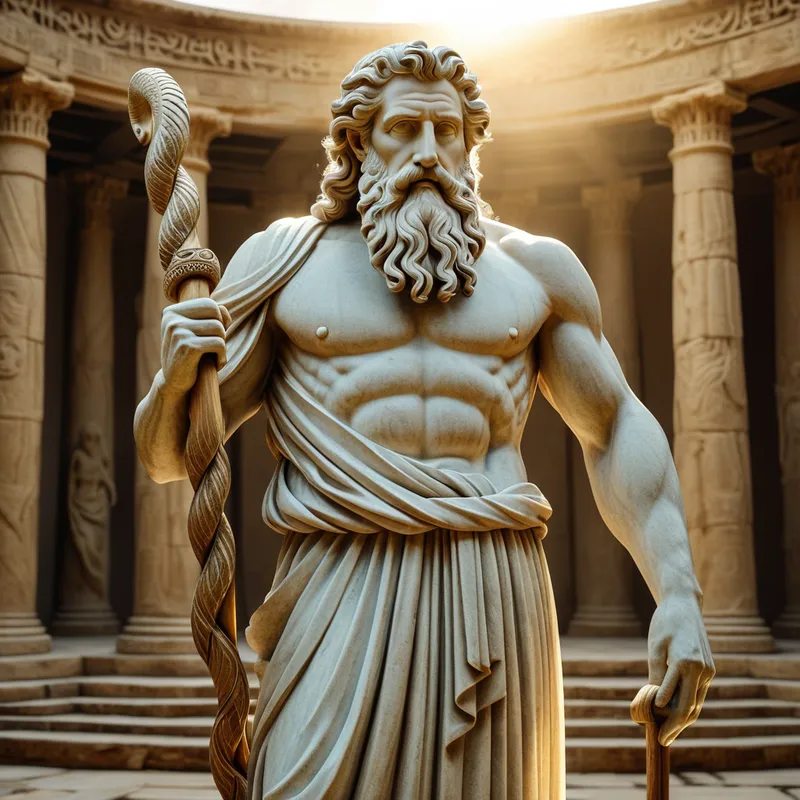
The Rod of Asclepius Myth Meaning & Symbolism
The myth of the healer Asclepius, his divine serpent-entwined rod, and the dangerous power of restoring life, challenging the finality of death.
The Tale of The Rod of Asclepius
Hear now the tale of the wound and the healer, of the breath that returns and the price it demands. It begins not with a man, but with a cry of pain. The princess Coronis, beloved of the silver-bowed Apollo, lay bleeding upon the earth, struck down by the god’s own wrath for a betrayal whispered by a jealous raven. As her life ebbed onto the soil, Apollo’s rage turned to ash, leaving only a hollow grief. He rushed to her side, but the Fates’ thread was nearly cut. From her cooling body, he performed a desperate surgery of the divine, drawing forth the unborn child within her womb—a son, alive and squalling amidst death.
This child was Asclepius. Given to the wise centaur Chiron to be raised, he did not learn the arts of war, but the deeper mysteries of the earth. Chiron taught him the language of roots and the song of herbs, the humors of the body and the whispers of the spirit. Asclepius’s hands were not for wielding swords, but for tracing the paths of pain beneath the skin. His genius grew like a mighty oak. He learned to mend shattered bone, to cool fevered brows, to draw poison from wounds. Yet, his greatest teacher came not from his tutor, but from a moment of stillness.
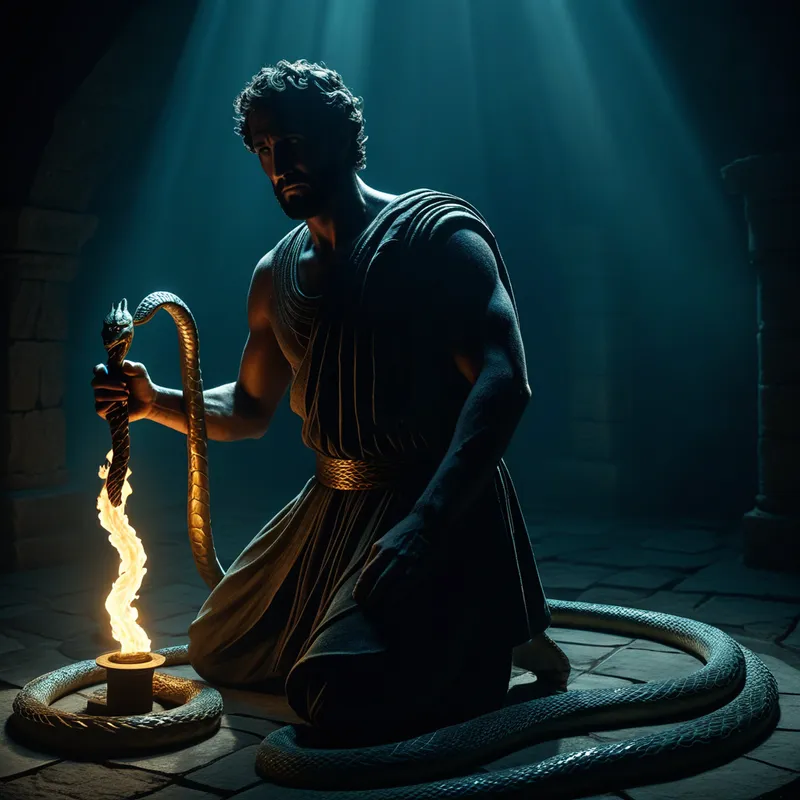
One day, as he pondered a dire illness, a serpent glided into his hut. In a flash of instinct, he raised his sturdy walking rod and struck, killing it. Then, a second serpent appeared, bearing in its mouth a herb, which it placed upon the head of its dead companion. To Asclepius’s awe, the first serpent stirred, shook off death, and slid away, whole. In that moment, the secret was revealed. The serpent, which sheds its skin to be reborn, knew the art of regeneration. From that day forth, a single, wise serpent coiled itself around Asclepius’s rod, and he understood the final, most sacred law of healing.
His fame spread across the world. The lame walked. The blind saw. The Asclepieia became islands of hope where the sick slept, awaiting a healing dream from the god himself. But Asclepius’s art pressed against the ultimate boundary. When the heroic Hippolytus was torn apart by his own horses, brought low by a curse, his broken body was carried to the healer. Gazing upon such unjust ruin, Asclepius’s compassion hardened into resolve. He entered the shadowed halls where the living dare not tread, and with the power vested in him and his serpent-coiled rod, he called the soul back. He restored breath to stilled lungs, light to vacant eyes. Hippolytus lived.
In the sunless depths of Hades, a chill silence fell. The boatman Charon found his waters still. The lord of the dead, Hades, looked upon his thinning realms and felt a theft more profound than any mortal crime. He ascended to the bright world of Zeus, his voice a rumble of tectonic grievance. “What order remains,” he asked, “if the final door swings both ways? What is death if it can be undone by a mortal’s craft?” Zeus, keeper of cosmic balance, listened. The act was too great. To return a soul from the underworld was to unravel the tapestry of fate itself. A flash of Olympian lightning, brighter than a thousand suns, descended. It found Asclepius in his sanctuary, and the healer who had conquered death was consumed by it. His rod clattered to the earth, the serpent upon it unharmed, a silent witness to the ultimate limit of mortal art.
Cultural Origins & Context
The myth of Asclepius is not merely a story, but the sacred narrative backbone of one of the most practical and revered institutions in the ancient Greek world: the healing sanctuary. The tales were told and retold in the Asclepieia, most famously at Epidaurus, Cos, and Pergamon. These were not hospitals in a purely clinical sense, but holistic centers of therapeia—service to the whole person. The myth provided divine sanction for the healer’s art and established a ritual framework for cure.
The story was passed down through the Homeric Hymn to Asclepius, the tragedies of Euripides (who references the resurrection of Hippolytus), and the extensive writings of later physicians like Galen, who saw themselves as sons of Asclepius. His cult was immensely popular because it addressed a universal, visceral human need, offering hope where secular means failed. The myth functioned societally to elevate medicine from a craft to a sacred calling, while simultaneously delineating its boundaries. It acknowledged the awesome, almost divine power of a true healer, while placing that power firmly under the ultimate authority of cosmic law (Dike) and the gods. The healer was a mediator between life and death, but not its master.
Symbolic Architecture
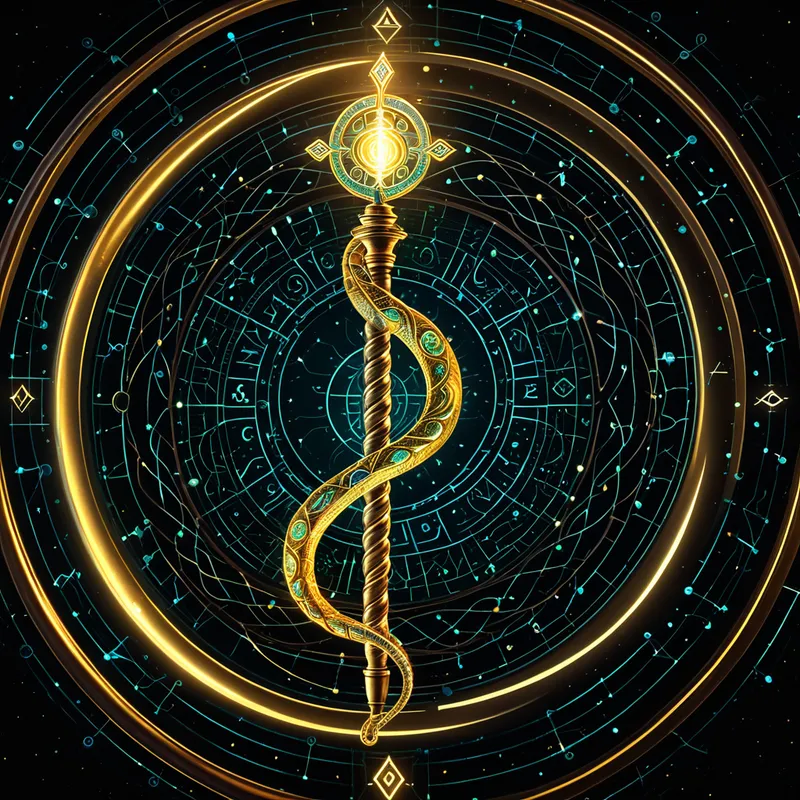
At its core, the Rod of Asclepius is a symbol of integration. The rod itself—straight, sturdy, of the earth—represents the spine, the structural support, the path of conscious discipline and knowledge. It is the principle of order, the logos of medicine.
The serpent is the wisdom of the body itself—instinctual, cyclical, deeply unconscious. It is the physis, the vital force that regenerates and heals.
The serpent entwining the rod symbolizes the necessary marriage of conscious knowledge and unconscious, instinctual wisdom. True healing cannot occur through intellect alone (the bare rod), nor through blind instinct alone (the serpent on the ground). It is the conscious channeling of the life force. The serpent, as a creature that sheds its skin, is a universal symbol of renewal, poison and cure, and the cyclical nature of life and death—the very processes the healer seeks to mediate.
Asclepius himself embodies the Caregiver archetype at its most potent and most perilous. His shadow is not malice, but hubris born of excessive compassion. His desire to heal is so absolute that it challenges the necessary rhythm of existence, the archetypal pattern of life-death-rebirth. His fate illustrates a profound psychological truth: the caregiver who cannot accept limits, who seeks to erase all suffering, is ultimately destroyed by the weight of that impossible responsibility. He is struck down not for healing, but for refusing to acknowledge death as a part of the whole.
The Dreamer's Resonance
When the Rod of Asclepius or its essence appears in a modern dream, it signals a profound process of psychic healing underway. This is not about a common cold, but a mending at the soul level.
To dream of finding or being given the rod suggests the dreamer is discovering or being called to their own innate healing capacities—perhaps to heal a fractured part of their own psyche (an inner child, a past trauma) or to take up a caregiving role in their outer life. The dream is an invitation to integrate knowledge (the rod) with deep, instinctual wisdom (the serpent).
To dream of the rod broken or the serpent dead often points to a crisis of the caregiver archetype: burnout, compassion fatigue, or the feeling that one’s efforts to heal or help are futile or have transgressed a boundary. It is a somatic signal from the unconscious to step back, to acknowledge limits, to practice self-care.
Dreaming of being Asclepius, performing a miraculous cure, can reflect a grandiosity in one’s healing ambitions—a belief that one can “fix” another person completely, which is a subtle form of psychological control. Conversely, dreaming of being struck by lightning after a healing act is a powerful metaphor for the shock of encountering an immovable limit, a necessary failure that, while painful, serves to re-establish proper boundaries of the self.

Alchemical Translation
The myth of Asclepius is a precise alchemical map for the process of psychic individuation, where the goal is not perfection, but wholeness—including the integration of one’s relationship with mortality and limit.
The first stage, nigredo, is the wound: the death of Coronis, the traumatic birth of Asclepius. This is the initial suffering, illness, or fragmentation that forces the healing journey upon us. We are cut from the womb of our old, perhaps naïve, state.
The albedo is the long apprenticeship with Chiron and the revelation of the serpent. This is the conscious work of therapy, introspection, and education—gathering the “herbs” of insight and discipline. It is also the crucial moment of receiving wisdom from the unconscious (the serpent), integrating instinct and symbol.
The rubedo, the reddening, is the pinnacle of the healer’s power and his fatal error. Psychologically, this is the point where the ego, having mastered significant inner healing, may inflate. It believes it can resurrect what must truly die—an outmoded identity, a toxic attachment, a childhood fantasy. This is the “Asclepian hubris” of the individuation process: the attempt to cure the soul by refusing to let any part of it die.
Zeus’s lightning is the necessary mortificatio, the humbling death of this inflated ego-position. It is a brutal but sacred intervention from the Self (the archetype of wholeness, symbolized by Zeus) to shatter the illusion of total control. The final stage is not Asclepius’s apotheosis as a conqueror of death, but his integration into the pantheon as a god who heals within the natural order. For the modern individual, the alchemical goal is not to become an omnipotent healer of one’s own psyche, but to achieve a state where healing wisdom is present, the serpent is coiled around the staff, and one carries the rod with the sober knowledge of its power and its ultimate limit. One becomes a vessel for healing, not its defiant source.
Associated Symbols
Explore related symbols from the CaleaDream lexicon: