Meridians Myth Meaning & Symbolism
The story of the celestial channels that map the living cosmos, connecting heaven, earth, and the human body in one flowing breath.
The Tale of Meridians
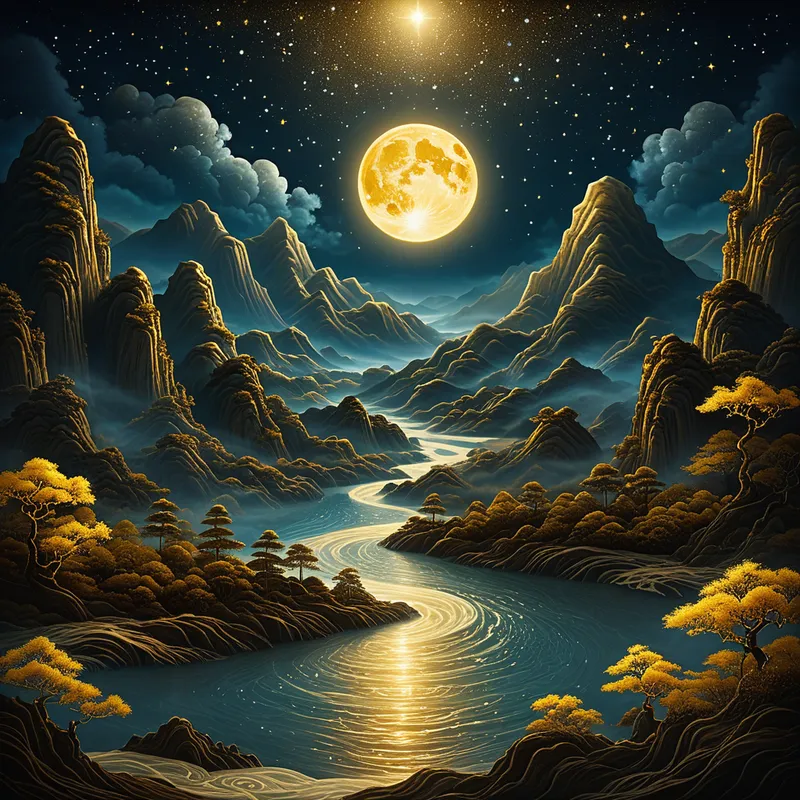
Before there were maps of nations, there were maps of the sky. Before there were roads of stone, there were rivers of light. In the time of the Yellow Emperor, the world was a body, and it breathed a single, vast breath. But this breath, this Qi, flowed wild and chaotic as an untamed stallion, bringing fevers to the land and tremors to the people.
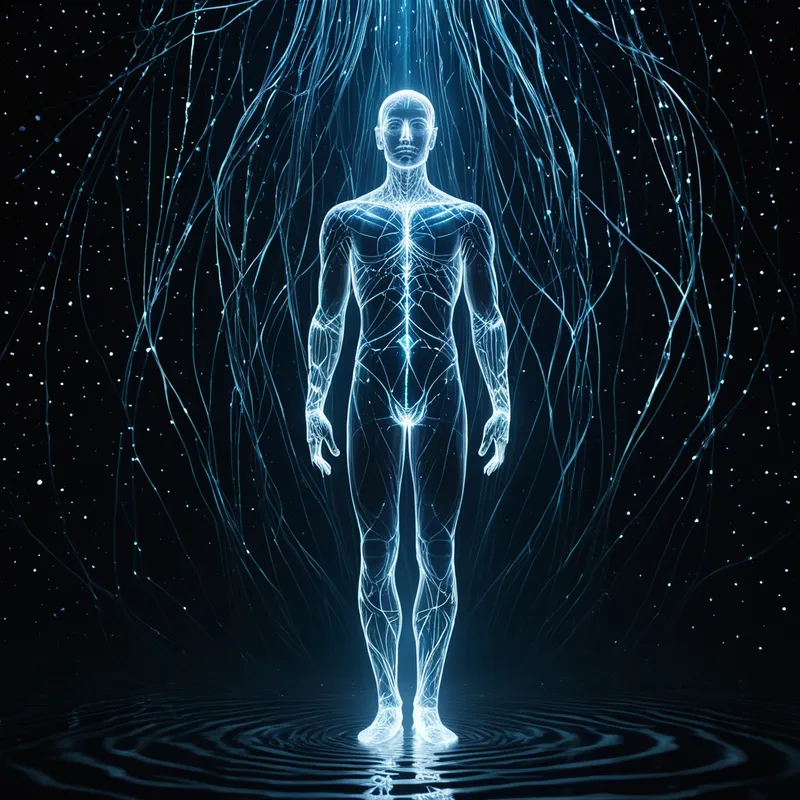
The Emperor, in his wisdom, looked not out to the horizons, but inward. He sat in stillness for nine times nine days, his awareness descending through the layers of his own flesh, past bone and sinew, into the luminous darkness within. There, he did not find silence. He found a symphony—a humming, vibrating network of currents, swift as mountain streams and deep as subterranean aquifers. He saw twelve great rivers of light, each with its own season, its own tide, its own song. He saw them branch into countless smaller channels, watering every corner of the corporeal earth.
But he also saw blockages. Where grief had settled, the flow thickened like cold honey. Where rage had flashed, the channels were scorched and brittle. Where fear pooled, the light grew dim and stagnant. The internal landscape mirrored the external one: drought here, flood there, and a pervasive disharmony.
Guided by the patterns of the heavens—the orderly march of the Twelve Earthly Branches—and the rhythms of the earth, the Emperor began to chart these inner waterways. With a mind as fine as a needle, he traced the path of the Taiyin channel, feeling its connection to the crisp autumn air and the weight of letting go. He followed the surging tide of the Jueyin, tied to the explosive growth of spring and the planning mind. He mapped them all, naming each for the vital organ where its deepest wellspring pooled.
This was no conquest, but a reconciliation. He did not command the rivers; he listened to them. By understanding their courses, he learned to remove the logjams of emotion and the silt of stagnation. As he restored the flow within himself, legend says, the heavens cleared and the earth grew fertile. The myth tells us he inscribed this living map not on parchment, but directly into the collective memory of the healing arts, a sacred geography written in light and breath, passed from master to disciple in the silent language of the pulse.
Cultural Origins & Context
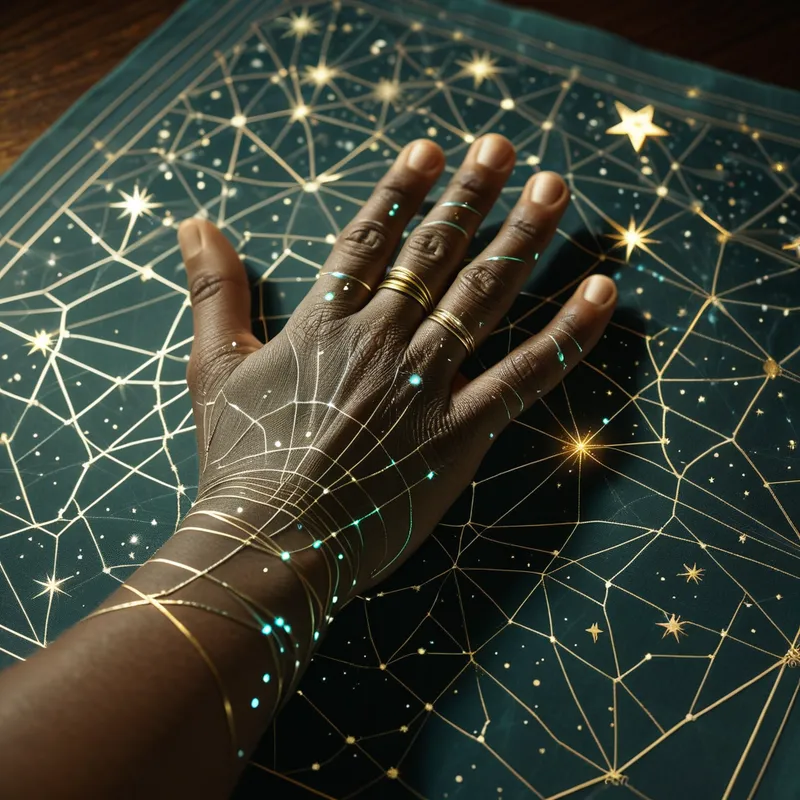
The concept of the Jingluo, or meridian system, is not the product of a single mythmaker but the crystallized insight of millennia of observation. Its origins are inseparable from the foundational Daoist worldview, which perceives no strict division between macrocosm and microcosm. The body is a xiaotiandi—a "small heaven and earth."
This knowledge was not primarily disseminated through written epic, but through an oral and somatic lineage. It was the territory of the fangshi (master of methods) and the physician-sage. The "myth" was lived and verified through practices like meditation, martial arts, and acupuncture. Transmission occurred in the clinical encounter, where a master, reading the pulses at the Cunkou, would speak of the "Dragons" (channels) being sluggish or the "Qi-blood" being rebellious. The societal function was profoundly practical: it was a system for maintaining health, longevity, and harmony, aligning the individual's rhythm with the cosmic order of the Yin and Yang and the Wuxing.
Symbolic Architecture
At its core, the myth of the Meridians is a profound symbol of interconnectedness. It dismantles the illusion of the isolated self, presenting the individual as a nexus of flowing relationships.
The body is not a fortress, but a watershed. Its health is not measured by the strength of its walls, but by the clarity and freedom of its rivers.
The twelve primary channels correspond to archetypal functions and phases. They are not merely plumbing, but emissaries. The Heart Channel is the sovereign, governing consciousness and joy; its blockage is not just a physical ailment, but a disconnection from one's sovereign purpose. The Kidney Channel is the root of will and ancestral essence; its depletion speaks of a loss of foundational fear and vitality. The system is a complete psychological landscape in hydraulic form.
The myth also encodes the principle of dynamic balance. Health is not a static state of perfection, but a continuous, flowing negotiation—like the ever-changing yet constant course of a river. A "disease" in this model is a story of disruption in the narrative flow of Qi, a chapter where the plot has thickened into a stagnant pool or burst its banks.
The Dreamer's Resonance
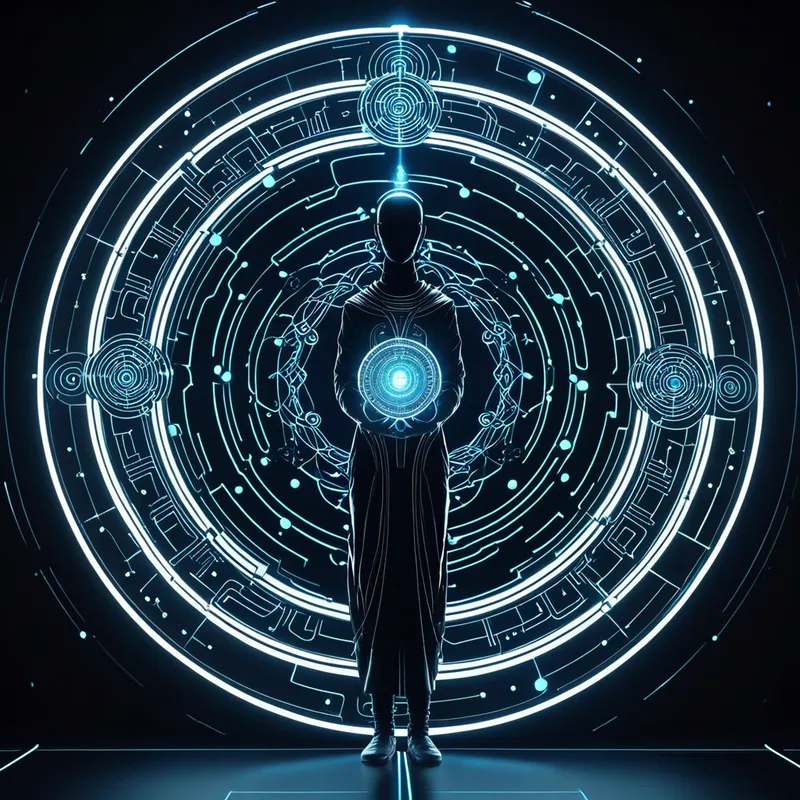
When this mythic pattern surfaces in modern dreams, it often manifests as imagery of internal networks, flows, or blockages. One might dream of intricate subway systems under the skin, of glowing fiber-optic cables replacing veins, or of beautiful gardens irrigated by a complex system of canals that have suddenly run dry or flooded.
Somatically, this dream points to a process where the unconscious is attempting to communicate the state of one's psychic energy flow. A dream of searching for a "control panel" or a "main valve" within the body suggests a felt sense of being out of tune with one's own instincts and emotions, seeking conscious regulation. Dreaming of unclogging a pipe or clearing a choked stream is a powerful symbol of the psyche's innate movement toward catharsis and emotional release. The dream is the mind's way of performing its own acupuncture, pointing to where the psychological Yu has accumulated and needs to be moved.
Alchemical Translation
The individuation process, the journey toward psychic wholeness, is perfectly modeled by the myth of the Meridians. It is the alchemical work of discovering and integrating one's internal, often hidden, circuitry.
Initially, we live identified with a few dominant "channels"—perhaps the driven, achieving energy of the Yangming, or the accommodating, nurturing flow of the Taiyin. Other channels, those associated with rejected emotions like anger (Liver) or grief (Lung), become blocked and fall into the shadow. They are the unmapped territories of the self.
Individuation is not about building a stronger ego, but about becoming a better conductor for the totality of one's nature.
The "alchemical translation" begins with the Yellow Emperor's first act: inward attention. It requires sitting with the discomfort of a blocked channel—the tightness of repressed rage, the heaviness of unmourned loss—and listening to its story without immediately trying to "fix" it. The process involves tracing this blockage back to its source, understanding its original protective purpose, and gently, through awareness and often through symbolic expression (art, movement, dialogue), allowing the dammed energy to find a new course.
The triumph is not the eradication of all blockages, which would be a lifeless perfection, but the achievement of a resilient, flowing system. It is the capacity for the full spectrum of human experience to move through us without causing permanent stagnation or destructive flooding. The integrated individual becomes like a well-managed watershed: they can handle the droughts of depression and the storms of passion because the internal channels are known, respected, and clear. They have become the sage of their own inner landscape, harmonizing the heavens of aspiration with the earth of embodiment in the continuous, flowing breath of the present moment.
Associated Symbols
Explore related symbols from the CaleaDream lexicon: