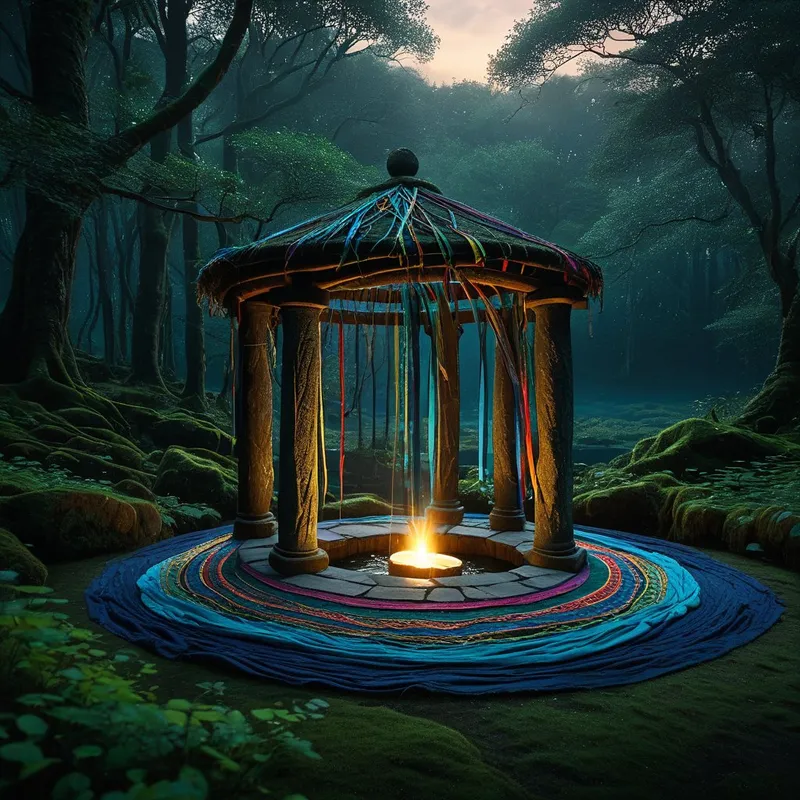
Clootie Well Myth Meaning & Symbolism
A sacred well where offerings are made, binding illness to rags, a pact with the liminal waters for healing and transformation.
The Tale of Clootie Well
Listen. In the deep green heart of the land, where the oak’s roots drink from the dark and the hawthorn guards the threshold, there is a place of whispering. It is not a place for the loud or the proud. It is a place for the broken, the fevered, the ones whose spirits walk with a limp. They call it the Clootie Well.
The air here is thick with the scent of damp earth and old leaves. The water does not babble; it seeps, silent and cold, from a cleft in the stone, collecting in a pool black as a raven’s eye. Above it, the trees are not adorned with leaves alone. From every reachable branch hang the tokens of the desperate: strips of cloth, faded by sun and rain, bleached by sorrow. They flutter like the last breaths of those who left them, a silent, ragged congregation.
The story is not of a single hero, but of every soul who ever turned their face from the sunlit path and stepped into this green gloom. It begins with a weight—a sickness in the bone, a grief in the chest, a shadow clinging to the mind. The afflicted one comes, often at the hinge of the day, at dawn or dusk. They come alone. In their hand, they carry a piece of cloth, a clootie, torn from their own garment—the sleeve that brushed their fevered brow, the hem that trailed through their despair.
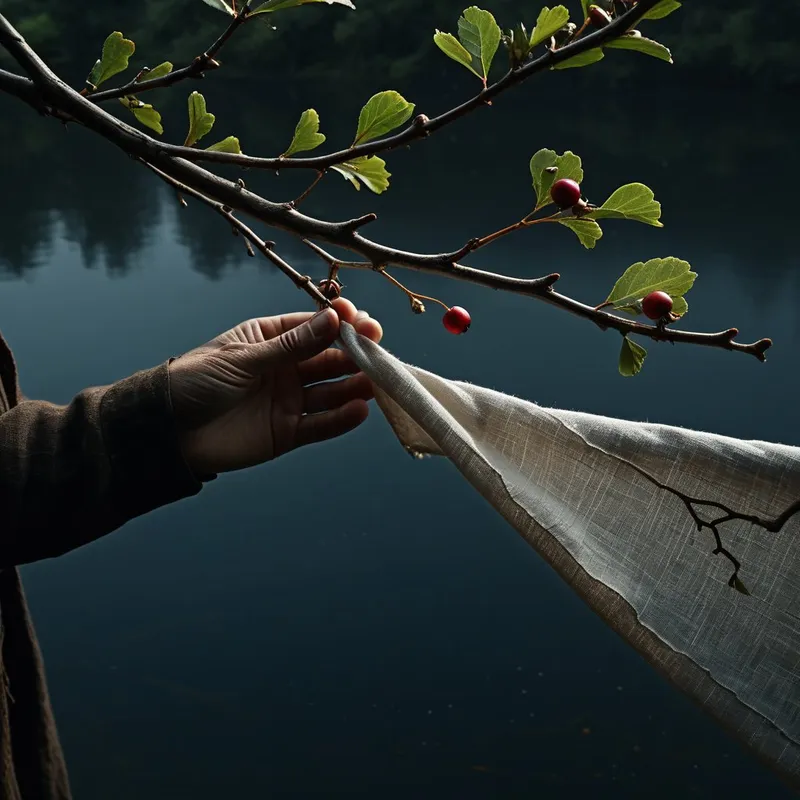
They kneel on the moss, feeling the chill of the earth seep into their knees. They dip the cloth into the icy water, and as the water touches the rag, they touch their own ailment. They press the wet cloth to the wounded place—the sore limb, the aching head, the heavy heart. They whisper not a prayer to the sky, but a bargain into the water. They transfer the essence of their suffering into the sodden fabric, a silent, somatic magic.
Then, with a finality that aches, they turn from the water. They do not take the sickness with them. They tie the cloth to the branch of the hawthorn or the oak. As they knot it tight, they knot their illness away from their own soul and onto the tree, onto the place. They leave it there for the spirit of the well, for the genius loci, to dissolve. They walk away, and they do not look back. To look back is to reclaim the burden. The cloth remains, a testament to surrender, weathering away as the sickness is meant to weather away with it. The well holds the offering; the tree bears the witness; the pilgrim seeks the cure.
Cultural Origins & Context
The practice of the Clootie Well is not a single myth with a canonical narrative, but a living, breathing folk tradition spanning Scotland, Ireland, and other Celtic regions. Its origins are pre-Christian, rooted in the veneration of water spirits and divine feminine deities like Brigid. These wells were seen as apertures to the Otherworld, places where the veil was thin and the powers of life, death, and regeneration were acutely present.
The knowledge was passed down not by bards reciting epics, but by grandmothers and healers, by the community’s memory of what worked. Its societal function was profoundly practical and psychological. It was a technology of hope and a ritual of release for communities without modern medicine. It provided a structured, tangible process for dealing with intangible suffering—be it physical illness, mental anguish, or spiritual malaise. The act was communal in essence (you followed the path others had walked) yet deeply personal in execution. It externalized suffering, making it something that could be seen, touched, and left behind.
Symbolic Architecture
At its core, the Clootie Well ritual is a profound map of symbolic healing. The well represents the unconscious itself—a deep, dark, nourishing, and potentially perilous source. The water is its transformative substance, the prima materia of the soul.
The offering is not a gift, but a transfer. The illness moves from the invisible interior to a visible exterior, from the body to the symbol.
The clootie is the perfect symbol for the ailment. It is a piece of the self, intimately worn. By soaking it in the well-water, one infuses the symbol with the literal and psychic "humors" of the sickness. Tying it to the tree completes the circuit: the tree, a world-axis connecting earth, water, and sky, acts as a conduit. It holds the suffering in the liminal space between worlds, allowing the natural processes of decay (wind, rain, sun) to perform the alchemy the conscious mind cannot. The pilgrim’s forbidden glance backward mirrors the psychological danger of obsessive retrospection, of reclaiming an identity built around one’s wounds.
The Dreamer's Resonance
When this mythic pattern surfaces in modern dreams, it signals a profound somatic and psychological process of detoxification. To dream of a hidden well, a pool, or a spring is to encounter the deep, self-regulating wisdom of the unconscious. To dream of tying or binding something, especially a cloth or bandage, to a tree or post near water, speaks directly to the psyche’s innate healing ritual.
The dreamer is likely in a state of seeking release from a burden that has become psychosomatic—an old grief, a entrenched pattern of thought, a resentment, or a physical symptom with emotional roots. The dream is the psyche’s enactment of the Clootie Well rite. The body-mind is attempting to externalize the "toxin," to move it from the invisible, pressurized interior world into a symbolic form where it can be witnessed and, ultimately, decomposed by the larger processes of life (the unconscious). The feeling upon waking may be one of eerie calm, deep sadness, or unresolved tension, depending on whether the dream ritual felt complete.

Alchemical Translation
For the modern individual, the Clootie Well models the essential, non-linear process of psychic transmutation, or individuation. Our culture often demands we "get over" or "solve" our pain through conscious will. This myth teaches the opposite: the path to wholeness requires a sacred surrender.
The first alchemical operation is not solve (to dissolve) but negredo (the blackening)—the acknowledgment and embodiment of the suffering. The dipping of the cloth is this descent.
The conscious ego (the pilgrim) must first identify and "touch" its wound with full awareness (the touch of the cloth to the ailment). It must then immerse that identified pain into the waters of the unconscious (the well)—that is, to stop trying to intellectually solve it and to instead let it be held in the darker, unknowable processes of the psyche. The final act, tying it to the tree, is the crucial step of relinquishing control. We offer the complex to a power greater than our ego—to the Self, to the archetypal realm, to time, to nature’s cycles. We bind it there and walk away, trusting the alchemy of decay to transform leaden suffering into the fertile soil for new growth. The fading cloth is the evidence that what we identify with does not define us forever; it weathers, it changes, it returns to the source. The well remains, a perpetual promise that within the deepest, darkest parts of ourselves lies the ultimate, cleansing spring.
Associated Symbols
Explore related symbols from the CaleaDream lexicon: