
The Dance of the Dead Amazon
An Amazonian myth about a warrior's posthumous ritual dance, exploring themes of honor, the afterlife, and cultural rites of passage.
The Tale of The Dance of The Dead Amazon
The story begins not with a birth, but with a death. The warrior-woman, known only as Arani, fell in the deep green heart of the forest, her spear broken, her body pierced by the weapons of a rival tribe. Her sisters, their faces streaked with ochre and grief, carried her from the contested ground. They did not weep as they bore her home, for the salt of tears is for the uninitiated. Their sorrow was a heavier, quieter thing, a stone in the river of their spirits.
They prepared her not for burial, but for transition. They washed her wounds with water from the hidden cenote, anointed her skin with sacred urucum and fragrant resins. They dressed her in her finest feathered regalia, the vibrant greens and blues of the macaw, the stark black and white of the harpy eagle. They placed her spear, newly hafted, in her stiffened hand and stood her upright, binding her to the great Samaúma, the mother of trees, whose roots drink from the underworld rivers and whose crown touches the realm of birds and spirits.
As the first star, the Evening Hunter, pierced the velvet canopy, the eldest shaman began. She did not chant for the soul to depart; she chanted for it to remember. The rhythm was not the frantic beat of war, but the deep, slow pulse of the earth itself, played on a hollow log drum. And as the drum spoke, a strange tension entered the clearing. The fireflies, which had been drifting, began to orbit the standing form of Arani. A breeze, smelling of damp earth and night flowers, stirred the feathers on her shoulders.
Then, her foot moved.
It was a shudder at first, a tremor against the bindings. Then the other foot shifted. The drum pulsed, and the dead knees bent. The bindings held her torso to the tree, but her legs, her arms, began to move. It was not the graceful flow of a living dancer, but a powerful, jerking articulation, as if her bones were being pulled by invisible strings from the stars. Her head lolled, then snapped upright, eyes milky and unseeing, yet fixed on some horizon beyond the forest roof.
This was the Dance of the Dead Amazon. It was a dance of grotesque beauty. She stamped the earth, communicating with the ancestors below. She thrust her spear at the shadows, fighting her final battle anew in the spirit realm. She mimed the paddling of a canoe, journeying down the great river of the sky. The dance was her final testimony, her body becoming a bridge between states of being. She danced her life’s story—the hunt, the vigil, the sisterhood, the kill. She danced her death, a re-enactment that transformed the trauma into a rite. She danced her future, a navigation toward the village of souls.
The living sisters did not watch in horror, but in profound participation. They echoed her movements in a wider circle, their living, fluid dance a mirror and a guide to her stiff, spirit-led steps. They were the chorus to her final soliloquy, weaving a net of memory and love to ensure she did not lose her way. The dance lasted until the first hint of grey touched the east. As the dawn birds began their chorus, the movements of the dead warrior slowed. The jerking subsided into a gentle sway. Finally, she was still. The shaman ceased her drumming. The bindings were cut, and Arani was lowered, now truly empty, ready for the funerary pyre. Her journey was complete. The dance had delivered her.
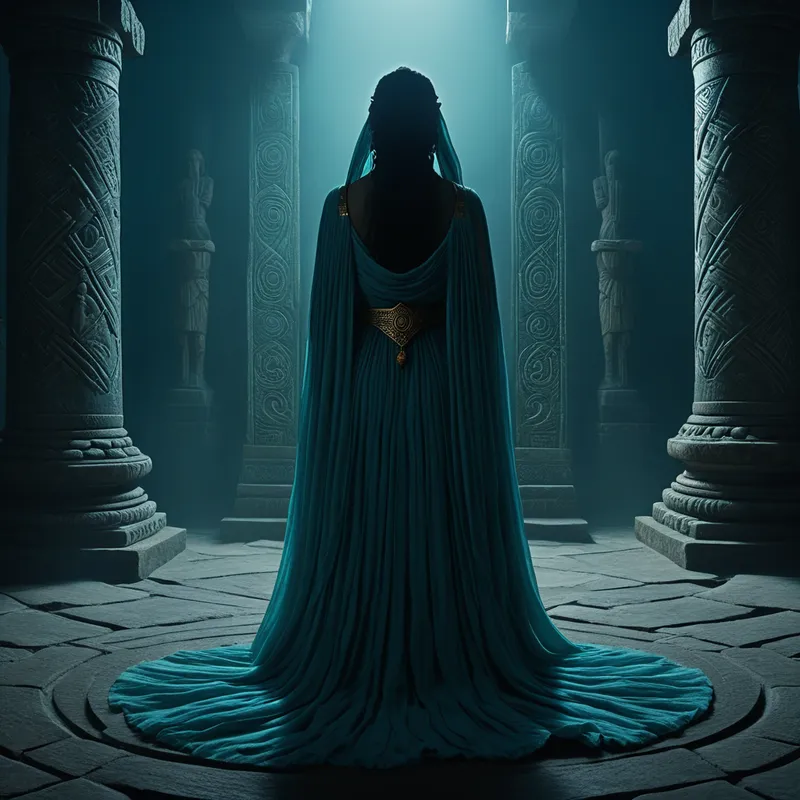
Cultural Origins & Context
This myth emerges from the complex tapestry of indigenous Amazonian cosmologies, where death is not an end but a change of ontological address. For many peoples, such as the Yanomami, the Shuar, and various groups of the Upper Xingu, the afterlife is a parallel existence, often a mirrored version of the living world, accessible via specific rituals and states of being. The warrior, especially a female warrior in matrifocal or egalitarian societal structures, holds a unique spiritual charge. Her life force is doubly potent—nurturing and destructive, creative and decisive.
The ritual described is a form of psychopompic ceremony, a guided passage for a soul deemed powerful enough to require active escort. The ordinary dead might simply be buried or exposed; their souls find their own way. But a warrior, particularly one who died violently away from home, is in spiritual peril. Her soul could become confused, angry, trapped at the site of death, or worse, return as a malicious spirit. The Dance is a technology of the soul. By using rhythm, community participation, and the resonant symbolism of the upright posture and the World Tree (Axis Mundi), the community helps the deceased’s spirit reconstitute its narrative. The dance physically enacts the soul’s necessary journey, providing a script written in movement for the disoriented psyche.
It is also a critical rite for the living. It transforms passive grief into active, culturally meaningful labor. The sisters are not merely mourners; they are essential guides, pilots on a dangerous spiritual river. Their participation reaffirms the social bonds that death threatens to sever and redistributes the warrior’s power (her courage, her skill) back into the community through the shared, exhausting, and sacred act of the ritual.
Symbolic Architecture
The myth is built upon profound archetypal architecture. The dead warrior, the Hero, is suspended in a liminal state—physically present, spiritually absent. Her dance is the ultimate Threshold activity, occurring at the Door between worlds. The great tree is the Axis Mundi, the vertical Bridge connecting the Earth of her corpse, the Forest of her life, and the Sky of her destination.
The dance is not an entertainment for ghosts, but a somatic language for translating a life into a passport for the afterlife. Each stiff gesture is a word in the story the soul must tell to the guardians of the next world.
The Mirror is a key, though unseen, symbol. The living sisters mirror the dead one’s movements, creating a resonant field that keeps her spirit engaged. Furthermore, the afterlife itself is often conceived as a mirrored reflection of this world. The dance may be the process of aligning the soul’s memory with that new, reflected reality. The Water used to wash her and the implied River of her journey speak of purification and transition, the fluid medium of change.
Most crucially, the ritual inverts the normal relationship between body and spirit. In life, the spirit animates the body. In this death ritual, the community’s will and the sacred rhythm temporarily re-animate the body to instruct the spirit. The body becomes a puppet not of life, but of sacred necessity, its final movements a map etched in air for the departing soul to follow.
The Dreamer's Resonance
For the modern psyche, encountering this myth is to confront our own impoverished relationship with death and grief. We sanitize death, hide it, and often experience grief as a private, pathological state to be “gotten over.” The Dance of the Dead Amazon presents a model where grief is communal, active, and creative. It suggests that to properly honor the dead—and to heal the living—we must find a way to actively engage with the story of the death and the life that preceded it.
Psychologically, the myth speaks to the process of integrating a traumatic or powerful ending. The “dead Amazon” can represent any profound loss, failure, or ending within us—a lost relationship, a deceased aspect of our identity, a crushed dream. The ritual dance is the inner work of revisiting that ending, not with passive regret, but with active, ritualized attention. We must “stand up” the memory, bind it to our core (our Tree), and through a painful, deliberate process (the Dance), allow it to move through its final motions until it is complete and can be laid to rest. The “living sisters” are the other parts of our psyche that witness, support, and guide this difficult integration.
To dream of such a dance is to receive a call from the unconscious to ritualize an ending. It is the soul’s demand for ceremony, for a conscious punctuation mark at the close of a significant chapter, lest its ghost haunt the halls of your future.
Alchemical Translation
In the alchemy of the soul, this myth describes the Nigredo—the blackening, the putrefaction—and its intentional, ritualized transformation. The dead warrior is the prima materia, the leaden weight of mortal end. The ritual is the alchemical vessel itself. The fire is not just the physical pyre at the end, but the sacred Fire of communal focus and rhythmic will that heats the vessel.
The dance is the stirring of the contents. The violent, jerking movements are the dissolution of the old fixed form (the identified self as “living warrior”). The guiding movements of the sisters represent the coniunctio, the sacred marriage of opposites: life with death, movement with stillness, individual with community. The goal is not to resurrect the body, but to liberate the essence. The Gold here is not eternal life, but a successfully translated soul, one that has shed its earthly attachments and trauma and achieved a new, coherent existence in the realm of ancestors.
The ultimate alchemy is not turning lead to gold, but turning a death story into a journey myth. The ritual is the retort where the raw fact of cessation is distilled into the pure spirit of passage.
The warrior’s Honor is not merely her reputation; it is the energetic integrity of her life-force, which must be preserved through this delicate operation. A botched ritual—a dance interrupted, a lack of sincere participation—risks a flawed distillation, leaving behind a toxic residue of restless spirit, which in psychological terms translates to unresolved complex, persistent guilt, or unprocessed trauma.
Associated Symbols
Explore related symbols from the CaleaDream lexicon:
- Ritual Dance — A prescribed, sacred movement intended to alter the state of the world or the soul, serving as a conduit between the mundane and the numinous.
- Bridge — A structure or symbol representing transition, connection between disparate realms (life/death, conscious/unconscious), and the perilous journey of transformation.
- Axis Mundi (Tree) — The World Tree or central pillar, representing stability, connection between heaven, earth, and underworld, and the vertical path of spiritual ascent and descent.
- Mirror — A symbol of reflection, truth, self-knowledge, the soul, and the idea that other realms are precise yet inverted echoes of our own.
- Threshold (Door) — The liminal space between two states of being, a place of potential, danger, and transition where transformation becomes possible.
- Psychopomp — A guide of souls, an archetypal figure (like the shaman) who conducts the deceased from the world of the living to the afterlife.
- Fire — The element of transformation, purification, destruction of the old, and the sacred energy of ritual focus and spiritual will.
- Water — The element of the unconscious, emotion, purification, transition, and the fluid medium through which the soul travels.
- Honor — The spiritual integrity and earned respect of an individual, which must be preserved and ceremonially transferred at death to maintain cosmic and social order.
- Sacrifice — The act of offering something of value (a life, a comfort) to a higher purpose or power, which in this myth is the community’s energy offered to guide the dead.
- Shadow — The unconscious aspect of the personality, often containing repressed material; the dead warrior can represent the confrontation with one’s own mortal shadow.
- Rebirth — The emergence into a new state of existence following a symbolic death; the warrior’s soul achieves rebirth in the ancestral realm through the ritual.