Nigredo Myth Meaning & Symbolism
The alchemical process of putrefaction, where all matter dissolves into blackness, representing the necessary psychic death before rebirth.
The Tale of Nigredo
Listen, and I will tell you of the first and most terrible of the Great Works. It does not begin with gold, but with blackness. It does not begin with light, but with the extinguishing of all light.
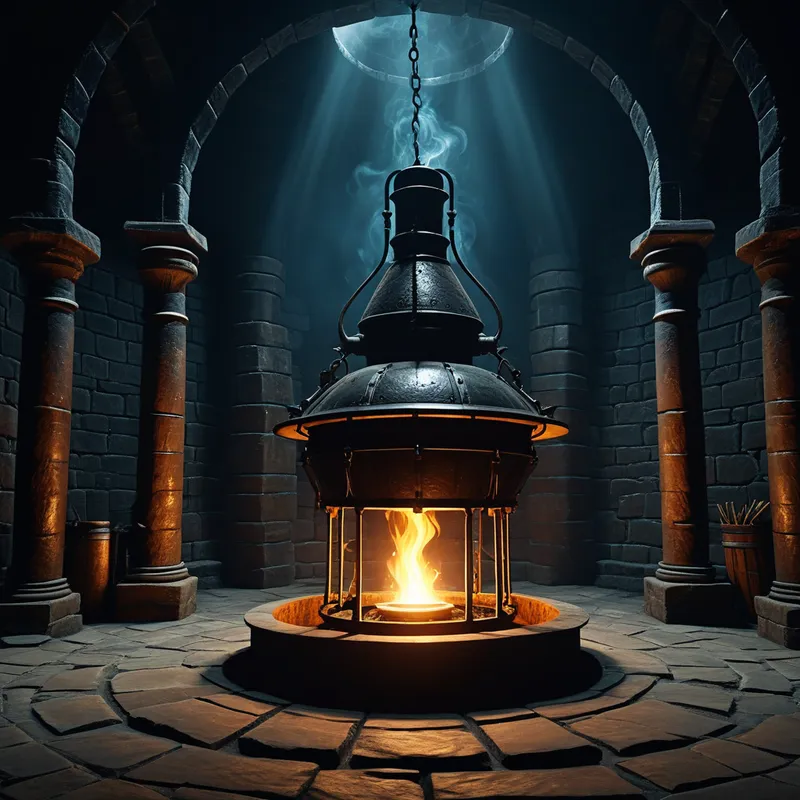
In the silent heart of the laboratory, under the watchful eye of the athanor, the Artifex gathers the prima materia. It is not one thing, but all things: the dust of the earth, the dregs of wine, the rust of old iron, the ash of burnt dreams. This confused mass, this Chaos, is sealed within the vas hermeticum, the egg of glass and clay.
A fire is kindled. Not a roaring blaze, but the slow, patient heat of buried sorrow—the balneum mariae. Days pass. The substance within begins to stir. It sweats. It weeps a bitter dew. Colors flicker and die: the green of hope sickens, the white of purity sullies. A stench rises, not of physical decay, but of moral and spiritual putrefaction. It is the smell of pride rotting, of certainty dissolving.
Then, the blackening. It comes not as a stain, but as a conquering tide. The unum cracks and putrefies. It becomes a raven’s wing at midnight, a starless sky, the void at the bottom of a well. This is the Caput Corvi—the Head of the Crow—pecking at the very substance of being. The Artifex watches, gripped by a sacred terror. All order is undone. All identity is lost in this pitch. The work is now a tomb. The vessel holds only a cosmic mourning, a black sun that emits no light, only a gravity that pulls all hope into its core.
The fire must be maintained. To flee is to abandon the Work forever. The Artifex must sit in vigil with this absolute blackness, this terra nigra, until the blackness itself becomes perfect, uniform, and complete. Only when the darkness is total, when not a single speck of the old color remains, does the first mystery reveal itself: in the depths of this utter negation, a strange, somber luminosity begins to emanate. Not light, but the promise of light. The black has become so profound it shines. The tale pauses here, in the perfect, fertile dark.

Cultural Origins & Context
The mythos of Nigredo is not a story told around fires, but one encoded in cryptic manuscripts, hidden behind the veil of Decknamen. It flourished in the workshops and scriptoria of Medieval and Renaissance Europe, though its roots tap into older Hellenistic and Arabic traditions. It was a Hermetic narrative, passed from master to apprentice not merely as a chemical recipe, but as a spiritual itinerary.
Its societal function was deeply subversive. In a world ordered by Church doctrine and feudal hierarchy, alchemy proposed a path of direct, personal gnosis through material metaphor. The myth of Nigredo provided a sacred container for experiences the culture had no other language for: despair, doubt, melancholia, the "dark night of the soul" described by mystics like St. John of the Cross. It legitimized dissolution as a holy phase. The alchemist in his study, confronting the blackening, was performing an internal drama of death and potential rebirth, using the external processes of the laboratory as his symbolic script.
Symbolic Architecture
Psychologically, Nigredo represents the unavoidable confrontation with the shadow. It is the death of the persona—the constructed, acceptable self—and the descent into the chaotic, often shameful, contents of the personal unconscious. The sealed vessel is the conscious psyche, forced to contain what it would rather project outward. The heat is the friction of life’s inevitable suffering and conflict, which initiates the process.
The sun must set before it can rise again. The seed must rot in the earth before it can sprout. So too must the conscious ego submit to a symbolic death, a dissolution of its rigid structures, for any genuine growth to occur.
The blackness is not evil, but the color of potential. It is the fertile soil, the rich humus created from the decay of outmoded attitudes, childhood complexes, and inflated self-images. The Caput Corvi is the scavenger that cleanses, pecking away the rotten flesh of illusion to leave bare bone—the essential structure. This stage asserts that wholeness is impossible without first acknowledging and integrating one’s fragmentation.

The Dreamer's Resonance
When this myth stirs in the modern dreamer, it announces a profound somatic and psychological process of decomposition. Dreams may be drenched in imagery of black water, crumbling buildings, dark forests with no path, or being buried alive. The dreamer might find themselves in a featureless black room or handling a precious object that turns to ash or ink in their hands.
Somatically, this can correlate with periods of deep fatigue, illness, or a sense of "heaviness" that is more psychic than physical. It is the body echoing the soul’s Nigredo. Psychologically, the dreamer is in a state where old coping mechanisms, life narratives, and self-concepts are failing. A career, relationship, or identity is "rotting," and the conscious mind is forced to sit with the anxiety, depression, and disorientation of the interim. The dream state becomes the vas hermeticum, where this painful but necessary dissolution is safely contained and processed.

Alchemical Translation
For the modern individual seeking individuation, the myth of Nigredo models the essential first step of psychic transmutation: the surrender to necessary suffering. We are culturally conditioned to avoid darkness—to medicate sadness, bypass grief, and spin failure into a "learning experience" before fully feeling the loss. Alchemy insists we must not skip this step.
The transmutation begins by consciously entering our own terra nigra. This means allowing oneself to fully feel the despair of a broken dream, the rage of a betrayal, the void of a lost meaning, without immediately seeking to fix it. It is the practice of "sitting in the fire" of one’s own emotions, not as a masochist, but as an Artifex observing a crucial reaction.
The gold of the authentic self is not found by polishing the surface personality, but by descending into the blackness where all that is false and borrowed is burned away.
This process transforms the quality of the darkness itself. From a state of meaningless depression (melancholia), it becomes a state of pregnant, meaningful void—the nigredo as the womb of the new. The individual learns that identity is not a fixed statue, but a process of continual death and rebirth. By enduring the blackening, one earns the right to the subsequent stages: the whitening (albedo), the yellowing (citrinitas), and finally, the reddening (rubedo). To seek the philosopher’s stone without first honoring the crow is to build a castle on a swamp. The myth of Nigredo is the eternal reminder: all true creation begins in the dark.
Associated Symbols
Explore related symbols from the CaleaDream lexicon:
- Trash
- Waste
- Burnt Toast
- Burned Toast
- Filthy Pot
- Minotaur
- Coal Black
- Midnight Bloom
- Attic of Ashes
- Spilled Ink
- Inkwell Abyss
- Crumpled Paper
- Overflowing Wastebasket
- Rotting Food
- Overflowing Trash Can
- Burnt Paper
- Cocoon of Flames
- Compost Heap
- Gritty Texture
- Fire Transformation
- Data Corruption
- Hawking Radiation
- Excretion
- Putrefaction
- Tumor
- Toxin
- Decrement
- Underflow
- Phlegm
- Harsh
- Putrid
- Molasses
- Charcoal
- Sewage