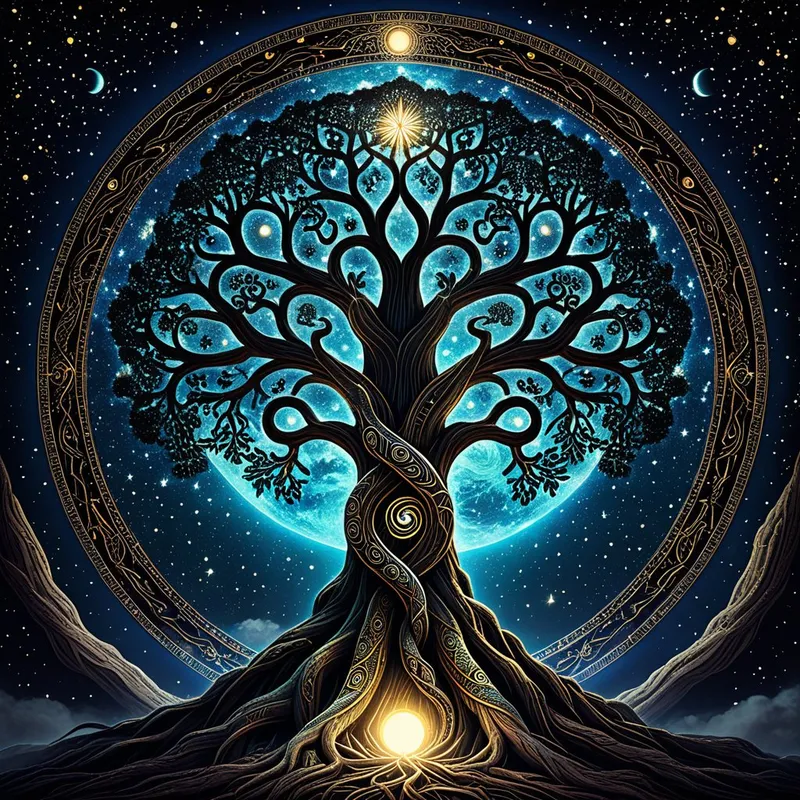
Axis Mundi Myth Meaning & Symbolism
The universal story of the World Center, a sacred pillar or mountain linking all realms, offering a path for gods, heroes, and the human soul.
The Tale of Axis Mundi
Listen. In the time before time, when the world was a formless soup of shadow and potential, there was a great groaning. From the deep, silent womb of the unformed, a force pushed. It was not a god, not yet; it was a yearning. A yearning for distinction, for separation, for a place to stand.
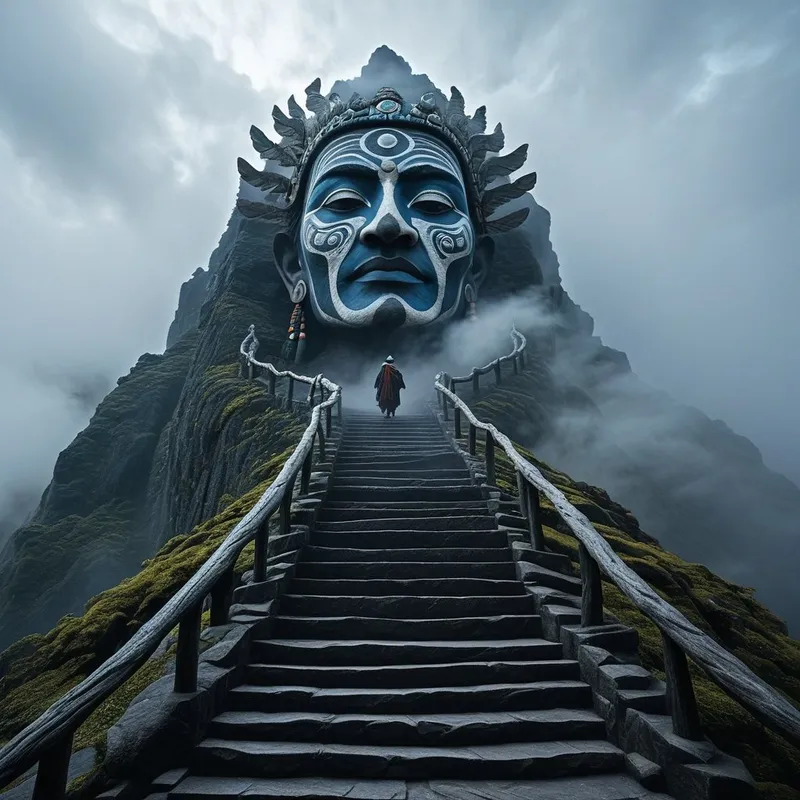
And so, it rose. A mountain, first as a thought, then as stone, heaving itself from the primal waters. It did not stop. It pushed through the mists of the middle-air, scraping the underbelly of the sky until, with a sound like a thousand thunderclaps, it pierced the vault of heaven. This was the First Pillar. Axis Mundi.
Upon its peak, the first light coalesced. The Sun-God found his throne. In its roots, which bored deep into the abyss, the damp soil gave birth to secrets and the dead found their rest. And upon its slopes, in the world-between, life sprouted—forests, rivers, and the first people, who looked up in awe at the ladder of the world.
But a pillar is a lonely thing. It yearned for connection. From its bark grew branches that became the limbs of the Yggdrasil, cradling the nine worlds. Its stones became the seven tiers of the Ziggurat, each a step closer to the divine. Its form was echoed in the solitary pole of the shaman’s tent, around which the spirits gathered. It was the spine of the cosmos, and all things were arranged around it.
Then came the Strife. The Serpent of Chaos, born from the same dark waters, envied the Pillar’s stability. It coiled around the base, whispering lies of dissolution, squeezing to bring the mountain down. The Eagle of Heaven, perched at the summit, shrieked a challenge. The tension between them—the pull of the depths and the call of the heights—thrummed along the Axis, a sacred vibration that sustained all creation.
It is said that in those days, heroes and shamans could climb. They would follow the narrow path, face the serpent’s whispers, brave the thinning air, and if their hearts were pure, they would reach the summit. There, they would speak with the gods, steal the fire of wisdom, or plead for rain. And they would return, forever changed, carrying a piece of the celestial order back to the horizontal world. The Axis was not just a place. It was the journey itself.
Cultural Origins & Context
The Axis Mundi is not a myth from a single culture, but a primordial pattern etched into the human psyche and expressed in countless forms across time and geography. It is the ultimate archetype of the sacred center. We find it in the physical and mythic geography of virtually every traditional society.
It was the societal anchor, the central postulate from which all order flowed. For the ancient Mesopotamians, it was the Ziggurat, the artificial mountain at the heart of the city-state, connecting the king to the god Anu. For the Norse, it was the ash tree Yggdrasil, around which all realms, including Asgard and Hel, were organized. In India, it was Mount Meru. For Siberian shamans, it was the central pole of their yurt, up which their soul would travel in trance.
This myth was not merely told; it was lived and built. It dictated city planning—the Roman umbilicus urbis, the Chinese concept of the central kingdom. It governed ritual: the climbing of sacred hills, the dancing around a maypole, the architectural striving of cathedrals and stupas pointing toward heaven. Its function was profound: to combat chaos (cosmos vs. chaos) by establishing an immutable center, a reference point that gave meaning, direction, and stability to the human world. It answered the fundamental human question: "Where, in all this vastness, is here? And how do I get there from here?"
Symbolic Architecture
At its core, the Axis Mundi is a symbol of connection and mediation. It represents the possibility of communication between different planes of existence: the conscious (earth), the superconscious or spiritual (heaven), and the unconscious (the underworld).
The Axis is the psyche’s own spine, the vertical dimension along which awareness can travel from instinct to intuition.
Psychologically, it symbolizes the Self in Jungian terms—the central organizing principle of the psyche around which the complexes (the various realms) orbit. The serpent at its base is the chthonic, instinctual energy, the pull of the shadow and the personal unconscious. The eagle at its summit is the spirit, the drive for meaning, consciousness, and transcendence. The eternal tension between them is not a flaw, but the very dynamo of psychic life. The hero’s climb is the ego’s difficult journey toward aligning itself with the Self, integrating the heights and depths into a coherent whole.
It is also a symbol of orientation. In a state of psychological chaos or crisis—a "dark night of the soul"—the myth of the Axis tells us that healing begins by finding our center again. It is the internal compass point from which we can re-survey our world and our place within it.
The Dreamer's Resonance
When the Axis Mundi appears in modern dreams, it rarely manifests as a literal world tree or mountain. Its presence is more subtle, more liminal. The dreamer may find themselves in a vast, empty train station, fixated on a single, central clock tower whose face shows impossible times. They may be in an endless library, drawn to a solitary, spiraling staircase that vanishes into the ceiling. They might dream of a towering, monolithic skyscraper in a deserted city, feeling an irresistible urge to enter its lobby and ascend.
These are dreams of recentering. The psyche is signaling a critical need to find its axis amid the fragmentation of modern life. The somatic feeling is often one of being drawn, pulled vertically. There may be anxiety (fear of the climb, fear of the heights or depths) mixed with profound longing.
The process at work is one of psychic navigation. The dream is presenting a symbolic structure for re-connecting disparate parts of the self. If the dreamer is climbing, they are actively engaged in a process of consciousness-raising or confronting elevated challenges. If they are descending, they may be being called to explore repressed material, instincts, or grief. A crumbling or damaged Axis in a dream often points to a profound disorientation, a loss of core values or meaning—a true psychological crisis of direction.

Alchemical Translation
The alchemical journey, like the process of individuation, is one of distillation and integration, of solving the mysterium coniunctionis—the mystery of the union of opposites. The Axis Mundi is the alembic itself, the vessel in which this transmutation occurs.
For the modern individual, the myth models a threefold alchemical operation. First, Descensus: the voluntary descent into one’s own underworld (the nigredo). This is facing the serpent—engaging with shadow, trauma, and base instincts without being consumed by them. It is rooting oneself in the reality of one’s own nature.
The climb is not an escape from the depths, but a journey made possible by having first acknowledged them. The summit’s view includes the abyss.
Second, Ascent: the arduous climb of conscious development (the albedo). This is the discipline of refining the ego, cultivating awareness, ethics, and perspective—building a stable structure of consciousness that can withstand the winds of the heights.
Finally, Mediation: the pinnacle state where one becomes the axis (the rubedo). This is not about residing only in spirit or only in matter, but becoming the living conduit between them. The integrated individual becomes their own center of gravity. They can access intuition (the eagle’s view) without losing touch with embodied instinct (the serpent’s wisdom). They bring order to their personal cosmos by holding the tension of opposites, becoming a pillar of meaning in their own world. They realize, in the end, that the sacred center they sought was not a place on a map, but the very act of courageous, conscious connection within themselves.
Associated Symbols
Explore related symbols from the CaleaDream lexicon: