Sacred Marriage Myth Meaning & Symbolism
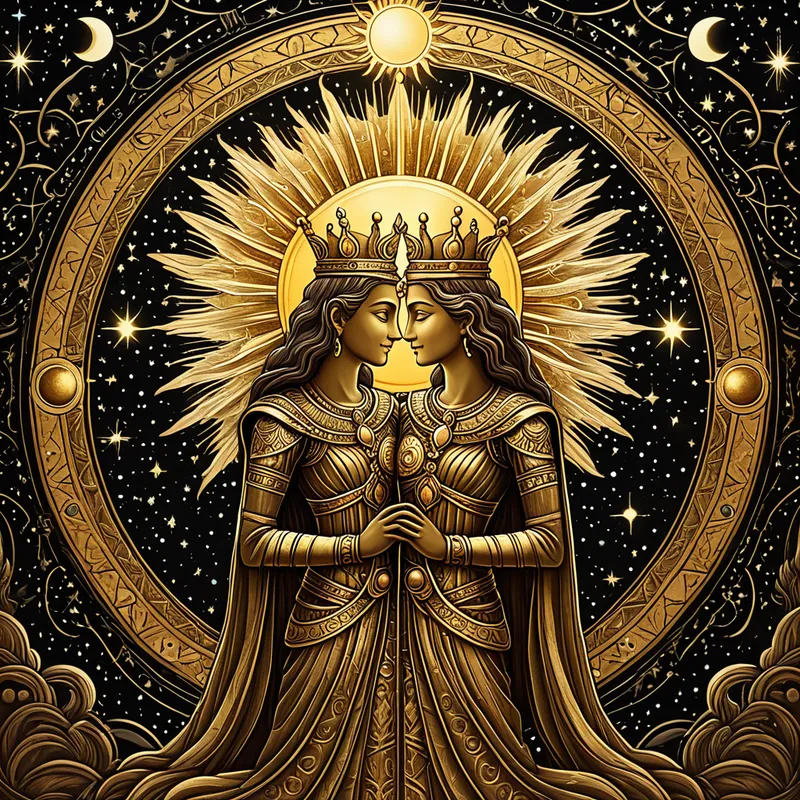
The alchemical myth of the Sacred Marriage, the hieros gamos, where the King and Queen unite to birth the Philosopher's Stone, symbolizing the soul's ultimate integration.
The Tale of Sacred Marriage
Listen, and hear the tale whispered in the heat of the furnace and seen in the dance of vapors within the glass. In the beginning, there was division. Sol, the King, a being of pure, relentless fire, sat upon a throne of gold in a citadel of noon. His light was brilliant, but it cast the deepest, most absolute shadows. He knew all things by their outlines, by their separation from his radiance, and in his knowing, he was profoundly alone.
Across the abyss of the Prima Materia dwelt Luna, the Queen. Her palace was of silver and pearl, lit by the cool, reflective glow of the moon on still water. She knew all things by their connection, by the hidden tides that pulled at their essence. She felt the dreams of stones and the memories of metals, but her knowledge was fluid, formless, and in its boundlessness, she too was solitary.
The Artifex, the seeker in the laboratory, whose soul was the true vessel, enacted the great work. Through the arduous process of Nigredo, the King was stripped of his blinding crown. His gold was dissolved in aqua fortis, his certainty reduced to a black, chaotic ash. He descended into the grave of matter. Simultaneously, the Queen was subjected to the fire. Her silver liquidity was coagulated, her boundless feeling crystallized into a white salt. She ascended into a state of rigid purity.
From these twin ordeals, they were reborn, not as monarchs, but as seekers. The King, now a red lion of passionate purpose. The Queen, a white eagle of soaring intuition. Drawn by a magnetism older than their thrones, they approached the sacred bath, the Vas Hermeticum. Here, the waters were neither hot nor cold, but both. The lion laid down his ferocity; the eagle folded her wings.
They entered the bath as two, and there, in the gentle, sustaining heat of the Bain-Marie, a miracle of stillness occurred. Their essences did not clash, but commingled. The solar gold and the lunar silver spiraled together, not creating a dull alloy, but a new, living light. From their union, a child was conceived in the secret heart of the vessel—a child not of flesh, but of spirit and stone. This was the Lapis Philosophorum, the Philosopher's Stone, born from the embrace of the once-divided King and Queen. The laboratory filled with a scent both metallic and floral, the sign of the Hieros Gamos complete.
Cultural Origins & Context
The myth of the Sacred Marriage is not a singular story from a lost scripture, but the central, living narrative of the Western alchemical tradition, spanning from Hellenistic Egypt through the Islamic Golden Age to the Renaissance courts of Europe. It was never meant for public theaters, but for the silent, smoke-filled laboratorium—a word meaning both workplace and place of prayer. It was passed down through cryptic texts like the Rosarium Philosophorum and the visions of practitioners such as Maria Prophetissa.
Its tellers were the alchemists themselves, who saw their work not merely as proto-chemistry, but as a opus divinum, a divine work upon the soul. The myth served a profound societal function for a clandestine few: it provided a symbolic language to discuss the most dangerous of subjects—direct, personal spiritual experience and psychological transformation—under the guise of manipulating physical matter. In an age where orthodoxy was strictly enforced, the allegory of the marrying King and Queen allowed the mystic to explore the union of their own inner opposites without heresy. It was a map for the journey of individuation, disguised as a recipe.
Symbolic Architecture
At its core, the Sacred Marriage is the archetypal drama of conjunctio oppositorum—the conjunction of opposites. Sol and Luna are not merely male and female deities; they represent the fundamental polarities within the human psyche.
The King is consciousness: logos, will, discrimination, and the burning desire to act upon the world. The Queen is the unconscious: eros, receptivity, relatedness, and the deep, formless knowing of the body and soul.
Their initial separation is the state of neurosis, where reason is cut off from feeling, and spirit is alienated from nature. The alchemical processes of dissolution and coagulation represent the necessary, painful deconstruction of these rigid, one-sided positions. The King must be humbled (dissolved), the Queen must be focused (coagulated). Only after this mortificatio—this symbolic death—can they meet as equals in the vas, the sealed container of the therapeutic or meditative space.
Their union gives birth to the Lapis, which symbolizes the transcendent function—the new, third thing that emerges from the reconciliation of warring opposites within the self. It is not a compromise, but a novel creation: the integrated personality, the Self in Jungian terms.
The Dreamer's Resonance
When this myth stirs in the modern dreamer, it announces a profound process of inner reconciliation. One may dream of two animals—perhaps a hawk and an otter, a stag and a dove—circling each other before merging. Or of a room with two distinct, contrasting halves (one orderly and bright, one chaotic and lush) where a door suddenly opens between them.
Somatically, this can feel like a release of chronic tension held in the body’s midline, a softening of the heart center, or a synchronizing of breath and heartbeat. Psychologically, it is the felt sense of a long-held inner conflict—between career and family, logic and intuition, responsibility and desire—losing its charge. The dreamer is not "solving" the conflict, but experiencing the birth of a new capacity that can hold both sides. The emotion is often one of profound, quiet awe and a sense of coming home to oneself. It is the unconscious signaling that the psyche is laboring to give birth to its own wholeness.
Alchemical Translation
For the modern individual, the myth models the non-linear, often tortuous path to psychic wholeness, or individuation. We all begin with inner kingdoms at war: the rational mind dismissive of the body's wisdom, the vulnerable heart armored by cynical intellect.
The first translation is Nigredo: the dark night of the soul. This is the necessary dissolution, where our conscious identity (the King) fails. A career crumbles, a relationship ends, depression sets in. Everything we thought we were is reduced to ash. Simultaneously, our unconscious (the Queen) is called to the fire. Our chaotic emotions and instincts must be given form and attention—through therapy, art, or deep reflection—coagulating them from mere mood into discernible pattern.
The second is the Conjunctio: the sacred bath. This is not an act of will, but of surrender and allowing. It happens in the vessel of committed self-observation, where we stop identifying exclusively with one side of our conflict and simply hold the tension. In that sustained, patient heat, a third perspective emerges. The activist discovers compassion is not weakness; the artist finds structure is not a cage.
The birth of the Stone is the realization of the Self. It is the moment when one’s life ceases to be a problem to be solved and becomes a mystery to be lived. The integrated person acts not from a fragmented impulse of either mind or heart, but from a centered, creative source that transcends both.
The Sacred Marriage teaches that gold—our highest potential—is not found by rejecting our silver nature, but by wedding it. The ultimate philosopher's stone is not a physical object, but the human being who has successfully performed the alchemy of the soul, uniting their inner Sol and Luna to shine with a unique, authentic, and complete light.
Associated Symbols
Explore related symbols from the CaleaDream lexicon: