
Arjuna's Meditation
Arjuna's intense meditation in Indonesian tradition unveils divine visions and spiritual insights, bridging earthly struggles with cosmic wisdom.
The Tale of Arjuna's Meditation
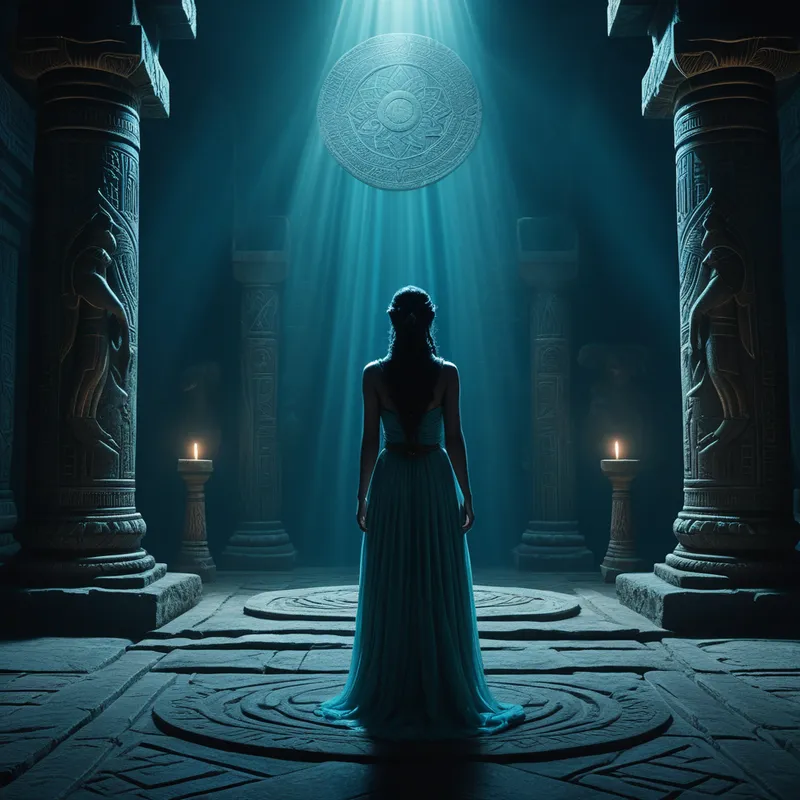
The air in the Indrakila cave was still, thick with the scent of damp earth and ancient stone. Arjuna, the peerless archer, sat not upon a throne of conquest but upon the bare rock of solitude. His famed bow, Gandiva, lay beside him, a silent companion in this vigil of non-action. He had come not to fight demons of flesh, but to wage the far more perilous war within—the perang batin, the spiritual warfare that rages in the silent chambers of the soul. Exhausted by the moral abyss of the impending Kurukshetra war, where he would be forced to raise his bow against beloved elders and kin, he sought not strategy, but clarity. He sought not victory, but truth.
His meditation was not a gentle retreat; it was an ascetic ordeal, a fierce tapas of the spirit. He withdrew his senses from the world, drawing his consciousness inward like a sword being sheathed. Days bled into nights, marked only by the deepening rhythm of his breath. He fasted, his physical form becoming a vessel emptied of desire, ready to be filled with a different kind of sustenance. In this profound stillness, the boundaries of his self began to dissolve. The warrior-prince was deconstructed, his identity as a Pandava, a husband, a hero, all falling away like discarded armor.
It was from this sacred void that the vision arose. The cave walls seemed to melt, and the cosmos poured in. He beheld Batara Guru, not as a distant deity, but as the pulsating heart of reality, seated in majestic stillness. The god’s form shimmered with the terrifying beauty of absolute power and absolute peace. This was not a god of simple blessings, but the architect of cosmic law, dharma itself, whose gaze saw the beginning and the end of all things. In that presence, Arjuna’s personal anguish was both acknowledged and transcended; it was revealed as a single note in a vast, eternal symphony of conflict and resolution.
From Batara Guru, he received the ultimate weapon: not a physical arrow, but the Pasopati, a divine arrow imbued with the power of ultimate truth and focused will. More crucially, he received the Ilmu Sastra Jendra Hayuningrat Pangruwating Diyu—the "Science of the Perfect Letter for the Subjugation of Demons." This was not mere tactical knowledge. It was an esoteric wisdom, a spiritual technology for recognizing and neutralizing the inner demons of confusion, attachment, and fear that cloud judgment and pervert duty. The gift re-framed his coming battle. Kurukshetra was no longer just a field of earthly conflict; it was to become the external theater for an internal, alchemical process. Armed with this gnosis, Arjuna emerged from the cave. His body was gaunt, but his eyes held a new light—the hard, clear light of one who has seen the machinery of fate and found the resolve to act within it, free from the tyranny of personal outcome.
Cultural Origins & Context
This episode is a cornerstone of Javanese wayang mythology, a localized and deeply philosophized retelling of the Mahabharata’s "Kirata Parvan" or the "Episode of the Mountain Man." In the Indian epic, Arjuna meditates to please Shiva and obtain the Pashupatastra. In the Indonesian archipelago, particularly in Java and Bali, the story underwent a profound acculturation. The god Shiva seamlessly merged with indigenous, pre-Hindu conceptions of the supreme mountain god, becoming Batara Guru.
This shift is critical. The narrative moved from a context of divine boon-seeking to one of spiritual crisis and integration. Javanese mysticism, or kejawen, with its emphasis on inner perfection (manunggaling kawula Gusti, the union of servant and Lord), and the pursuit of rasa (deep intuitive feeling/essence), imbued the myth with its distinctive psychological depth. Arjuna’s meditation became the paradigmatic example of laku, a spiritual discipline or ascetic practice undertaken to achieve clarity and power. It reflects a worldview where outer power (kesaktian) must be balanced and preceded by inner purity (kesucian). The myth served as a teaching tool for the warrior class (ksatriya), illustrating that true leadership and courage stem not from brute force, but from a heart stabilized by wisdom and a spirit aligned with cosmic order.
Symbolic Architecture
The myth constructs a profound map of the psyche’s journey from fragmentation to wholeness. Each element is a deliberate symbol in this inner landscape.
- The Indrakila Cave: This is the temen, the sacred, isolated place of retreat. Psychologically, it represents the interiority of the Self, the womb-like container where conscious ego (the warrior) descends to confront the unconscious. It is a liminal space, neither fully of the world nor entirely divorced from it, where transformation can safely occur.
- The Layered Withdrawal: Arjuna’s fasting and sensory withdrawal (pratyahara) is the deliberate dismantling of the persona. The hero strips away the social masks and worldly attachments that define him, creating a vacuum. This vacuum is not emptiness, but potential—the necessary condition for a new, more authentic consciousness to be born.
- Batara Guru & the Divine Weapon: The vision of the supreme deity is the culmination of the inward journey—the encounter with the Self, the central, organizing archetype of the psyche (in Jungian terms). Batara Guru represents the totality of cosmic law and consciousness. The gift of the Pasopati and the esoteric science is the integration of this Self-knowledge. The weapon symbolizes a transformed attitude: action (the arrow) now guided by transcendent wisdom (the divine source).
The meditation is not an escape from duty, but a descent into the forge where duty is purified of ego. Arjuna does not avoid his fate; he consciously drinks the cup of its bitter necessity, having first seen the hand of the divine that offers it.
- The Inner and Outer War: The entire narrative establishes the foundational Javanese principle of correspondence between the microcosm and macrocosm (jagad alit and jagad gedhe). The chaos of the Bharata war mirrors the chaos in the human soul. Arjuna’s victory on the battlefield is predicated on his prior victory in the cave. He first conquers the inner demons of doubt and grief, so that he may engage the outer enemies with detached clarity, as an instrument of dharma.

The Dreamer's Resonance
For the modern dreamer or seeker, Arjuna’s vigil is a powerful mirror. It speaks to anyone standing at a life threshold, paralyzed by a moral or existential dilemma. The myth validates the necessity of retreat—not as weakness, but as the deepest strength. It sanctions the need to step back from the frantic demands of life (ramé) to seek the quiet center (hening).
Psychologically, it models the critical process of holding the tension of opposites. Arjuna holds his love for his kin opposite his duty as a warrior; his compassion opposite his resolve. He does not collapse into one side or the other. By sustaining this unbearable tension in meditation, he allows a transcendent third to emerge: the vision that re-contextualizes the conflict. This is the alchemy of the psyche, where paralyzing conflict is transformed into conscious, purposeful action. The dreamer learns that clarity often comes not from frantic thinking, but from the courageous stillness that allows a deeper intelligence—the Self—to speak.

Alchemical Translation
The myth is a precise allegory for the individuation process. Arjuna begins in a state of identification with his heroic ego, which is shattered by the ethical complexity of his situation (the nigredo, or blackening, the descent into confusion and despair). His retreat into the cave is the mortificatio, the symbolic death of the old, rigid identity.
The intense meditation is the solutio—a dissolving of psychic structures in the waters of the unconscious. In this fluid state, the core archetypes are activated. The encounter with Batara Guru is the coniunctio, the sacred marriage of the human consciousness with the divine Self. This union produces the "philosophical child," not a physical offspring, but a new, integrated consciousness symbolized by the Pasopati.
The Ilmu Sastra Jendra is the encoded wisdom of discernment. It represents the ability to differentiate the eternal from the transient within one’s own psyche, to see the shadow (Diyu) not as an external enemy to destroy, but as a disowned part of the self to be recognized and integrated (pangruwating).
His return to the world, armed with this new consciousness, is the rubedo, the reddening or awakening. He re-enters life, but is no longer of it in the same way. He acts in the world, but from a place of inner alignment. The earthly battle becomes the vessel for his enacted enlightenment, the field upon which his inner realization is tested and embodied.
Associated Symbols
Explore related symbols from the CaleaDream lexicon:
- Meditation — The disciplined vessel of inward turning, the sacred space where the noise of the world is silenced to hear the whispers of the soul and the thunder of the cosmos.
- Cave — The primal womb of transformation, a dark, protective interior where the seeker confronts the shadow and receives visions from the depths of the unconscious.
- Mountain — The axis mundi connecting earth and sky, representing the arduous ascent toward spiritual clarity and the lofty perspective of the gods.
- Warrior — The archetype of disciplined action and courage, who must first conquer the inner landscape of fear and doubt before engaging any external battle.
- Shadow — The hidden, often rejected aspects of the self which must be faced and integrated, symbolized by the "demons" Arjuna learns to subdue from within.
- Vision — The transcendent insight that breaks into conscious awareness, reordering perception and granting a map of reality previously hidden.
- Path of Enlightenment — The arduous, individual journey from ignorance to wisdom, marked by trials, retreat, and the integration of painful truths.
- Light — The illuminating force of consciousness and divine truth that dispels the darkness of confusion, often achieved after a long vigil in the dark.
- Weapon — A symbol of focused power, will, and discrimination; when bestowed divinely, it represents action guided by transcendent wisdom rather than personal desire.
- Death — Not merely physical cessation, but the necessary end of a psychological state, an old identity, or a naive worldview, making way for rebirth.
- Rebirth — The emergence of a new, more integrated consciousness from the symbolic death of the former self, as Arjuna returns from the cave transformed.
- Bridge — The connecting principle between dualities: heaven and earth, inner realization and outer action, the human struggle and divine law.