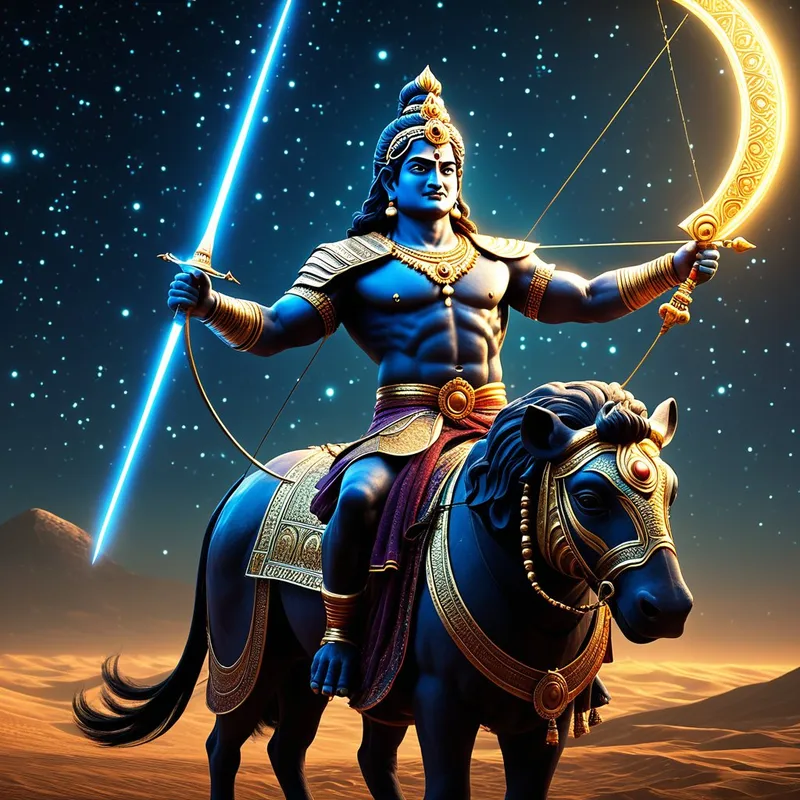
Gandiva Myth Meaning & Symbolism
The tale of the celestial bow Gandiva, a divine weapon of cosmic order, and its wielder Arjuna, bound by a sacred contract to uphold dharma.
The Tale of Gandiva
Listen. Before the great war, before the world turned on the axis of fate, there was a fire that hungered. Not a common fire, but Agni, the divine consumer, fell ill with a ravenous need. To be cured, he must feast upon the entire Khandava forest, a place teeming with magical creatures and protected by the rain god, Indra. Agni tried, but each time his flames leapt, Indra’s compassionate clouds wept, dousing the sacred hunger.
Agni, weakened and desperate, sought a wielder of unmatched skill, a warrior who could hold back the heavens themselves. He found them by a riverbank: Arjuna, the peerless archer, and his divine friend and charioteer, Krishna. To them, Agni made his plea, his form flickering with suppressed power.
And from the heart of his need, Agni summoned it. The air shimmered, the very sound of creation hummed, and there it was—Gandiva. It was not crafted; it was manifested. Its back was of gold, impossibly elegant, yet radiating a density that spoke of cosmic storms contained. Its string, when plucked, did not twang but thrummed with the primordial syllable Om. It was a bow that had witnessed the churning of the cosmic ocean, wielded by gods before time had a name. Agni placed it in Arjuna’s hands, and with it, a quiver that never emptied.
The forest burned. Arjuna stood as a ring of fire himself, a whirlwind of arrows creating a canopy so dense that not a single drop of Indra’s rain could penetrate. The sky darkened with Indra’s wrath, his divine Apsaras and Devas raining down weapons. But Arjuna, with Gandiva singing in his hands, met each celestial bolt with one of his own, a symphony of destruction performed for the sake of a god’s purification. The air smelled of ozone, burnt sandalwood, and wet earth denied. For days, the duel raged, until Indra himself looked upon his son Arjuna, not with anger, but with a profound, tragic pride. He withdrew. The feast was complete. Agni roared back to health, and as thanks, he gave Gandiva to Arjuna forever, with a solemn charge: “This power is yours, but it is not for you. It is for Dharma.”
And so the bow passed into the service of a mortal, bound by a sacred contract. It would be the instrument through which a world would end, so that a truer one might begin. It would twang on the field of Kurukshetra, its song a dirge for the old age and a midwife’s cry for the new.
Cultural Origins & Context
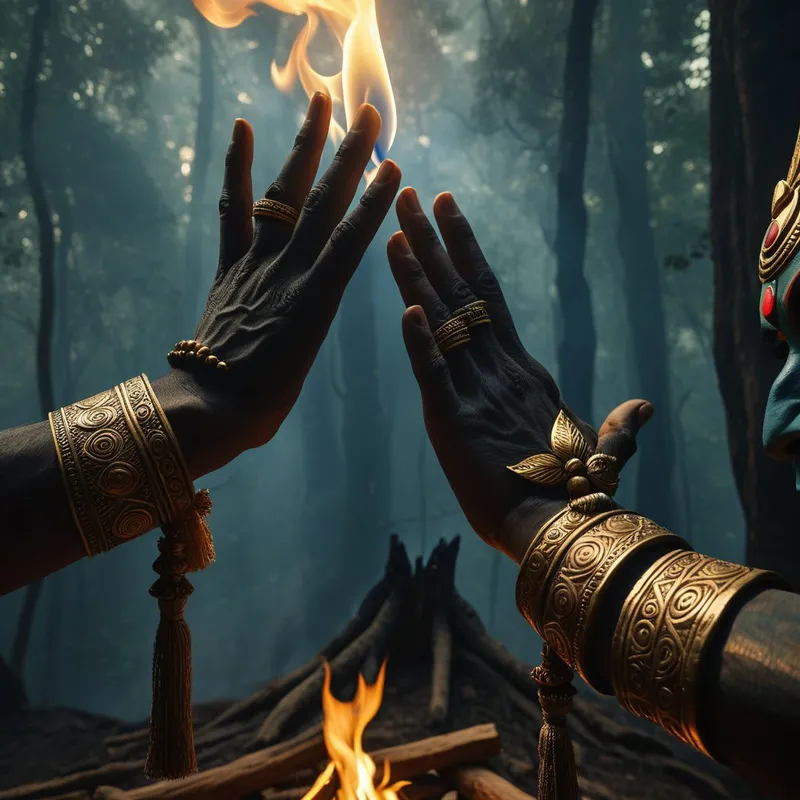
The myth of Gandiva is woven into the epic tapestry of the Mahabharata, a text of monumental scale and philosophical depth. Its origins are oral, passed down by generations of bards and storytellers (sutas) long before being codified in Sanskrit. This was not mere entertainment; it was the living memory, the theological discourse, and the moral compass of a civilization.
The story of Gandiva’s bestowal functions as a critical prelude to the central drama. It establishes Arjuna’s divine sanction and unparalleled capability. It is a myth of qualification. In a culture deeply structured by the concept of dharma and rightful duty, the weapon must choose the warrior as much as the warrior chooses his path. Gandiva’s transfer from Agni to Arjuna is a cosmic investiture, a ceremony where the human is handed a tool of such destructive and creative potential that its wielder’s character becomes a matter of universal consequence. The myth served to elevate the ensuing human conflict on the Kurukshetra plain to a cosmological event, reminding listeners that the struggles of kings and heroes were reflections of eternal struggles between order and chaos, duty and desire.
Symbolic Architecture
Gandiva is far more than a powerful weapon. It is a profound symbol of the soul’s ordained purpose and the terrifying responsibility that comes with supreme capability.
The divine instrument is not an extension of the ego, but a covenant with the cosmos. To grasp it is to accept that your personal will must now negotiate with a transpersonal mandate.
Psychologically, Gandiva represents the authentic vocation—that unique, potent skill or calling that feels both innate and bestowed, a “gift from the gods.” It is the artist’s vision, the healer’s touch, the leader’s charisma, operating at its highest pitch. Yet, the myth insists this gift is never free. It arrives, like Agni’s request, with a consuming demand. The Khandava forest that must burn symbolizes the dense, protected thickets of our own latent potential, our complacencies, and the old, sheltered parts of the psyche that must be sacrificed for the gift to be fully activated. The fight with Indra represents the inevitable conflict with internal and external authorities—the paternal voices of tradition, security, and conventional morality that may resist such a radical, purifying transformation.
The bow itself, a tool that channels tension into directed force, is the archetype of focused consciousness. The string is the taut line of intention, and the arrow is the decisive action born from that tension. Gandiva, therefore, symbolizes the psyche’s ability to hold immense tension—between opposites like compassion and duty, destruction and creation—and to release it with precision toward a goal aligned with a greater law.
The Dreamer's Resonance
When the pattern of the Gandiva myth stirs in the modern unconscious, it often manifests in dreams of being given a powerful, ancient, or technologically sublime tool. You may dream of receiving a key that unlocks everything, a pen that writes truth, or a device of impossible complexity that you somehow know how to operate. There is a somatic feeling of both awe and dread—a weight in the hands, a humming in the chest.
This dream signals a profound psychological process: the ego’s confrontation with its sacred contract. The dreamer is at a threshold where a latent, god-given talent or life-purpose is demanding recognition and use. The conflict is not about discovering the “bow,” but about accepting the conditions of its use. The accompanying anxiety (the “Indra’s rain”) often manifests as fear of success, fear of outstripping one’s family or social sphere, or a deep ambivalence about the destructive consequences such focused power might have on one’s current, comfortable life. The dream is the soul’s way of presenting the contract for signature, forcing the dreamer to ask: “Am I willing to burn my Khandava forest? Am I prepared to defend my calling against all internal and external opposition?”

Alchemical Translation
The journey of Gandiva models the alchemical process of psychic transmutation, where base personal ambition is refined into gold service to the Self (the totality of the psyche). It maps the heroic stage of individuation, where one moves from being a subject of fate to an agent of destiny.
The first operation is Calcinatio (burning): Agni’s hunger. This is the inner fire of discontent, a divine illness that demands the consumption of the old, lush, but ultimately confining forest of one’s immature identity. The second is Separatio (separation): Arjuna’s stand against Indra. One must differentiate one’s authentic calling from the internalized voices of the “father complex”—the shoulds, the expectations, the conventional paths that would water down one’s fire. The third is Coniunctio (sacred union): The lasting bond between Arjuna and Gandiva. This is the integration of the power into the personality, not as a possession, but as a partnership.
The ultimate alchemy is not wielding power, but being wielded by a purpose so grand it dissolves the illusion of the separate wielder.
For the modern individual, the myth instructs that true power is always in service to something greater than the self. The “war” we fight is not for personal glory, but for the establishment of inner and outer dharma—right order. Our “Kurukshetra” is the daily battlefield of choices where we must aim the arrow of our unique capability with clarity and detachment. To hold Gandiva is to understand that your greatest gift is also your most solemn debt to existence, and in repaying that debt through conscious, disciplined action, you complete the circuit of the divine, returning the borrowed fire to the cosmos from whence it came.
Associated Symbols
Explore related symbols from the CaleaDream lexicon: