The Inner War: A Blueprint for Psychological Sovereignty
The Somatic Echo
Before the mind conjures images of trenches or artillery, the body knows. It is a low-frequency hum in the marrow, a tectonic pressure building along the fault lines of the psyche. The breath becomes shallow, held in the chest like a soldier on watch. Muscles, even in sleep, brace for an impact that has no physical source. This is the somatic echo of inner warfare—not a call to arms, but a profound signal that a long-held internal ceasefire has broken. The territory of the self is being contested. Old treaties of suppression, signed in the ink of fear or obligation, are being torn apart by a rising faction of disowned truth. The body registers this not as metaphor, but as physics: a system under the strain of reconciling irreconcilable parts.
The Dreamer's Log
She finds herself in the command center of a vast, silent war. Screens flicker with tactical data she cannot read. The enemy’s designation is blurred, their location unknown, yet a profound, chilling certainty of threat permeates the sterile air. Her orders are to hold the line at all costs, but she has forgotten what the line protects, or why she is fighting.
This dream is the psyche’s command to cease automated defense and interrogate the source of the perceived threat—to discover what ancient, exiled part of the self is now demanding recognition.

The False Lead
A dream of warfare is not a prophecy of external conflict or a simple release of daily stress. To interpret it as a prediction of an argument or a bad day is to mistake the earthquake for the tremor. This is not about the skirmishes of ego; it is about the civil war of the soul. It does not signify mere "bad luck" or an aggressive personality. The conflict is structural, not situational. It is the sound of the foundational pillars of a constructed identity groaning under the weight of an expanding consciousness. The enemy, therefore, is never truly "out there." The enemy is the internal garrison that refuses to surrender outdated laws, the shadow militia fighting to maintain a familiar, yet crumbling, kingdom of the self.
Psychological Architecture
This is the Shadow work of sovereignty. When warfare erupts in the dreamscape, it signals that the process of Individuation—the conscious integration of the total self, light and shadow—has moved from theory into lived, visceral experience. You are no longer politely discussing your contradictions over tea; you are feeling them mobilize into opposing factions within. One army may represent the rigid, ruling ego-complex: the inner Ruler who maintains order through control, tradition, and suppression. The opposing force is often a coalition of the repressed: the orphaned creativity, the rebellious desire, the lover’s neglected passion, the sage’s forbidden questions.
This is not a dysfunction, but a function of profound health. The psyche is architecting a more complex, resilient structure, and the old, simpler foundation must be dismantled. The terror of the dream is the terror of the demolition crew arriving. The grief is for the familiar edifice that must fall. You are not falling apart; you are being re-membered, piece by contested piece, into a sovereign whole.
Mythic Resonance
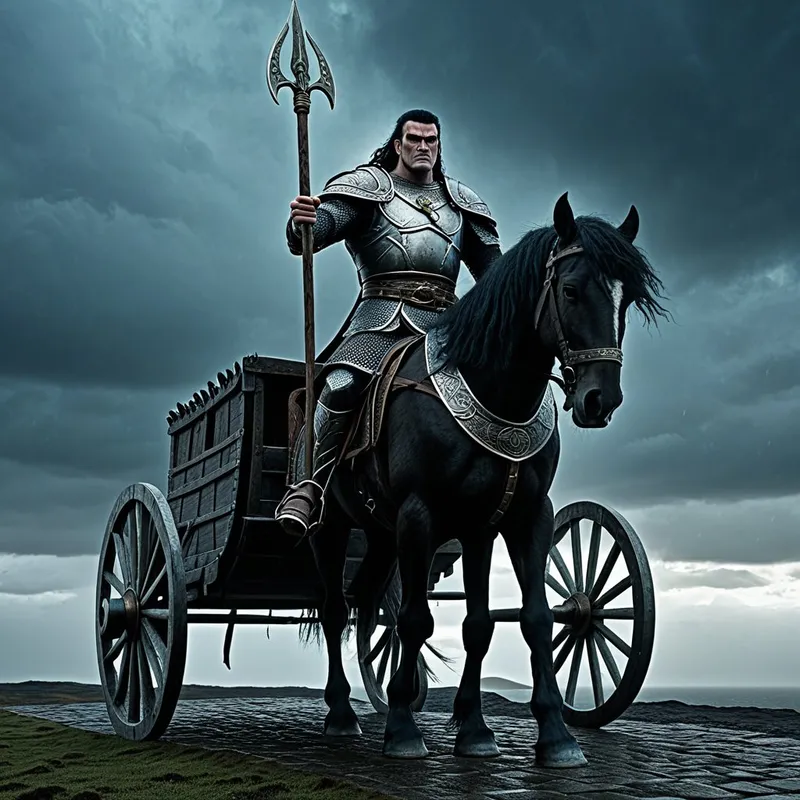
We see this eternal process in the Norse myth of Ragnarök, not merely as an apocalyptic end, but as a necessary, cyclical dissolution. The gods, representing established cosmic order and conscious values, face the chaotic, primal forces of the giants and monsters—the collective shadow. The world tree itself shakes. This is not a myth of good versus evil, but of one state of being necessarily consuming itself to birth another. The old world, with all its treaties and hierarchies, must be razed so the new, fertile earth can emerge from the sea. Your dream is your personal Ragnarök, the cataclysm that precedes renewal. Similarly, the alchemical stage of Nigredo, the blackening, speaks not of despair but of the essential first step: the breakdown of composite matter into its base components, so true transmutation can begin. The battlefield is your Nigredo.
Symbolic Nodes
- Trenches & Fortifications: Psychological defenses, entrenched patterns, emotional bunkers.
- Maps & Strategies: The ego's attempt to rationalize and control the uncontrollable inner process.
- Fog of War: The conscious mind's confusion, the unclear nature of the internal conflict.
- Unknown/Blurred Enemy: The projected shadow, aspects of the self so disowned they are unrecognizable.
- Silent Weapons/Explosions: Suppressed emotions (anger, grief, passion) detonating in the unconscious.
- Broken Communications: The dissociation between the heart, the gut, and the head.
- Abandoned Battlefields: Past inner conflicts that were never resolved, only fled from.
Archetypal Resonance
The energy most active in the theme of warfare is The Shadow Ruler.
The core of the warfare dream is the crisis of a governing principle. The Shadow Ruler archetype manifests not as a wise sovereign, but as the internal tyrant, the control-freak, the martinet of the psyche who maintains a fragile order through sheer force of will, suppression, and fear. Its somatic echo is that clenched jaw, that held breath, that rigid posture—the body held in a state of militarized alert. This archetype goes to war to protect its kingdom: the ego's constructed identity, its rules, its "shoulds." The alchemical potential lies in the battle itself, for the conflict forces the Shadow Ruler to confront the very chaos it seeks to dominate. Through the heat of this inner war, the tyrannical need for absolute control can be transmuted into the authentic sovereignty of the integrated Ruler—one who governs not by suppression, but through wise negotiation with all parts of the self.
The Alchemical Process
The alchemical transmutation here is from Fragmentation to Sovereign Integrity. The required heat and pressure are generated by one act: sustained, non-judgmental observation of the conflict. This is the solve et coagula—dissolve and recombine—applied to the psyche. You must allow the war to rage within your awareness without immediately taking a side, without rushing to broker a false peace. This conscious holding of the tension is the crucible. It feels like madness. It is the grief of watching cherished parts of your self-concept be wounded, the terror of the unknown outcome.
In this white-hot space, a miracle occurs. As you witness the "enemy" with curiosity rather than fear, its demonic mask begins to dissolve. The rebellious force reveals itself as a lost creative impulse. The invading army shows the banner of a neglected core need. The bombardment is the pounding demand of your authentic life to be lived. The transmutation is not the victory of one side, but the birth of a diplomatic council within. The energy once spent on internal warfare becomes the power for conscious, sovereign action in the world.

The Integration Protocol
Question 1: If the "enemy" in my dream could speak, what one sentence does it most need my conscious self to hear?
Question 2: What familiar, comfortable territory within me (a belief, an identity, a habit) is the "war" threatening to overrun or destroy?
Question 3: Where in my waking life do I feel the same somatic echo—that bracing, that vigilance—as I felt in the dream? What is the perceived threat there?
Action 1 (Somatic Ceasefire): For three minutes upon waking, place your hands on your solar plexus and heart. Breathe deeply into the places that feel braced or tight. Do not try to relax them; simply send breath there, as an observer visiting a tense border. Acknowledge the alertness without fueling it.
Action 2 (Cartography of Conflict): Create a simple, abstract drawing or diagram of the battle. Use colors, shapes, and lines—not literal figures. Let one color/shape represent the "defending force" (the status quo) and another the "attacking force" (the change). Where are the boundaries? Is there a no-man's-land? Place this drawing where you can see it for a day, observing it without analysis.
Action 3 (Treaty Drafting): Write two short statements. First, from the perspective of the "defending force," state its primary fear and its core positive intention (e.g., "I fear chaos and my intention is safety."). Second, from the "attacking force," state its primary frustration and its core positive intention (e.g., "I am frustrated by stagnation and my intention is liberation."). Read them aloud together. This is the first draft of your inner peace accord.
Final Validation
This is hard, sacred work. To feel besieged by your own soul is a profound and lonely terror. Honor the fatigue. The dream does not come to break you, but because you are already strong enough to hold the contradiction. You are not a battlefield; you are the sovereign territory being made whole. The conflict is the evidence of your growth, the labor pains of a more authentic self. The integration of this war is what forges unshakable inner authority—the peace that comes not from the absence of conflict, but from the capacity to hold it all within your boundless, witnessing sky.