Abstract & Philosophy

Microcosm Dream Meaning

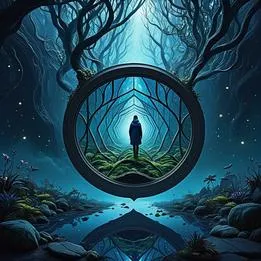
A small, self-contained system that mirrors or represents a larger, more complex whole, often reflecting the universe within an individual.

Common Appearances & Contexts

Context Emotion Interpretation
Tiny world Wonder Discovering inner vastness.
Miniature ecosystem Peace Personal harmony achieved.
Shrinking self Anxiety Feeling insignificant, overwhelmed.
Expanding room Awe Inner world limitless.
Nested boxes Confusion Layers of self.
Mirror universe Clarity Self reflects cosmos.
Model solar system Nostalgia Childhood understanding returns.
Terrarium breaking Fear Fragile self-containment.
Ant farm Detachment Observing own patterns.
Snow globe Isolation Separate but complete.
DNA strand Awe Blueprint of existence.
Clockwork mechanism Fascination Order within chaos.

Interpretive Themes

Cultural Lenses

Jungian Perspective

View Context →

Represents the individuated Self as a complete universe, integrating conscious and unconscious elements. The microcosm reflects the archetypal structure of the psyche, where personal experiences mirror universal patterns.

Freudian Perspective

View Context →

Symbolizes condensed representation of the dreamer's entire psychosexual development. The microcosm compresses childhood memories, desires, and conflicts into a single symbolic scene for analysis.

Gestalt Perspective

View Context →

The whole person represented in miniature. Every element of the microcosm represents an aspect of the dreamer's current experience, with the configuration revealing unfinished business or integration needs.

Cognitive Perspective

View Context →

Mental model of the dreamer's worldview. The brain creates simplified representations of complex reality during sleep to process information, solve problems, or consolidate memories through symbolic compression.

Evolutionary Perspective

View Context →

Adaptive simulation for threat assessment and social navigation. Dreaming of microcosms allows safe exploration of scale relationships, hierarchy dynamics, and environmental patterns crucial for survival.

Global/Universal Perspective

View Context →

Ancient concept found worldwide: 'as above, so below.' From Hermeticism to Taoism, the idea that individual lives reflect cosmic patterns appears in mystical traditions across continents as fundamental wisdom.

East Asian Perspective

View Context →

In Daoist and Buddhist thought, the body is a microcosm of the universe with correspondences between organs and elements. Traditional Chinese medicine uses this for diagnosis, seeing illness as cosmic imbalance.

South Asian Perspective

View Context →

Hindu and Jain philosophies describe the atman (individual soul) as identical to Brahman (cosmic soul). Mandalas and yantras are ritual microcosms used for meditation to realize this unity through geometric patterns.

Middle Eastern Perspective

View Context →

Sufi mysticism sees the human heart as microcosm containing divine attributes. Islamic architecture often features geometric patterns representing cosmic order, with mosques designed as microcosms of paradise.

European Perspective

View Context →

Renaissance alchemy and Hermeticism popularized microcosm-macrocosm correspondence. Medieval cathedrals were built as microcosms, with architectural elements symbolizing heavenly hierarchy and earthly order in Christian cosmology.

African Perspective

View Context →

Many traditions view the community as microcosm of ancestral and natural worlds. Ritual masks and sculptures often contain cosmic symbols, representing the interconnectedness of human, spirit, and animal realms.

Modern Western Perspective

View Context →

Digital age reinterpretation through simulations, virtual worlds, and quantum physics. The holographic principle suggests the universe may be encoded on its boundaries, making every part contain the whole.

AI-Powered

Interpret Your Full Dream

Beyond this symbol, every dream carries a unique story. Share your dream for a personalized AI-powered interpretation.