The Immortal Echo: When Dreams Demand You Live Forever
The Somatic Echo
It begins not as a thought, but as a density. A weight in the marrow of your long bones, a cold, metallic taste at the back of the tongue that has nothing to do with food. It is the feeling of a horizon that never curves, of watching a tide come in that you know will never, ever recede. This is the visceral signature of the immortality dream: a profound, cellular ambivalence. There is a terrifying grandeur in it, a swelling of the chest that whispers of infinite potential, immediately countered by a deep, sinking dread in the gut—the claustrophobia of a sentence without end. The body knows, long before the mind articulates it, that eternity is not a gift, but a condition. It is the somatic echo of the psyche brushing against the ultimate boundary, and finding it both a prison wall and a vanishing point.
The Dreamer's Log
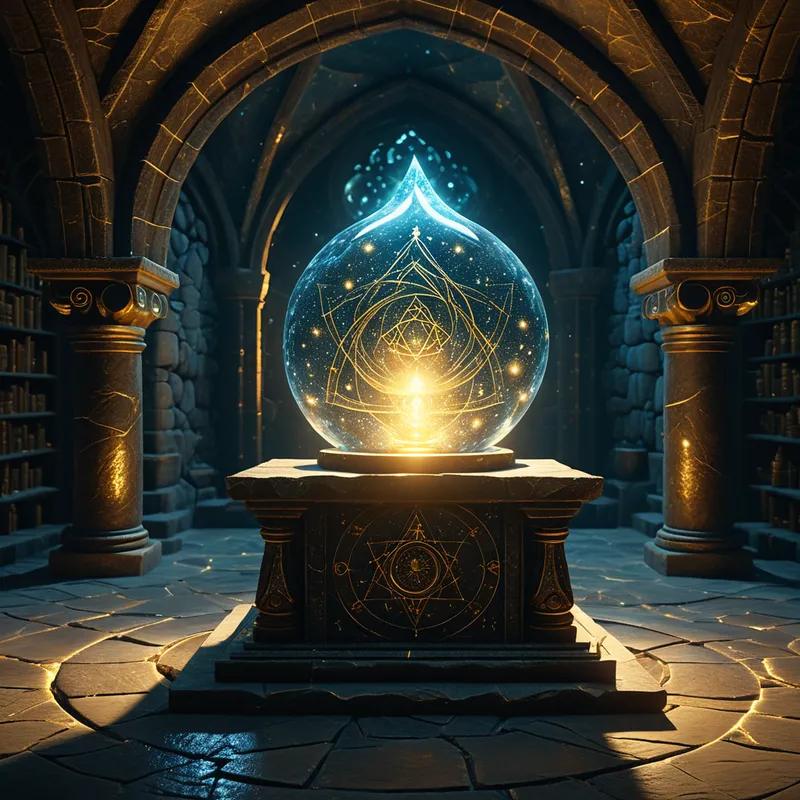
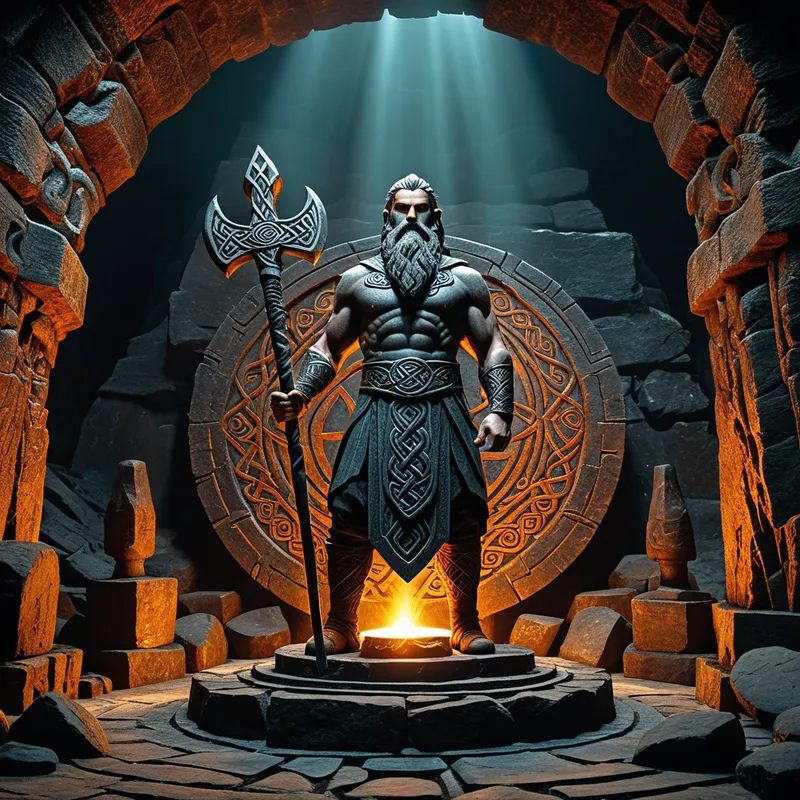
I stood in a vast, silent library of black stone. The only book was a single, heavy tablet on a pedestal. As I touched it, my name etched itself into the surface in glowing script. I understood, with absolute certainty, that this tablet would exist unchanged, bearing my name, long after the stars had burned to ash. A profound, lonely grief filled me.
This dream is not a fantasy of conquest, but an alchemical vision of the ego’s signature fossilized—a record of a self that refuses the necessary dissolution required for true transformation.

The False Lead
Do not mistake this theme for a simple fear of death, or its opposite, a naive wish for eternal youth. Those are surface ripples. The dream of immortality is not about evading the grave; it is about confronting the terror of psychological dissolution. It is the part of you—often a rigid, managerial aspect of the psyche—that mistakes permanence for safety, that would rather be a fixed, lonely monument than a flowing, anonymous river. It is the shadow of the Creator, desperate to leave a final, unchangeable mark, fearing that to be forgotten is to have never existed at all. This dream is a signal that you are clinging to an identity, a story, or a pain that has outlived its purpose, confusing its endurance with your worth.
Psychological Architecture
To dream of immortality is to stand at the precipice of the most profound Shadow work: the dismantling of the ego’s central project. The ego’s prime directive is continuity. It builds a citadel of personality, history, and achievement, and calls it “I.” The immortality dream is this citadel dreaming of itself as a pyramid—eternal, impenetrable, and utterly, desolately empty.
The individuation process here is one of brutal, graceful surrender. It asks you to differentiate the Self—the timeless, central, and paradoxically ever-changing core of your being—from the ego—the time-bound character you play. The dream exposes the grief at the heart of the ego’s ambition: to make itself permanent is to sever itself from the cycle of life-death-rebirth that is the very pulse of the psyche. The work is to hold that grief, to feel the orphaned part that believes it will be annihilated if it changes. You are not asked to kill this part, but to witness its terrified strategy of building forever, and to offer it the incomprehensible truth: you are more vast than what can be recorded. Your essence is not in the signature, but in the hand that signs, and the hand dissolves back into the universe from which it came.
Mythic Resonance
We see this architecture in the fate of the Sibyl of Cumae in Greco-Roman myth. Granted immortality by Apollo, she forgot to ask for eternal youth. She shriveled into a tiny, ancient voice, kept in a jar, her endless life becoming a curse of endless decay. Her myth is not a warning about making bad wishes, but a precise map of the psychological state: the desire for pure, unchanging consciousness (immortality) without the rejuvenating, embodying force of the life instinct (eternal youth) leads to a living death, a consciousness trapped in its own rigid vessel. Similarly, the Buddhist parable of the skandhas—the five aggregates that form the illusion of a permanent self—teaches that the thirst for immortality is the very root of suffering. It is the clutch at a mirage of solidity, while reality is a flowing process. The dream arrives to initiate you into this flow.
Symbolic Nodes
- Indestructible or self-repairing objects (diamond bones, metal skin, unbreakable glass).
- Witnessing cosmic endings (the sun dying, continents sinking) while remaining unchanged.
- Signing a contract in blood or light that has no expiration.
- Being turned to stone, crystal, or statue.
- A clock with no hands, or a hourglass where the sand never falls.
Archetypal Resonance
The Shadow Creator is the archetypal engine of this dream. The Creator’s divine impulse is to bring form from chaos, to leave a mark upon the void. In its shadow aspect, this impulse curdles into a desperate, rigid need for a legacy—not as an organic expression of life, but as a bulwark against death. The somatic echo of cold, metallic permanence is the Shadow Creator’s artifact: a self sculpted not for joy or expression, but for endurance. Its alchemical potential lies in the fire of this realization. The heat of the dream’s grief can melt the rigid artifact back into raw, creative potential, transforming the need to be remembered forever into the courage to create fully now, knowing the creation, and the creator, are fleeting parts of a beautiful, endless process.
The Alchemical Process
The alchemy of immortality is the transmutation of chronos (linear, quantitative time) into kairos (the qualitative, right moment). The base metal is the leaden fear of ending; the philosopher’s gold is the capacity for total presence.
The nigredo, the blackening, is the dream itself—the confrontation with the terrifying, grief-stricken truth of the ego’s project. The heat is applied in the waking contemplation of your own mortality, not as morbid fixation, but as the most vitalizing pressure imaginable. It is the pressure that forces differentiation: “Is this what I am, or is this just what I’ve been carrying?” The albedo, the whitening, is the mourning for the immortal self you thought you needed to be. You wash it with the tears of letting go. The final rubedo, the reddening, is not the achievement of eternity, but the embodiment of the eternal now. It is the sovereign act of living from the Self, which is both unique and utterly disposable, precious and completely participatory. You stop building your pyramid and start dancing in the fleeting meadow. The permanence you sought is found in the depth of your engagement with the impermanent.

The Integration Protocol
Question 1: What part of my identity or story feels so fundamental that its loss would feel like my own annihilation? Can I feel the fear in that part?
Question 2: If I knew I had only one year to live, what rigid structure in my life (habit, relationship, belief) would I immediately stop maintaining or defending?
Question 3: Where in my life am I already experiencing moments of kairos—timeless, fully-absorbed presence? What allows that state to emerge?
Action 1 (The Dissolving Signature): Take a pen and paper. Write your full name, slowly and deliberately. Then, with a wet brush or your finger, slowly blur and dissolve the ink of your name until it is an abstract stain. Sit with the feeling that arises.
Action 2 (Ephemeral Artifact): Go into nature and create a small, intricate, beautiful sculpture or arrangement using only found materials (leaves, stones, twigs). Photograph it, then walk away and leave it to the wind and rain. Do not return to check on it.
Action 3 (The Mortality Altar): Create a small, private space with a candle. Place there one object that represents something you have outgrown or released (an old photo, a letter, a token of a past role). Light the candle and, aloud, thank this former self for its service and state your permission for it to dissolve. Extinguish the candle. Keep the object for a week, then dispose of it respectfully.
Final Validation
The loneliness you felt in that dream of endless stone is real. The part of you that wants to last forever is not foolish or vain; it is a terrified child of consciousness, trying its best to secure a foothold in the infinite. Honor its fear. And then, gently, introduce it to the deeper truth: you are not here to endure. You are here to blaze. Sovereignty is not found in defying time, but in marrying it so completely—moment by fragile, magnificent moment—that when the end comes, it feels not like a theft, but like a natural, final note in a song you finally learned to sing with your whole, dying, immortal heart.