The Land of Youth Myth Meaning & Symbolism
A warrior journeys to an immortal paradise but is undone by a longing for home, revealing the soul's eternal conflict between transcendence and belonging.
The Tale of The Land of Youth
Listen now, and let the hearth-fire grow low. Let the world outside the ráth fade to a murmur. I will tell you of a time when the borders were thin, when the sea was not a barrier but a road, and when a woman from the Otherworld came riding on a horse whiter than sea-foam.
Her name was Niamh Chinn Óir, Niamh of the Golden Hair, and she rode from the west where the sun sinks into the ocean’s cup. She came to the hall of the Fianna, to their greatest poet and warrior, Oisín. The air around her shimmered with the scent of apple blossoms in a land without winter. “Oisín,” she said, her voice the sound of a distant bell, “I have come for you. I offer you a land where time does not bite, where sorrow is unknown, where feasting, music, and joy are as constant as the tide. It is Tír na nÓg, and I would have you be its king by my side.”
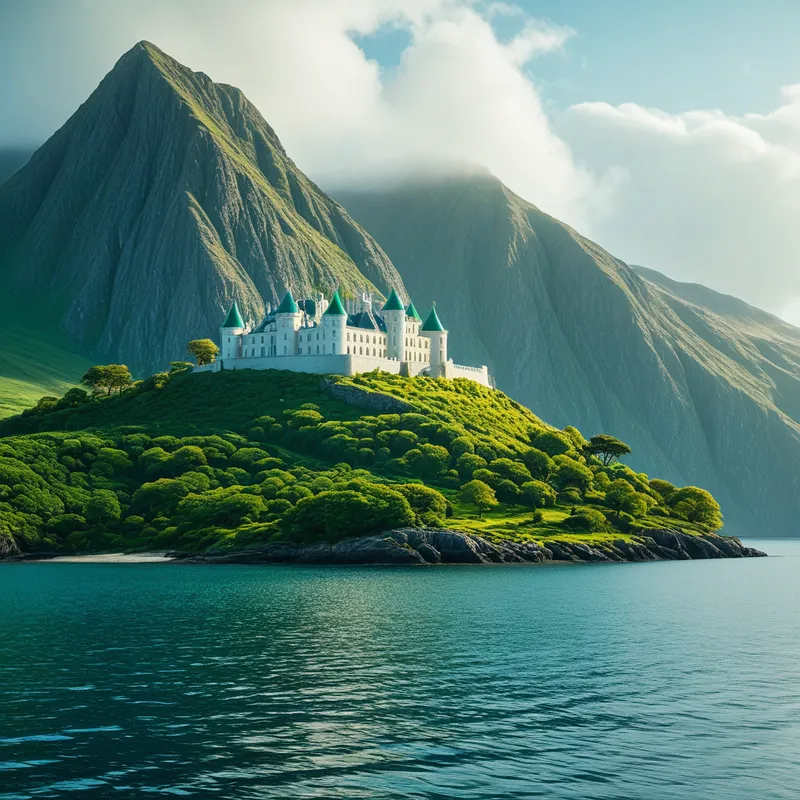
Oisín, whose heart was as brave as it was tender, looked into her eyes and saw a promise deeper than any he had known. He mounted the white steed behind her, and they turned towards the setting sun. The horse’s hooves did not touch the waves but galloped upon them as if they were solid ground. They passed through a luminous mist, a curtain between the worlds, and emerged into a light that had no shadow. Here, the grass was eternally emerald, the trees heavy with fruit that knew no rot, and the people fair and laughing, their bodies untouched by age or decay. For three hundred years, by the counting of that land, Oisín lived in bliss. He feasted, he hunted strange and gentle beasts, he composed poetry for Niamh, and he thought not a single thought of Ireland.
But a seed, small and hard, began to grow in his heart. It was a longing, a memory of the rough heather of the Irish hills, the sound of his father Fionn’s horn, the camaraderie of the Fianna around a campfire. A homesickness for mortality itself began to ache within his immortal breast. He told Niamh of his desire to see his homeland once more. Her eyes, usually bright as stars, clouded with a sorrow she had never known. “If you set foot on the soil of Ireland,” she warned, “the weight of all the years you have not aged will fall upon you in an instant. You will become a withered old man, and you can never return to me.”
She gave him the white steed, with one unbreakable condition: he must not dismount. Not once. He could look, he could call out, but he must remain in the saddle that bridged the worlds. Oisín promised, and the horse carried him back across the sea. He found an Ireland changed, smaller, stranger. The forts of the Fianna were grassy mounds. The people seemed like children, and when he spoke his father’s name, they knew it only as a legend from a distant past. Despair gripped him. Riding through a glen, he saw a group of men struggling to lift a great stone slab. Moved by the old warrior’s code of his people, he leaned from his saddle to help them. The girth broke. Oisín tumbled from the horse, and his body hit the earth of Ireland.
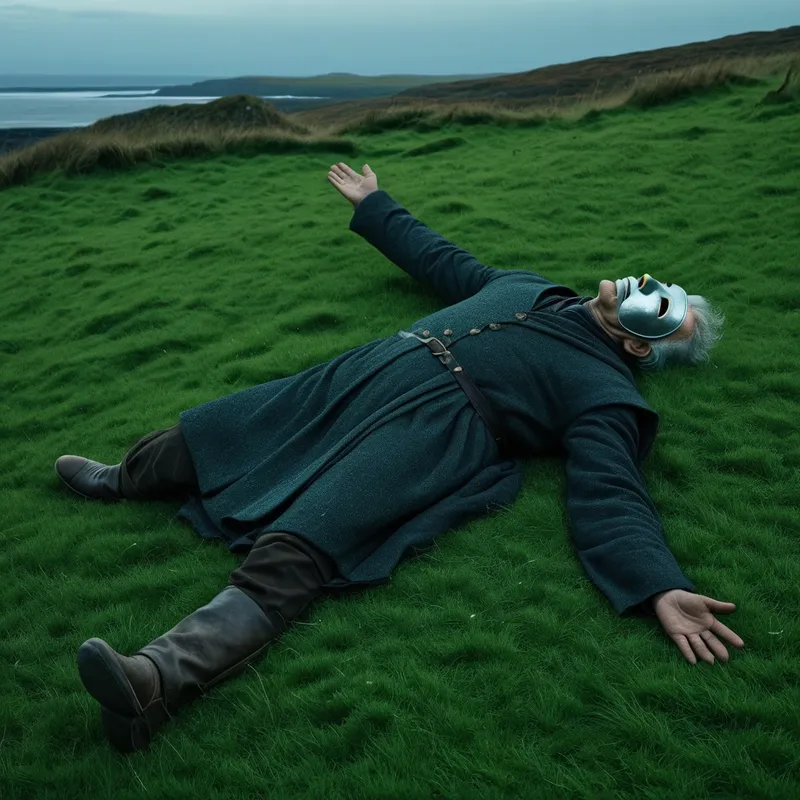
The centuries descended. In the blink of an eye, the mighty warrior shrank and withered, his skin becoming parchment, his muscles dust, his bright eyes dimming. The white horse screamed, wheeled, and vanished back towards the west. Oisín, now a blind, ancient man, was left alone on the grass, having touched the paradise of eternal youth only to be shattered by the immutable gravity of time and memory.
Cultural Origins & Context
This poignant tale is part of the Ossianic Cycle, surviving in manuscripts like The Book of the Dean of Lismore and The Duanaire Finn. It is a late, literary flowering of a much older Celtic worldview. The Celts did not believe in a linear, terminal end to life but in a cyclical movement between this world and the Otherworld. Tír na nÓg is one of many names for this realm—others include Tír Tairngire and Mag Mell.
The myth was not mere entertainment; it was a metaphysical map. Bards and filí (poet-seers) recited these stories to affirm a reality where death was a door, not a wall. The voyage to the Otherworld, often via a sea journey to the west (the direction of the setting sun and the realm of the dead), was a central motif. The story of Oisín and Niamh served as a beautiful, tragic meditation on the price of transcendence and the powerful, defining pull of earthly belonging and lineage. It explained the presence of ancient ruins in the landscape as echoes of a greater, lost age, and it framed the hero’s journey not as a conquest, but as a transformative encounter with a different order of time.
Symbolic Architecture
At its core, the myth is a profound exploration of the soul’s impossible dilemma. Tír na nÓg represents the unconscious in its pristine, pre-personal state—a paradise of undifferentiated bliss, where the complexes of ego, time, and loss do not exist. It is the womb, the primordial garden, the state of psychic inflation where one is united with the archetypal Anima (Niamh) and feels godlike.
The Land of Youth is the soul's memory of wholeness before the fall into time, a siren call to abandon the difficult work of becoming an individual.
Oisín’s fatal return is not a mistake, but a necessary, if devastating, completion. His homesickness is the call of the ego, of history, of the personal father (Fionn), and of the shadow—all that is mortal, flawed, and real. The white horse is the psychopomp, the vehicle of consciousness that can traverse realms but cannot make them compatible. The moment Oisín touches the earth is the moment of incarnation, where the timeless archetype crashes into the temporal reality of the body. His aging is the instantaneous acquisition of the life experience he bypassed.
The Dreamer's Resonance
When this myth stirs in the modern psyche, it often manifests in dreams of paradoxical landscapes. One may dream of finding a perfect, silent city of light, only to feel a creeping, inexplicable anxiety there. Or they may dream of desperately trying to return to a childhood home that has become alien and unrecognizable. These are dreams of alienation from paradise.
Somatically, this can feel like a deep, inconsolable nostalgia for something one has never actually known—a longing for a "home" that exists only in the soul. Psychologically, it signals a critical juncture in the process of individuation. The dreamer may be in a state of "spiritual bypass," using transcendence, enlightenment, or idealistic fantasies (their personal Tír na nÓg) to avoid the messy, aging, grieving, human work of integrating their personal history and shadow. The dream is a warning from the Self: you cannot stay in the perfect garden. Your wholeness requires your history.
Alchemical Translation
The alchemical journey mirrored in this myth is the solve et coagula—dissolve and coagulate. Oisín’s journey to Tír na nÓg is the solve: the dissolution of the mortal ego into the boundless waters of the unconscious, a blissful union with the archetypal feminine. But this is only half the work. It is spiritual gold that remains projected, out in the Otherworld.
The true philosopher's stone is not found in the eternal land, but forged in the return to the mortal one, where timeless gold is tempered by time's lead.
The coagula, the crucial re-solidification, is the return. It is the descent of the spirit back into the body, the incarnation of insight into daily life. Oisín’s tragedy is that he attempts the return without conscious integration; he is shattered by it. The alchemical lesson for the modern individual is that we must make the return consciously. We must voluntarily take on the weight of our years, our memories, our failures—the "age" that we would rather transcend. We must touch the ground of our own reality, our own personal Ireland with all its changes and losses. Only by embracing that mortality, that specific, time-bound story, can the gold of the transcendent experience be made real and durable within the soul. The paradise is not lost; it is transformed from a place we visit into a quality of being we embody, now, in this aging, beautiful, and fleeting world.
Associated Symbols
Explore related symbols from the CaleaDream lexicon: