Mid-Autumn Festival Myth Meaning & Symbolism
A celestial archer, a stolen elixir, and an eternal lunar exile weave a timeless myth of love, sacrifice, and the bittersweet nature of wholeness.
The Tale of Mid-Autumn Festival
Listen, and let the cool, silver light of the fullest moon wash over you. Once, the sky held not one sun, but ten—ten blazing sons of the Jade Emperor. They took turns crossing the heavens, but in their youthful arrogance, they decided to race together. The world below baked and cracked. Rivers boiled to steam, forests became tinder, and the people cried out in despair.
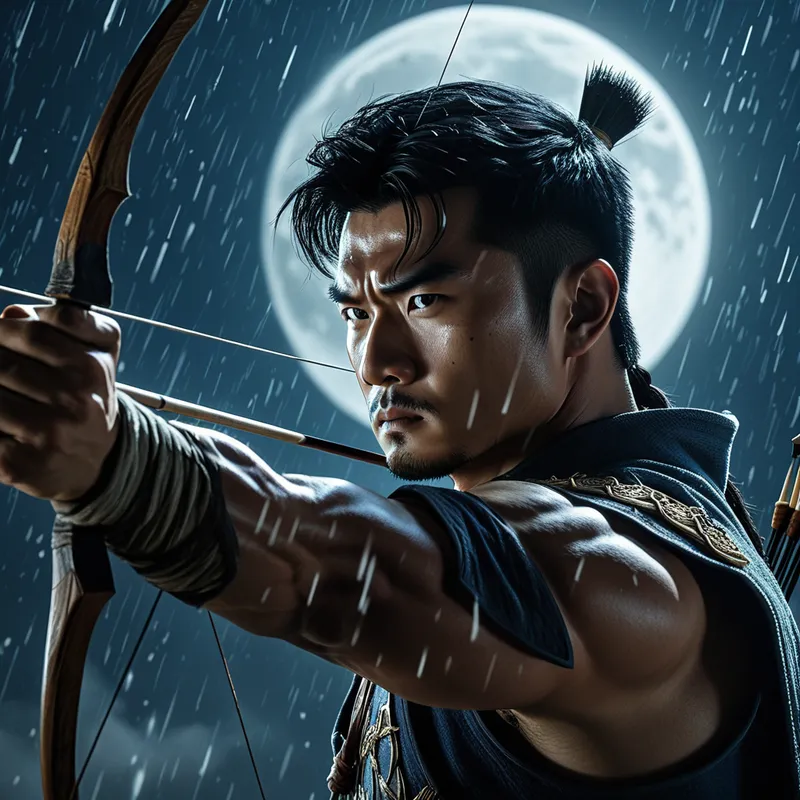
From among them rose a man of peerless skill and courage, Hou Yi. His heart was a forge of compassion, tempered by the suffering he witnessed. Taking up his divine bow, crafted from dragon tendon and phoenix bone, he climbed the highest peak, Kunlun Mountain. One by one, his arrows, like threads of shadow, pierced the heart of the celestial infernos. Nine suns fell, extinguished, leaving the sky to the one who knew his duty. The world sighed in relief, and the Jade Emperor, in recognition—or perhaps in hidden wrath—granted Hou Yi a gift: a single pill of Xian Dan, the Elixir of Eternal Life.
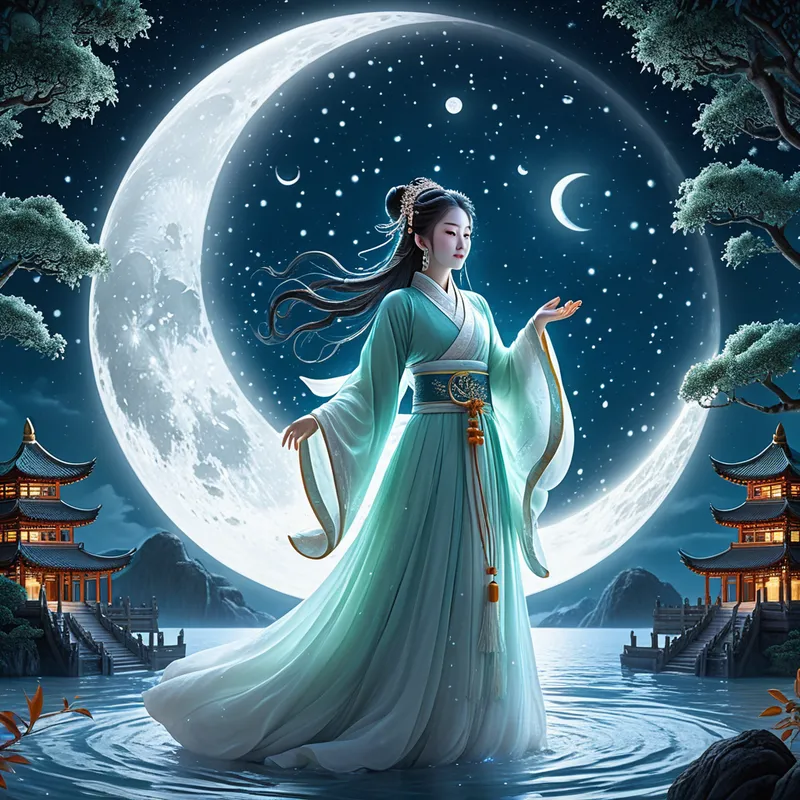
But immortality is a lonely road. Hou Yi chose mortality, chose a life of shared seasons with his beloved wife, the beautiful and gentle Chang'e. He hid the elixir, a pearl of condensed moonlight, within their home. Yet, fate is a thief in the midday sun. While Hou Yi hunted, his envious apprentice, Feng Meng, came to steal the prize. Cornered, with the villain's shadow at the door, Chang'e faced an impossible choice: let the elixir fall into wicked hands, or consume it herself.
She chose the moon.
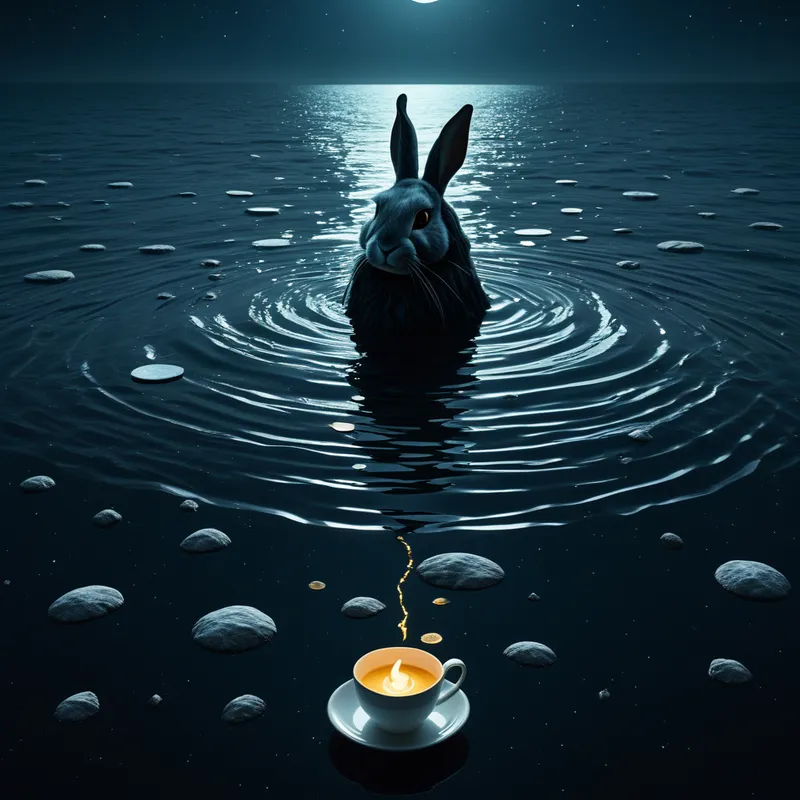
The pill dissolved on her tongue like winter frost. Her feet lifted from the earth, her body becoming light as a sigh. Out the window she floated, drawn upwards, a leaf on the river of the night sky, past the clouds, past the stars, towards the cold, waiting disc of the moon. There, she alighted, her mortality shed, her humanity now a celestial burden. In her new palace of jade and moonlight, she was joined only by a Jade Rabbit, who forever pounds herbs with a mortar and pestle, a futile effort to compound another elixir for a return journey that can never be.
And Hou Yi? He returned to an empty home, a silent sky, and the cruel, beautiful eye of the moon staring down. He built an altar, laid out her favorite fruits and sweet cakes, but the distance was infinite. On the fifteenth night of the eighth lunar month, when the moon is most round, most full, most like a mirror, it is said you can still see her shape there—the goddess in her exile, the lover in her prison, forever close, forever apart.
Cultural Origins & Context
The myth of Chang'e and Hou Yi is not a single, canonical text, but a living story that has evolved over millennia, with roots stretching back to the Shang Dynasty divinations and the poetry of the Zhou. It was woven into the fabric of Daoist cosmology, which richly populated the heavens with immortals and palaces. The story was passed down not by a single bard, but by generations of grandmothers pointing at the moon, by poets sighing over separation, and by imperial courts conducting elaborate Moon Sacrifices.
Its societal function was multifaceted. It explained a celestial phenomenon, giving personality and narrative to the moon's markings. It reinforced core values: Hou Yi's heroism embodied selfless service, while Chang'e's act was a tragic defense of cosmic order against chaos (represented by Feng Meng). Most importantly, it provided an emotional and ritual container for the universal human experience of separation and the longing for reunion. The Mid-Autumn Festival itself, with its family gatherings and moon-viewing, became the cultural ritual to actively counteract the myth's sadness, transforming cosmic loneliness into communal intimacy under the same, shared moon.
Symbolic Architecture
At its heart, this is a myth of impossible wholeness. The moon, eternally cycling from crescent to full, is the perfect symbol of completion and fragmentation. Chang'e and Hou Yi represent a primal unity—the Archer (active, solar, protective) and the Goddess (receptive, lunar, nurturing)—that has been catastrophically split.
The elixir is not merely immortality; it is the unbearable weight of ultimate consciousness, of a choice that separates one from the fabric of ordinary, connected life.
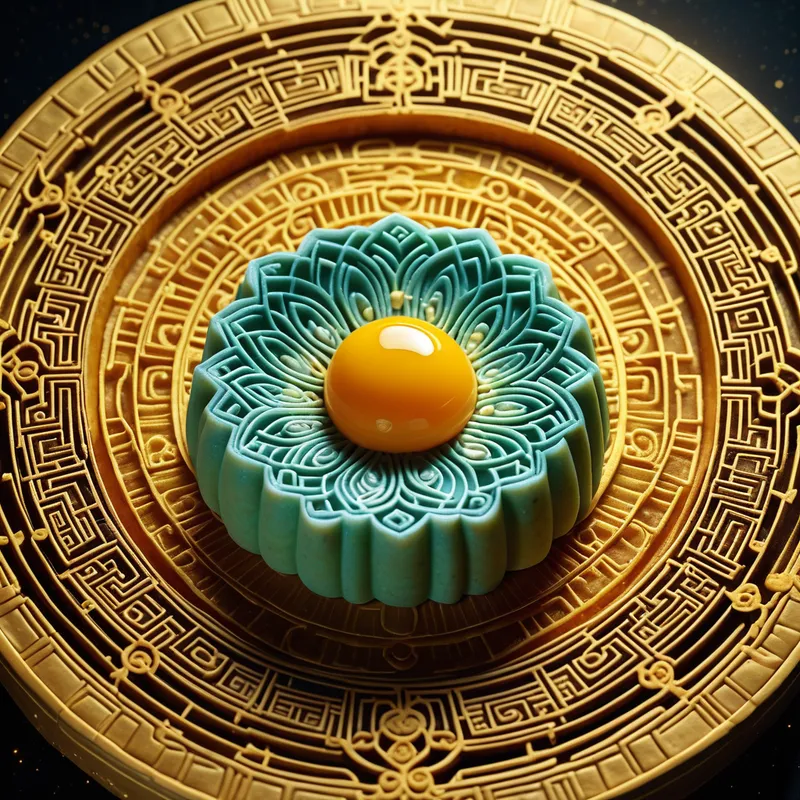
Chang'e's consumption of the elixir is not greed, but a sacrificial ingestion of a fate meant for two. Her exile is the psychological state of carrying a consciousness or a burden that isolates. The moon is not a palace, but the anima mundi—the world soul—where the repressed, the sacred, and the lost parts of ourselves reside, visible but untouchable. The Yuebing eaten during the festival are more than sweets; they are symbolic mandalas, round like the full moon, often cut and shared, enacting the ritual of dividing and re-integrating the wholeness we celebrate and mourn.
The Yutu is a profound symbol of endless, devoted labor in the face of eternity. It does not seek glory like Hou Yi or bear tragic beauty like Chang'e; it simply works, a testament to the humble, ongoing process of tending to the impossible task of healing an irreparable rift.
The Dreamer's Resonance
When this myth stirs in the modern unconscious, it often surfaces in dreams of poignant distance. To dream of a brilliantly full moon that feels both beautiful and sad, of calling out to someone on a far shore who cannot hear you, or of finding a precious, glowing object that you must hide or consume—these are somatic echoes of the Chang'e pattern.
The dreamer may be psychologically navigating a necessary but painful separation: the end of a relationship, a move far from home, or the internal feeling of being "set apart" due to a personal truth, a trauma, or a responsibility they alone carry. The body might feel weightless yet heavy, cold, or suspended. This is the somatic signature of the elixir—a transformation that grants a kind of awareness (immortality) but at the cost of earthly connection (mortality). The dream is not pathological; it is the psyche mapping its own exile, making visible the cost of a choice that, at the time, felt like the only way to preserve something sacred.
Alchemical Translation
The individuation process, the journey toward psychic wholeness, is mirrored in the myth's painful arc. We all contain our inner Hou Yi—the heroic ego that acts, achieves, and seeks to order the world. And we all contain our inner Chang'e—the soul, the anima or animus, that holds our deepest longing, intuition, and connection to the mystical.
The crisis occurs when the "elixir"—a moment of profound truth, a spiritual awakening, or a traumatic insight—is thrust upon us. The ego cannot integrate it; to do so would mean the death of the ego's solitary reign.
The initial "theft" by Feng Meng represents the threatening approach of the shadow, the neglected or envious parts of the self that would misuse this new consciousness. The conscious self (Chang'e) must then make the sacrifice: it must "ingest" the truth, allowing the ego to be relativized. This feels like an exile. The conscious personality is elevated to a cold, lonely clarity (the moon), separate from the instinctual, earthly life (Hou Yi).
The alchemical work, the festival's true purpose, is the ritual reunion. It is the conscious effort, on the "night of the full moon"—during moments of peak awareness—to set out the "offerings." This is active imagination, prayer, art, or deep dialogue, where we honor the distance between our daily self and our soul-self. We don't bring Chang'e back to earth; we learn to commune with her where she is. We integrate not by collapsing the duality, but by fostering a conscious relationship between the archer and the goddess, the mortal striving and the immortal truth, until the longing itself becomes the bridge, and the shared mooncake becomes the symbol of a wholeness lovingly pieced back together, one sacred, shared bite at a time.
Associated Symbols
Explore related symbols from the CaleaDream lexicon: