Soma Myth Meaning & Symbolism
The myth of the stolen divine elixir, Soma, reveals a cosmic drama of sacrifice, fragmentation, and the quest for wholeness within the human soul.
The Tale of Soma
In the beginning, before the worlds were fully formed, there was a thirst. Not a thirst of the body, but a thirst of the spirit, a yearning that echoed through the hollows of the newly-born cosmos. The Devas and the Asuras, born from the same breath of the Primordial One, felt this thirst. They looked upon the churning ocean of potential and knew that to sustain creation, to fuel their divine powers, they needed the essence of immortality itself. They needed Soma.
And so, they gathered at the shore of the Milk Ocean. Using the great serpent Vasuki as a rope and the mighty mountain Mandara as a staff, they began the cosmic churn. The Devas pulled at the serpent's tail, the Asuras at its head. For centuries, the mountain turned, grinding against the ocean floor. The ocean frothed and boiled, yielding both wonders and terrors—a deadly poison swallowed by Shiva, the wish-fulfilling cow, the moon. And finally, rising from the depths with a light that pierced the very fabric of reality, came Dhanvantari, holding the radiant pot, the Kumbha, brimming with liquid immortality.
A great clamor arose. The elixir was here! But who would claim it? Distrust, that ancient seed sown at the dawn of duality, blossomed into a fierce battle. In the chaos, the Asuras seized the Kumbha. A shadow fell across the three worlds. The Devas, weakened, despaired. Their thirst became an agony.
Then, a plan was woven in the mind of Vishnu. He took the form of Mohini, a being of such intoxicating beauty that all who looked upon her were mesmerized. Mohini approached the quarreling Asuras and, with a voice like honeyed rain, offered to fairly distribute the Soma. Enthralled, the Asuras agreed. Mohini had the Devas sit in one row and the Asuras in another. But as she poured, she poured only for the Devas. So complete was the enchantment that the Asuras, lost in her illusion, did not notice they received none.
One Asura, Rahu, saw the trick. Disguising himself, he sat among the Devas and took a sip of the divine draft. But before the liquid could pass his throat, the sun and moon gods, Surya and Chandra, cried out in alarm. Vishnu, discarding the form of Mohini, swung his celestial discus and severed Rahu's head. The head, immortalized by the drop of Soma, flew into the sky, forever chasing the sun and moon in eternal eclipse. The body, Ketu, became the descending node, a shadow planet.
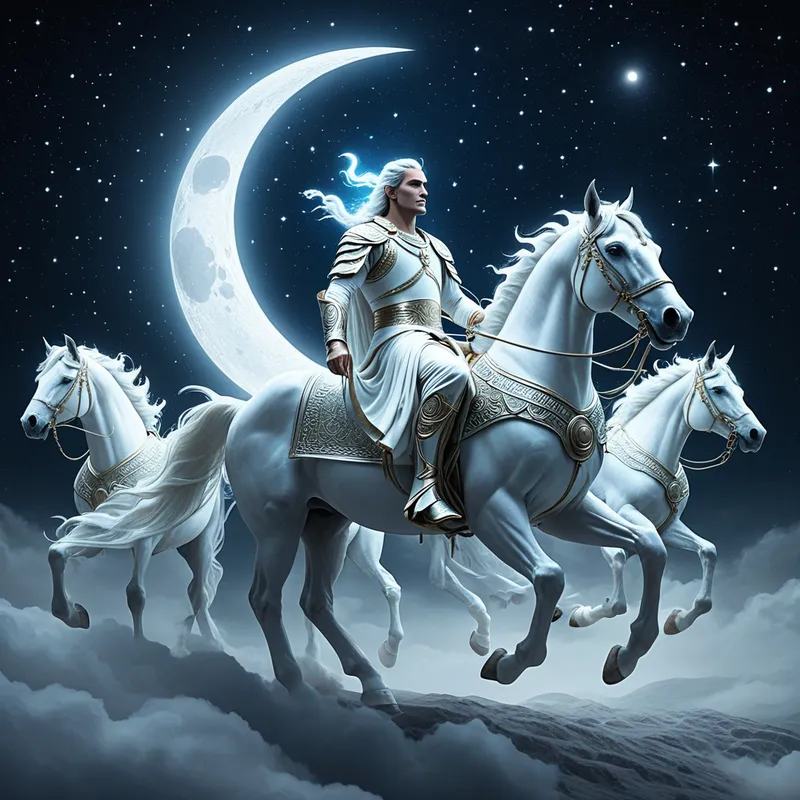
The Devas drank deeply. Their radiance was restored, their power cemented. The cosmos found a fragile balance. But the Soma itself, this essence of immortal consciousness, was not simply consumed. A portion was placed in the care of the Moon, who became its guardian. And from his luminescent cup, he pours it out each night, a silver libation to the sleeping earth, only to have it drunk away, sip by sip, by the gods, until he wanes, empty and dark, before being filled once more in an eternal cycle of sacrifice and renewal.
Cultural Origins & Context
The myth of Soma is not a single story but a vast, echoing tradition rooted in the most ancient layers of Vedic culture. Its earliest and most potent expressions are found in the Rigveda, where an entire book, the ninth Mandala, is devoted to hymns praising Soma. Here, Soma is simultaneously a sacred plant, a pressed ritual drink, and a mighty god—the king of plants, the intoxicating inspiration of poets and priests, and the fuel of the gods themselves.
The myth was passed down through an oral tradition of immense precision. Rishis (seers) and Brahmins would chant the hymns during the elaborate Yajna ceremonies, where the actual Soma drink was prepared, offered into the fire, and consumed. This ritual was the axis of the ancient world, a technology for maintaining cosmic order (Rta/Dharma). The myth provided the sacred narrative that gave the ritual its meaning and power. It was a story told not for entertainment, but for survival—the survival of the cosmos and the community. Later, in the Puranas and epics, the narrative crystallized into the dramatic "Churning of the Ocean" (Samudra Manthan) saga, embedding the Soma myth within a larger cosmological framework accessible to all.
Symbolic Architecture
At its heart, Soma represents the quintessential elixir of consciousness. It is the distilled essence of life, ecstasy, inspiration, and immortality that lies hidden within the churning chaos of existence.
The quest for Soma is the soul's longing for a state of being that transcends the painful dichotomies of life and death, joy and sorrow, self and other.
The cosmic churning (Manthan) symbolizes the necessary inner and outer struggle required to produce this essence. It is the friction between opposites—Deva and Asura, light and shadow, conscious will and unconscious impulse—that generates the psychic energy needed for transformation. The poison that emerges first, swallowed by Shiva, signifies that any profound journey toward wholeness must first integrate its own inherent toxicity, its shadow.
The theft and retrieval by Mohini/Vishnu reveals a profound psychological truth: the transcendent function, the force that unites opposites (here, the androgynous Mohini), often operates through illusion (Maya) and strategy. The conscious ego (the Asuras) cannot grasp wholeness through force or direct claim; it must be enchanted, tricked into a state of receptivity where a higher order (the Devas, representing ordered consciousness) can integrate the life-giving essence. Rahu and Ketu, the immortal head and the mortal body, represent the eternal, obsessive hunger of the ego (Rahu) for immortality, and the karmic, bodily consequences (Ketu) of that unintegrated desire.
Finally, the Moon's cyclical waxing and waning as the keeper of Soma embodies the ultimate law: wholeness is not a permanent state of possession, but a rhythmic process of filling and emptying, of inspiration and expiration, of sacrifice and receipt.
The Dreamer's Resonance
When the pattern of the Soma myth stirs in the modern dreamer, it often signals a profound somatic and psychological process of extraction and integration. One may dream of searching for a lost, precious fluid; of a radiant cup that is always just out of reach; or of a brilliant light stolen by shadowy figures. The body may feel a deep, unquenchable thirst upon waking.
Psychologically, this dream-resonance points to a phase where the individual is "churning" their own psychic ocean. Old conflicts (Deva/Asura dynamics within, such as duty versus desire) are being agitated. The dreamer is in the laborious process of generating, from the raw material of their life experiences and the unconscious, a new, vitalizing essence—a fresh perspective, a creative insight, a deeper connection to life. The "theft" in the dream may reflect a fear that this nascent wholeness will be claimed by an unconscious complex (an old wound, an addiction, a negative self-image) before the conscious self can integrate it. The appearance of an enchanting, guiding, or trickster figure (the Mohini archetype) suggests the intervention of the Self, orchestrating a resolution that the conscious ego cannot yet comprehend.
Alchemical Translation
The Soma myth is a master blueprint for the alchemical process of individuation—the psychic transmutation of the base lead of the fragmented personality into the gold of the integrated Self.
The first alchemical operation is the churning: confronting and engaging the inner opposites. One must willingly take up the serpent of one's own instinctual nature and the mountain of one's karma, and begin the difficult, often painful, work of self-examination.
From this friction emerges the poison—the repressed traumas, shame, and anger—which must be "swallowed" and transmuted by the inner Shiva, the capacity for radical acceptance and dissolution of identity.
The radiant Soma that surfaces is the transcendent function, the new attitude that emerges from the tension of opposites. But the ego (the Asuric tendency) will immediately try to claim this prize for its own aggrandizement. Here, the alchemical work requires the enchantment of the ego. One must allow a deeper, guiding intelligence (the Vishnu/Mohini principle, the Self) to orchestrate the distribution. This often feels like grace, synchronicity, or a sudden intuitive knowing that rearranges one's life in a way the ego would never have planned.
The final, crucial stage is the lunar sacrifice. The integrated essence (Soma) is not hoarded. It is entrusted to the cyclical, reflective nature of the soul (the Moon) and offered back to the cosmos through one's work, relationships, and being. One becomes a vessel that is periodically filled from the depths and emptied into the world, participating in the eternal rhythm of giving and receiving, thus achieving not a static immortality, but a dynamic, participatory wholeness. The myth teaches that the elixir is found not in final possession, but in the sacred process of its perpetual offering.
Associated Symbols
Explore related symbols from the CaleaDream lexicon: