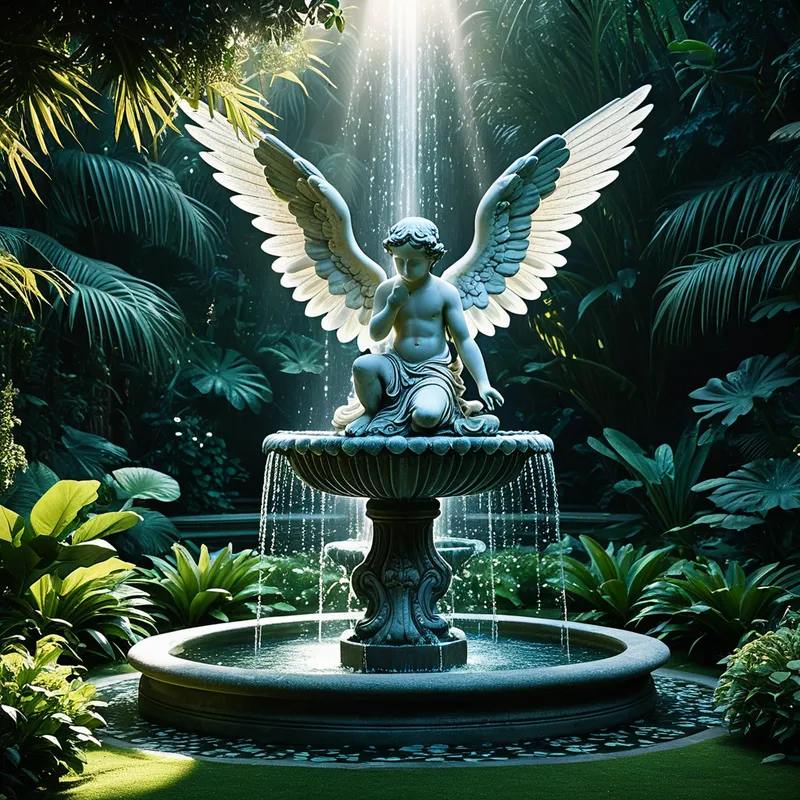
The Fountain of Life Myth Meaning & Symbolism
A mystical fountain of healing and immortality, flowing from paradise, representing the soul's deepest quest for divine grace and eternal renewal.
The Tale of The Fountain of Life
In the beginning, before time was counted in years, there was a Garden. Not a garden of mere earth and seed, but the Garden of Eden, a place where the air itself was a prayer and every leaf sang of the Creator’s glory. From its very heart, where the light did not fall but was born, flowed a river. It was clear as intention, sweet as forgiveness. This river parted into four heads to water the world, but at its source, where it first sprang from the living rock, was the Fountain of Life.
It was not a thing to be found by maps, but by longing. After the great sundering—the closing of the eastern gate with its flaming sword—the Fountain became a whisper on the wind, a memory in the blood of humankind. Prophets spoke of it in visions: a stream making glad the city of God, a river whose waters healed all bitterness. Kings and emperors, their crowns heavy with mortality, sent expeditions into the trackless deserts and over impassable mountains, seeking the waters that would turn back time. They sought a place, but the legend spoke of a state of grace.
Then came the tales of a land beyond the sunrise, a kingdom of a priest-king named Prester John. In his realm, nestled among impossible wonders, the Fountain was said to flow once more. It was guarded not by armies, but by its own holy nature. To find it required a purity of heart that had been lost to the ages. Many a knight, clad in steel and solemn vows, ventured forth. They crossed valleys of shadow and mountains of doubt. Some returned broken, speaking of a brilliance that blinded the unworthy. Others never returned at all, perhaps having found not a destination, but a transformation.
The quest itself became the path. The thirst for its water was the first sip. For the legend said the water did not merely grant endless years; it restored the soul to its original, unblemished state. It was the antidote to the Fall, a liquid echo of the primordial grace. To drink was to remember one’s true name, written in the Book of Life before the foundation of the world. The Fountain was both the lost homeland and the promise of a future restoration, a wellspring at the end of history when the New Jerusalem would descend, and a river of the water of life, bright as crystal, would flow once more from the throne of God and of the Lamb.

Cultural Origins & Context
The myth of the Fountain of Life is a powerful tributary flowing into the great river of Christian symbolism, sourced in scripture and amplified by medieval imagination. Its primary wellspring is the Book of Genesis (2:10-14), where a river waters Eden before dividing. This image was profoundly developed by the prophets, particularly Ezekiel (47:1-12), who envisions a life-giving river flowing from the Temple, and the Psalmist (46:4) who sings of “a river whose streams make glad the city of God.”
In the Book of Revelation (22:1-2), the archetype finds its ultimate expression: “Then the angel showed me the river of the water of life, bright as crystal, flowing from the throne of God and of the Lamb.” This scriptural core provided a rich, divinely-sanctioned symbol of grace, salvation, and eternal life.
During the Middle Ages, this biblical symbol merged with circulating travelers' tales and the ubiquitous human desire to conquer decay and death. It became entangled with the legends of Prester John and the quest for the Holy Grail. The Fountain appeared in bestiaries, mappa mundi, and romances. Its societal function was multifaceted: it was a theological metaphor for baptism and Christ as the living water; a narrative engine for tales of adventure and purity; and a poignant expression of the medieval tension between a fallen, mortal world and the yearning for paradisiacal restoration. It was a myth told from pulpits, sung by minstrels, and dreamed of by knights, binding the promise of scripture to the earthly quest for transcendence.
Symbolic Architecture
At its core, the Fountain is not a literal place but a symbol of the source. It represents the origin point of divine grace, the unbroken connection to the numinous, and the possibility of returning to a state of wholeness before fragmentation.
The Fountain is the psyche’s memory of its own divine origin, a symbol of the Self that promises integration and the end of spiritual exile.
The water is the central symbol—multivalent and profound. It is the water of creation, of baptism (death and rebirth), of healing, and of revelation. It is the aqua vitae, the water of life that contrasts with the aqua mortis of mundane existence. The quest for the Fountain symbolizes the soul’s journey back to its source, the often-arduous path of spiritual seeking and purification. The guardians and perils of the quest represent the psychological defenses and complexes that protect the deep, transformative core of the Self from a conscious ego not yet ready to integrate its power.
The myth also presents a profound duality: the Fountain is both lost (in Eden, in the past) and promised (in the New Jerusalem, in the future). This speaks to the human condition of living in the “already but not yet”—we carry a spark of the divine (the image of God) yet experience separation, and we strive for a wholeness we intuit but have not fully grasped.
The Dreamer's Resonance
When the Fountain of Life appears in modern dreams, it rarely manifests as a biblical illustration. Instead, it surfaces in the symbolic language of the personal unconscious, signaling a profound process of psychic renewal.
A dreamer might find themselves in a decaying urban landscape, drawn to a forgotten, overgrown courtyard where a simple, ancient wellspring bubbles with impossibly clear water. The somatic feeling is often one of intense, relieving thirst finally quenched, or a cleansing coolness washing over the dream body. This can indicate a deep need for emotional or spiritual hydration—a self that has been arid, perhaps due to burnout, cynicism, or emotional isolation, is now in contact with a renewing source from the unconscious.
Alternatively, the dream Fountain may be inaccessible: behind a locked gate, guarded by a frightening figure (a shadow aspect), or its water may appear polluted or toxic when the dreamer tries to drink. This reflects a blockage in the process of individuation. The ego recognizes the need for renewal (the Fountain) but is confronted by unresolved complexes, fears, or aspects of the personality that must be addressed before integration can occur. The quest in the dream becomes a mirror of the dreamer’s internal struggle to overcome inner obstacles to wholeness.
Alchemical Translation
The myth of the Fountain of Life is a perfect allegory for the alchemical process of individuation. The entire narrative maps onto the journey of psychic transmutation.
The initial state is nigredo—the blackening, the sense of exile, mortality, and spiritual thirst. This is the condition that launches the quest. The long, perilous journey through wilderness represents the conscious engagement with the unconscious (solutio—dissolution in the waters of the unknown), where the ego’s rigid structures are challenged and softened.
To seek the Fountain is to consent to the dissolution of the old self in the waters of the unconscious, so that a new, more complete form may crystallize.
Finding the Fountain is the moment of albedo—the whitening, the illumination. It is the encounter with the Self, the central archetype of wholeness. Drinking the waters is the coniunctio—the sacred marriage of the conscious ego with this deeper Self. This is not merely an acquisition but a transformation; the “water of life” transmutes the lead of the fragmented personality into the gold of the integrated individual.
Finally, the promise of the Fountain flowing in the New Jerusalem points to the rubedo—the reddening, the culmination. This is the state where the achieved wholeness is lived out in the world, not as a private enlightenment but as a sustained, embodied reality. The Fountain, once an external object of quest, is realized as an eternal, internal source. The individual becomes, in a symbolic sense, a vessel through which the aqua vitae—the water of conscious, redeemed life—flows into their own world. The myth thus charts the path from spiritual thirst to becoming a source.
Associated Symbols
Explore related symbols from the CaleaDream lexicon: