Hesperides Myth Meaning & Symbolism
A garden at the edge of the world guards golden apples of immortality, watched by serpent and nymphs, a prize for heroes and a test of divine order.
The Tale of Hesperides
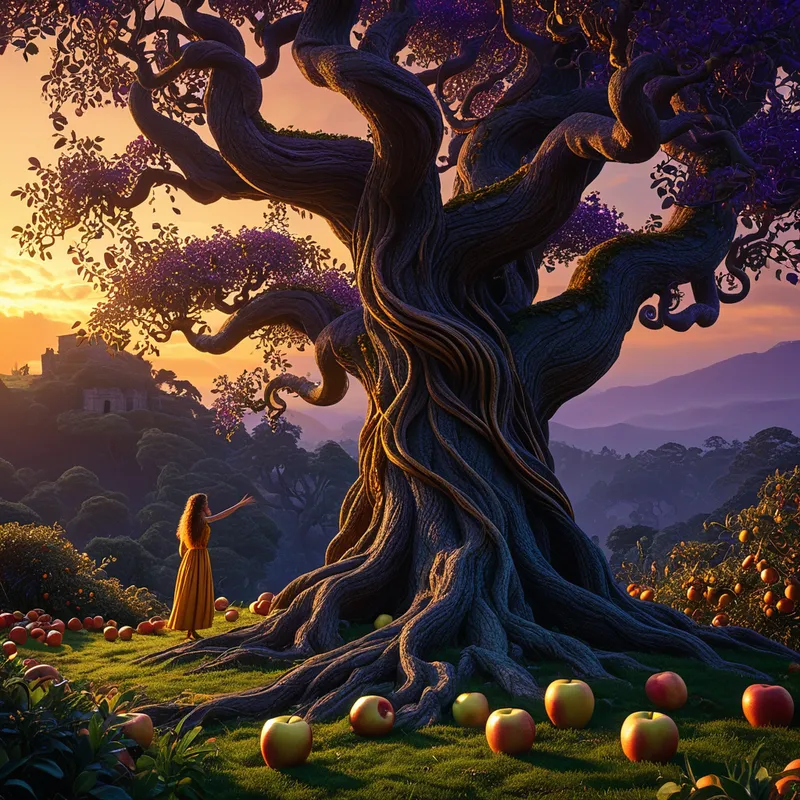
Listen, and let your mind travel to the very rim of the world, where the sun, weary from its daily labors, sinks into the embrace of the ocean. This is the land of evening, the Hesperides. Here, in a garden that knows no winter, where the air is perpetually honeyed with the scent of blossoms unknown to mortals, grows the ultimate treasure.
The tree is not mighty like an oak, but sacred, its bark silver, its leaves whispering secrets in a tongue older than the gods. And from its branches hang fruits that are not fruits, but captured sunlight, solidified ambrosia: the Golden Apples of Immortality. They are the ultimate wedding gift from Gaia to Hera, a symbol of eternal union and undying power.
But a treasure so profound is never left unguarded. Around the tree’s base, a being of coiled vigilance rests—Ladon, a dragon with a hundred heads, each one whispering a different warning, each pair of eyes seeing in every direction. His scales are the color of tarnished bronze and deep earth, and his breath is the quiet hiss of eternity itself. And dancing in the twilight, their song a melody that could lull the stars to sleep, are the daughters of the evening, the Hesperides themselves. They are the tender caretakers, watering the roots with celestial dew, singing to the apples so they may ripen in divine resonance.
Into this perfected, closed circle of divine custody strides disruption: the hero. Not as a thief in the night, but as an agent of fate. Heracles, son of Zeus, burdened by a penance, is commanded to fetch these apples as his eleventh labor. His journey is an odyssey to the edge of known reality. He wrestles the shape-shifting sea god Nereus for knowledge. He liberates Prometheus from his torment. He takes upon himself the weight of the heavens so that the Titan Atlas might retrieve the prize for him.
The garden, when he finally stands before it, is silent but for the serpent’s whisper and the nymphs’ fading song. This is not a battle of brute force against a monster, but the culmination of a cosmic negotiation. In some tellings, Heracles slays the ever-watchful Ladon with a well-aimed arrow, a violent intrusion into a timeless scene. In others, the titan Atlas enters and plucks the apples while Heracles shoulders the sky. The golden orbs, cool and heavy with destiny, are gathered. They leave the garden, this eternal sunset, and enter the world of time, of tasks, and of mortal kingdoms. They are briefly in the hands of Heracles, then given to Eurystheus, only to be returned by the goddess Athena to their sacred grove. The circle, though breached, is mended. The apples go home, but the world is forever changed by their having been touched.
Cultural Origins & Context
The myth of the Hesperides is a tapestry woven from threads of extreme antiquity, likely pre-dating the Olympian pantheon. The Hesperides themselves are often called daughters of Nyx, placing them among the first beings to emerge from Chaos. This connects the garden not just to a geographical "west," but to the conceptual West—the land of the dead, of endings, and of the mysteries that follow the setting sun. Later traditions made them daughters of Atlas, tethering them to the pillar between heaven and earth.
The story was never codified in a single, canonical text like Homer’s epics. Instead, it shimmered in the background of Greek mythology, referenced by poets like Hesiod in his Theogony, and later fleshed out as a labor of Heracles in the efforts of playwrights and mythographers. Its function was multifaceted: it explained the existence of a mythical, unattainable paradise on the edges of maps; it served as an ultimate test for the archetypal hero; and it reinforced the cosmic order. The apples were Hera’s property, symbolizing the inviolable nature of divine marriage and sovereignty. Their theft (or retrieval) was thus a profound transgression that required Herculean effort and divine sanction to accomplish, ultimately underscoring that even immortality, when removed from its proper context, cannot be kept by mortals.
Symbolic Architecture
At its heart, the Garden of the Hesperides is a psychological map of the shadow and the treasure within it. The garden is the temenos, the sacred enclosed space of the unconscious self, lush with potential but hidden at the world’s end.
The Golden Apple is the symbol of wholeness, the integrated Self that promises an end to fragmentation and mortality. It is not merely eternal life, but eternal completeness.
The Ladon is the guardian of this treasure, and thus is not merely an obstacle, but a vital part of the psychic ecosystem. He represents the autonomous, instinctual defense mechanisms of the psyche. His hundred heads are the myriad forms of resistance—fear, doubt, anxiety, old wounds—that rise up to protect the core self from premature, unintegrated exposure. To slay him outright is to risk psychic inflation, to seize the treasure without integrating the guardian’s strength.
The Hesperides represent the anima, the feminine principle of relatedness, nurturing, and connection to the deep, instinctual layers of life. Their evening song is the alluring, often melancholic call of the soul towards introspection, beauty, and the acceptance of cycles (the setting sun). The hero must engage with them, either through persuasion or by navigating their realm, indicating that the quest for self cannot be a purely masculine, conquering endeavor; it requires receptivity to this softer, twilight wisdom.
The Dreamer's Resonance
When this myth stirs in the modern dreamer, it often manifests as a profound sense of a hidden, precious resource just out of reach. You may dream of a beautiful, walled garden you cannot enter, or a radiant fruit on a tree you are forbidden to touch. The guardian may not be a dragon, but a locked door, a disapproving figure, or a pervasive feeling of anxiety that thickens the air as you approach.
Somatically, this can feel like a tightening in the chest, a literal "guardian" sensation. Psychologically, you are at the threshold of a major integration. The "apple" represents a nascent talent, a repressed memory, a deep truth about your identity, or a creative potential that feels like it would grant you a new, more potent life—a kind of personal immortality. The dream signals that this treasure is ripe, but the psyche is testing your readiness. Are you approaching with the brute force of Heracles’ early labors, or with the strategic wisdom and endured suffering of his later ones? The dream asks: Can you bear the weight of the sky—the full responsibility of your own consciousness—to claim what is yours?
Alchemical Translation
The labor of the Hesperides is an alchemical recipe for individuation. The quest begins with the nigredo, the blackening: Heracles’ state of servitude and madness that initiates the labors. His journey to the world’s edge is the separatio, leaving the known world (the conscious persona) behind.
The act of holding the heavens for Atlas is the supreme mortificatio—the ego’s humbling dissolution under a weight greater than itself. Only through this surrender can the treasure be approached.
Engaging with the garden’s inhabitants—the anima-nymphs and the shadow-serpent—is the coniunctio, the sacred marriage of opposites within the psyche. The retrieval of the apple is the production of the lapis philosophorum, the philosopher’s stone, the symbol of the achieved Self. But the alchemy is not complete with possession. The final, crucial stage is the return of the apples to the garden. This is the rubedo, the reddening, where the achieved insight is reintegrated into the larger, self-sustaining system of the soul. It is not about keeping the golden prize as a trophy for the ego, but about allowing the transformed self to re-become part of the eternal, cyclical order. The individual gains immortality not by hoarding divine fruit, but by having their entire being recalibrated by the journey to its source. The garden remains, but you are no longer a stranger at its gates.
Associated Symbols
Explore related symbols from the CaleaDream lexicon: