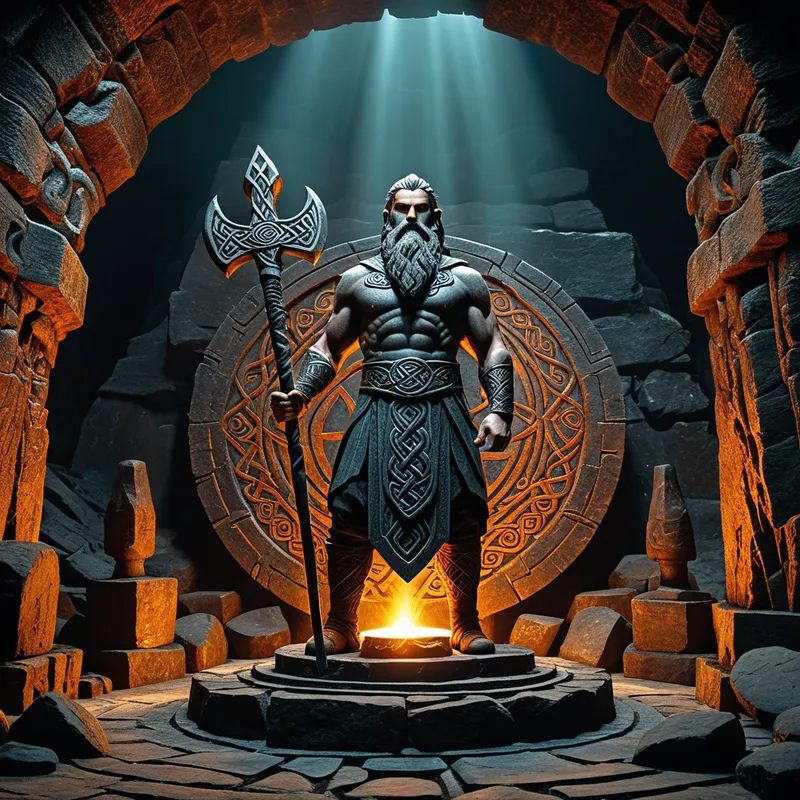
The Smith God Myth Meaning & Symbolism
The divine smith forges weapons of destiny and serves the feast of immortality, embodying the transformative fire that reshapes raw matter into sacred form.
The Tale of The Smith God
Listen. The world was younger then, and the air thrummed with a different music. Not the music of strings, but the deep, resonant song of the earth’s own heart—the clang of iron on anvil, the hiss of hot metal in water, the roar of a fire that never dies.
In the hollow hills of the Túatha Dé Danann, the People of the Goddess Danu, there was a hall that was not a hall, but a womb of stone and flame. Here worked Goibniu. He was not a giant of muscle alone, but of will. His arms were maps of sinew and old burns; his eyes held the patient, measuring stare of the flame itself. He was the Smith, and his forge was the crucible where destiny was hammered into shape.
The Second Battle of Mag Tuired loomed. The Fomorians, misshapen and cruel, gathered like a storm on the horizon. The Dagda, the good god, came to the forge. His shadow swallowed the firelight. "We need arms, Goibniu. Arms that will not break. Spears that will not miss."
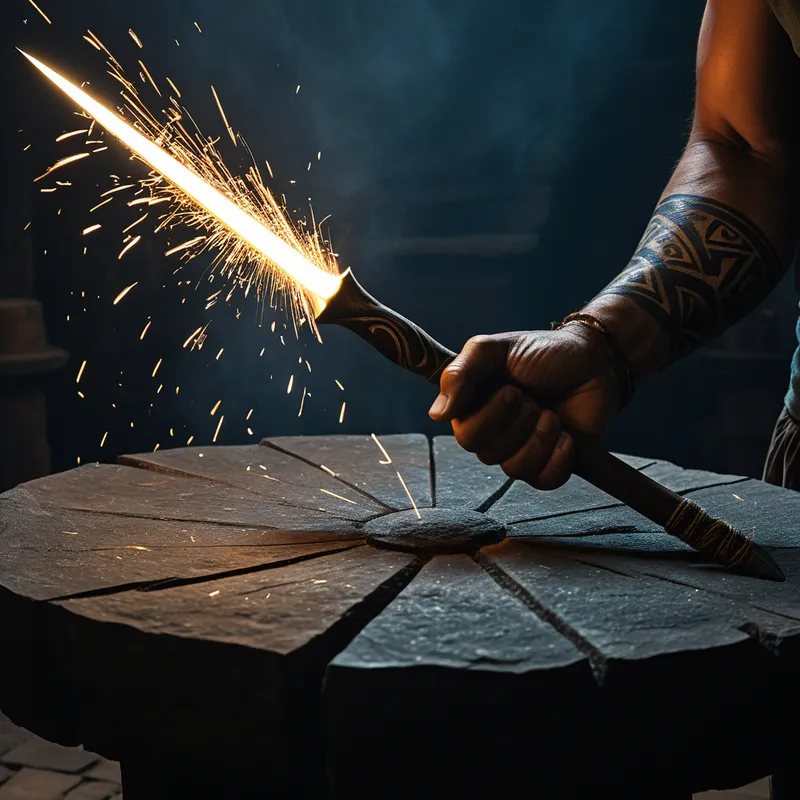
Goibniu nodded, a gesture as heavy as a falling hammer. He did not speak. He worked. He took the ore, the dark blood of the earth, and subjected it to the ordeal. The fire embraced it, made it pliant and weeping with light. The hammer fell—clang—a blow that shaped not just metal, but fate itself. With each strike, he sang a silent song of edge and point, of unyielding purpose. He forged a spearhead in three strokes. Three strokes only, and it was done, perfect, lethal, and thirsty.
He passed the spear to Dian Cécht, who fitted it with ash-wood. He passed it to Brigid, who breathed a rhyme of true flight upon it. Thus armed, the warriors of the Danann could not fall. For Goibniu also brewed the Fled Goibnenn. Any warrior wounded in battle had only to taste the ale from his sacred cauldron and be made whole, ready to fight again at dawn.
The Fomorians, in their desperation, sent a spy, a creature of poison, to kill the Smith. It loosed a venomous spear that pierced Goibniu’s body as he worked. The Smith looked down at the shaft protruding from his chest, then back at his anvil. He pulled the spear free, a grimace his only concession to pain. He walked, steadily, to his vat of ale. He drank deep. The wound closed. The poison became mere memory in his veins. He returned to the forge. The fire had not dimmed. The hammer was still warm. And the work, the eternal work, continued.
Cultural Origins & Context
The figure of the Smith God is not a singular character from one neat tale, but a pervasive archetype woven into the Celtic world-view, primarily preserved in the early medieval Irish mythological cycles. Goibniu is one of a triad of craft-gods, alongside Luchta and Creidhne. These myths were the province of the filid, the poet-seers who acted as custodians of history, law, and sacred narrative.
The smith in Celtic society was a liminal and revered figure. His workshop stood at the edge of the village, near the woods, a place of dangerous, transformative magic. He mediated between the raw, chaotic natural world (ore) and the ordered, cultural world (tools, weapons, art). His craft was essential to survival, warfare, and ritual. The myth of Goibniu served to sanctify this vital role, elevating practical skill to divine principle. The story of his unkillable nature and his provision of invincible arms served a societal function: it was a psychic anchor, a narrative assurance of the tribe’s resilience and the divine favor bestowed upon its protectors and creators.
Symbolic Architecture
At its core, the myth of the Smith God is a masterclass in the symbolism of conscious transformation. The forge is the individuation crucible—the contained, intensely focused psyche where raw, unconscious content (the ore of instinct, trauma, potential) is subjected to the heat of attention and the hammer-blow of will.
The anvil is the immutable Self, the solid core upon which the malleable ego is shaped. The hammer is disciplined consciousness, the repeated act of choice and effort.
Goibniu’s three-stroke spear is profoundly symbolic. It represents the triadic nature of creation: the raw material, the transformative process, and the perfected form. It speaks to the efficiency of true, aligned work—when one acts from the core of one's being, creation is not laborious but inevitable. His healing ale, the Fled Goibnenn, symbolizes the restorative power that comes from this sacred work. The poison spear of the Fomorian represents the inevitable "backlash" of the unconscious—the doubts, fears, and resistances that arise when one engages in profound self-change. Goibniu’s response—removing the spear and drinking from his own cauldron—models the solution: one must heal oneself with the very elixir one has learned to brew through one's craft.
The Dreamer's Resonance
When this myth stirs in the modern unconscious, it often manifests in dreams of workshops, basements, garages, or forgotten rooms containing tools. The dreamer may find themselves holding a heavy, unformed piece of metal, feeling both its weight and its potential. There is frequently an anxiety about "getting it wrong" or a fear of the fire itself.
Somatically, this can correlate with a felt sense of pressure in the chest or shoulders—the weight of unexpressed potential. Psychologically, this dream pattern emerges during life phases that demand self-forging: career changes, creative undertakings, or recovery from periods of dissolution. The figure of the Smith (who may not appear directly) is the dream’s invitation to become one’s own artificer. The dream asks: What in you needs to be subjected to the fire? What old, hardened story needs to be made pliant? What essential tool or weapon for your life’s battle are you being called to craft? The resistance felt in the dream is the necessary friction for the transformation to take hold.

Alchemical Translation
The alchemical journey mirrored in Goibniu’s myth is the opus contra naturam—the work against nature, which is really the work of refining nature’s raw state. The process begins with the nigredo: the dark, formless ore of one’s unlived life, one’s shadow. This is hauled into the forge of awareness.
The fire is not comfort; it is the heat of conscious suffering, the willingness to be changed by what one observes within oneself.
The hammer strikes represent the repeated, often tedious, acts of integration—the journal entry after the painful memory, the difficult conversation, the disciplined practice. This is the albedo, the whitening, where form begins to emerge from chaos. The final quenching, the plunge into the water (often symbolized by Goibniu’s ale), is the rubedo: the reddening, the infusion of spirit into the now-shaped form. The created object—be it a spear of purpose, a plowshare for new growth, or a torc of self-sovereignty—is the Lapis Philosophorum of the individual.
For the modern soul, the myth translates to a sacred practice: identify your forge (a dedicated space for inner work), tend your fire (sustained attention), find your anvil (your core values or truth), and take up your hammer (consistent, courageous action). The Fomorian poison will come. Failure, doubt, and criticism will pierce you. The myth does not promise an absence of wounds. It promises the means to create your own elixir of resilience from the very process of your crafting. You are both the smith and the substance. The goal is not to become invulnerable, but to become forgeable—able to participate consciously in your own endless, glorious becoming.
Associated Symbols
Explore related symbols from the CaleaDream lexicon: