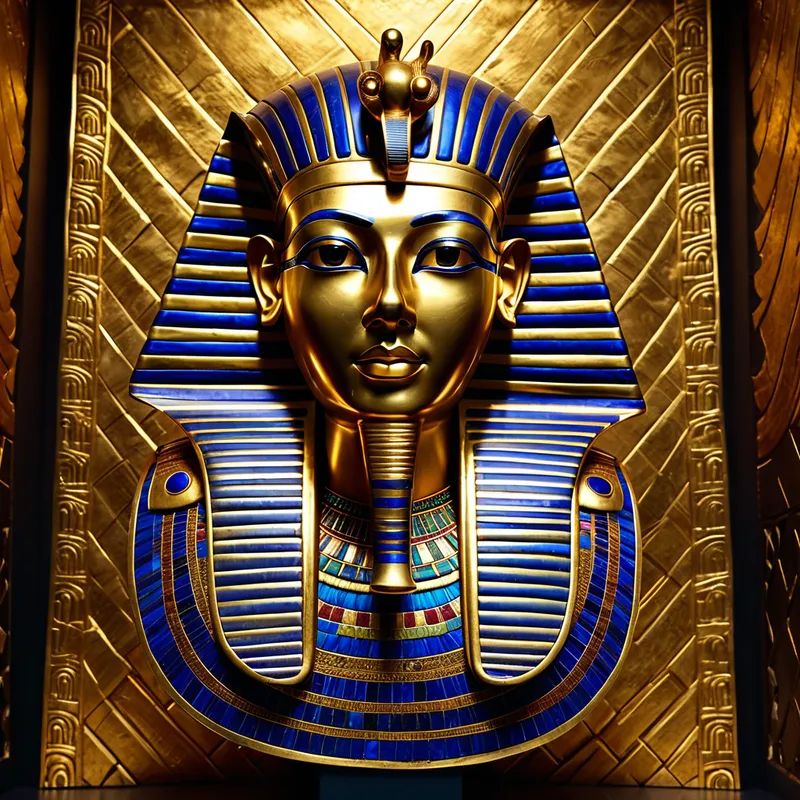
Tutankhamun's Funerary Mask Myth Meaning & Symbolism
The golden mask of a boy-king, a vessel of divine protection and eternal identity, forged to guide a soul through the perilous journey of the afterlife.
The Tale of Tutankhamun's Funerary Mask
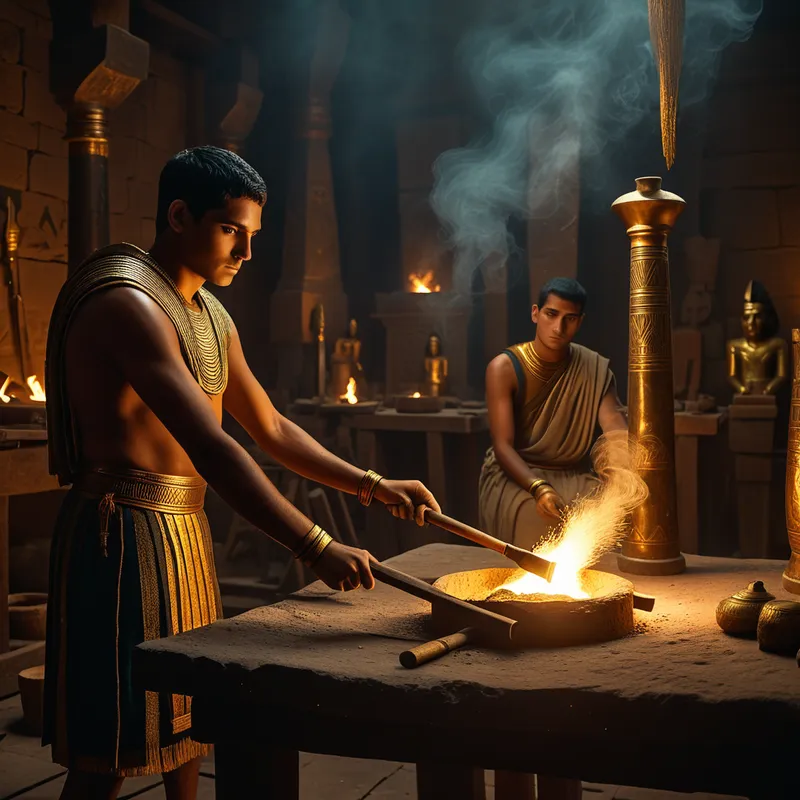
Listen. The air in the royal workshop is thick with incense and the scent of hot beeswax. The land outside is in tumult, a kingdom reeling from the heresy of a sun-king who turned his back on the old gods. But here, in this sacred space of hammer and fire, a different truth is being forged. A truth of eternity.
The boy-king, Pharaoh Tutankhamun, has been taken by the river of night. His Ka wanders, a lost star in the Duat. His body, the vessel of his divinity, lies empty. But his priests have spoken the words of power. The master craftsmen have been summoned. Their task is not to create a mere likeness, but to build a fortress for the soul, a beacon for the spirit. They are to craft the Sah.
Gold, the flesh of the gods, is brought forth—not from a mine, but from the treasury of the sun itself. Lapis lazuli, the stone of the night sky, is sourced from distant mountains. The chief artisan, his hands steady despite the weight of the ritual, begins. He does not sculpt a memory of the boy’s fleeting smile. He hammers out the eternal, impassive face of a god-king. The broad Nemes headdress is fashioned, its stripes of blue and gold like the ordered cosmos. Upon the brow, the Wadjet and the Nekhbet rise, guardians in miniature, their eyes of obsidian seeing into all worlds.
The most sacred moment comes with the eyes. Two perfect orbs of quartz and obsidian are set into the sockets. They are not blind. They are the windows through which the king’s Akh will see forever. A spell is whispered over them, a plea to Anubis, the opener of ways: “May these eyes behold the face of Osiris.”
Finally, the mask is lowered. It does not cover the mummified face of a dead youth. It replaces it. It becomes the new, imperishable face of Tutankhamun. In the flickering torchlight of the sealed burial chamber, surrounded by a universe of grave goods, the mask rests. It is a still point in the chaos of death. It is a promise. It says: I am not this decay. I am the golden one who endures. I am the Pharaoh who rules in the Field of Reeds. The door is sealed. Darkness falls for three thousand years. But within that gold, the story is not over. It is waiting.
Cultural Origins & Context
The object we call Tutankhamun’s funerary mask was not, in its own time, merely an object. It was a critical component of a vast and precise technological-religious system designed to cheat death. This practice emerged from the core Egyptian metaphysical belief in a multi-part soul. The physical body (Khat) had to be preserved to house the Ka (life force) and the Akh (transfigured spirit). If the body was destroyed or unrecognizable, the Ka would have no home, and the individual would cease to exist.
The gold mask, therefore, served as an eternal, incorruptible face and head for the mummy. It provided a permanent, idealized residence for the Ka. Its iconography was not decorative but operative. The nemes headcloth, false beard, and crook and flail insignia were the uniform of kingship, asserting the deceased’s right to rule in the afterlife as he did on earth. The spells from the Book of the Dead inscribed on the mask’s shoulders were not literature; they were functional software, programmed to activate protective deities and navigate the hazards of the Duat.
This mythic technology was passed down through priestly lineages and artisan guilds, a secret and sacred knowledge. Its societal function was dual: it ensured the eternal life of the divine king, whose continued existence was believed to maintain Maat (cosmic order) for the entire nation, and it modeled the ultimate aspiration for every Egyptian—a successful transition to an eternal, blessed state.
Symbolic Architecture
At its core, the myth of the funerary mask is a profound allegory for the creation of an immortal identity. It represents the triumph of essence over accident, of eternal meaning over temporal circumstance.
The mask does not hide the true self; it reveals the true self that time seeks to erode.
Psychologically, the mask symbolizes the Persona, but in its most perfected and sacred form. While the everyday persona can be a false adaptation, the golden mask is the opposite: it is the conscious crafting and assumption of one’s highest, most authentic identity. It is the face you choose to present to eternity. The boy-king’s short, politically tumultuous life is the ephemeral biography. The serene, golden visage is the timeless character of the soul.
The materials are deeply symbolic. Gold represents the solar, immortal, and indestructible aspect of the spirit—the divine spark within. Lapis Lazuli, the color of the night sky, symbolizes the cosmic, the hidden depths of the unconscious, and the realm of the gods. The fusion of these materials in the mask signifies the alchemical marriage of the conscious (solar, gold) and the unconscious (nocturnal, lapis) into a unified, transcendent whole.
The Dreamer's Resonance
When this mythic pattern surfaces in modern dreams, it rarely appears as a literal Egyptian artifact. Instead, one might dream of finding or being given a mask of incredible beauty and weight, often made of metal or stone. One might dream of their own face in the mirror solidifying into a calm, idealized, but impersonal likeness. Or, conversely, of struggling to remove a heavy, golden mask that has fused to their skin.
These dreams signal a critical psychological process: the confrontation with one’s own eternal identity, separate from the roles, traumas, and fleeting successes of the personal biography. The somatic sensation is often one of immense pressure on the head and face—the weight of this new, formidable self being born. It can feel both awe-inspiring and terrifying. The dream asks: What is the imperishable core of you? What face does your soul wear when all the costumes of life are stripped away? It is the psyche working to forge its own Sah, its own enduring form, often in response to a “death”—the end of a career, a relationship, or a life stage.
Alchemical Translation
The journey of Tutankhamun’s mask models the individuation process—the psychic transmutation of the lead of the mortal ego into the gold of the Self. The “boy-king” represents the nascent, undeveloped psyche, thrust into power but fragile and subject to the “heresies” of parental complexes or cultural upheaval. His physical death is the necessary dissolution of the old, provisional identity.
The alchemical furnace is not the tomb, but the dark night of the soul where the old self is broken down so the golden image can be assembled.
The crafting of the mask is the active, conscious work of analysis and self-creation. It is the patient, sacred labor of gathering the “gold” of our highest values and the “lapis” of our deepest unconscious wisdom to hammer out a new, more durable structure for the personality. We integrate our inner guardians (the Wadjet and Nekhbet as instinctual protection and far-seeing insight) and open the “eyes of quartz”—developing a clarity of perception that sees beyond the personal to the archetypal.
Finally, donning this inner mask is not an act of deception, but of sacred assumption. It is the moment when we fully identify with our timeless, responsible aspect—the inner Pharaoh or Pharaoh-ess who rules the inner kingdom with justice (Maat). The process concludes not with entombment, but with liberation. The sealed chamber is the integrated psyche, a self-contained cosmos where the immortal Self resides, guiding the individual’s journey through the ongoing Duat of life’s challenges, radiant and whole.
Associated Symbols
Explore related symbols from the CaleaDream lexicon: