
The Cicada Myth Meaning & Symbolism
A tale of a mortal granted immortality as a singing insect, bridging the human world and the divine through eternal music.
The Tale of The Cicada
Hear now the song that is not a song, the story hummed on the hot, still air of high summer. It begins not with a god, but with a mortal man, a prince of the line of Laomedon. His name was Tithonus, and his beauty was such that it pierced the veil of the heavens. Eos, the rosy-fingered Dawn herself, whose chariot parts the night, saw him and was stricken. She who witnessed the birth of each day fell in love with a creature of the dying day, a mortal.
She swept him away to the eastern edges of the world, to her palace of shimmering light. Their love was a hymn, a golden hour that stretched and glowed. But a shadow lay upon Eos’s heart—the shadow of Kronos. She could not bear the thought of her beloved turning to dust, his beauty ravaged by age, stolen by Hades. In her divine passion, she went to Zeus, the cloud-gatherer, and begged a boon: grant Tithonus immortality. Let him live forever at her side.
Zeus, perhaps amused, perhaps moved, nodded his mighty head. The boon was granted. But Eos, in her desperate love, had forgotten the most crucial word. She asked for athanatos—deathlessness. She did not ask for aγήραος—agelessness.
And so, the golden hour began to tarnish. Tithonus lived on, as the seasons wheeled and the stars shifted. But the gift was a curse. He grew old. The luster left his hair, the strength seeped from his limbs. He withered and shrank, a prisoner of an endless, decaying twilight. He who had been a prince became a burden, a voice that cracked and whined with the weight of centuries. Eos, her heart breaking with each new wrinkle upon his face, could no longer bear the sight of this perpetual decay. Love turned to pity, and pity to a quiet, desperate sorrow.
There was no release, for death was barred to him. His body became a cage of brittle bones and papery skin. In final, merciful despair, or perhaps by some deeper, older magic of the earth itself, transformation offered a third path. He could not die, and he could not remain as he was. So, the world itself took pity. Tithonus shriveled further, his form contracting, his voice rising not in speech but in a dry, incessant hum. He was enveloped by the very air, his essence merging with the summer heat. He became a creature of shell and song.
He became a tettix—a cicada. Shedding the final husk of his mortal suffering, he emerged with wings of finest gauze. No longer a man, he was now pure vibration, a living music box. He was given a new purpose: to sing. To sing with the dry, rhythmic fervor of the sun itself, to chant the hymn of endless day from the trees, a companion to Eos as she painted the sky each morning. His immortality was no longer a prison of flesh, but an eternity of song, a bittersweet chorus woven into the fabric of the hot, living world.

Cultural Origins & Context
This poignant myth is primarily preserved for us in the Homeric Hymn to Aphrodite, a text that delves into the tragic romances between goddesses and mortal men. It was a story told not just to explain the origin of an insect’s summer song, but to explore a profound and terrifying cultural anxiety: the nature of the gifts of the gods and the unbridgeable gap between mortal and immortal existence.
In the pragmatic world of the Greek farmer, the cicada’s song was the soundtrack to the arduous work of harvest, a symbol of peak summer and life in its most abundant, yet most fleeting, state. The myth provided an etiological explanation—a "just-so" story—for this ubiquitous insect. But for the poet and the philosopher, it served a deeper function. It was a narrative crucible for examining the consequences of desire unchecked by wisdom, and the horrific potential of a wish granted literally, but not in spirit. It was a cautionary tale about the terms of divine interaction, passed down through epic poetry and later explored by lyric poets like Sappho, who touched upon the themes of aging and lost beauty.
Symbolic Architecture
The cicada myth is a masterclass in symbolic paradox. It encapsulates the human yearning for transcendence and the brutal reality of our embodied, temporal condition.
The most profound curses are often granted wishes, where the letter of the prayer is answered, but its soul is left starving.
Tithonus represents the mortal ego that seeks to bypass its fundamental condition. He is the part of us that desires permanent peak experience, eternal youth, and exemption from life’s natural cycles. His transformation into the cicada is not a punishment, but a re-solution—a dissolving of the problematic human form and its insatiable, linear desire, into a cyclical, symbolic existence.
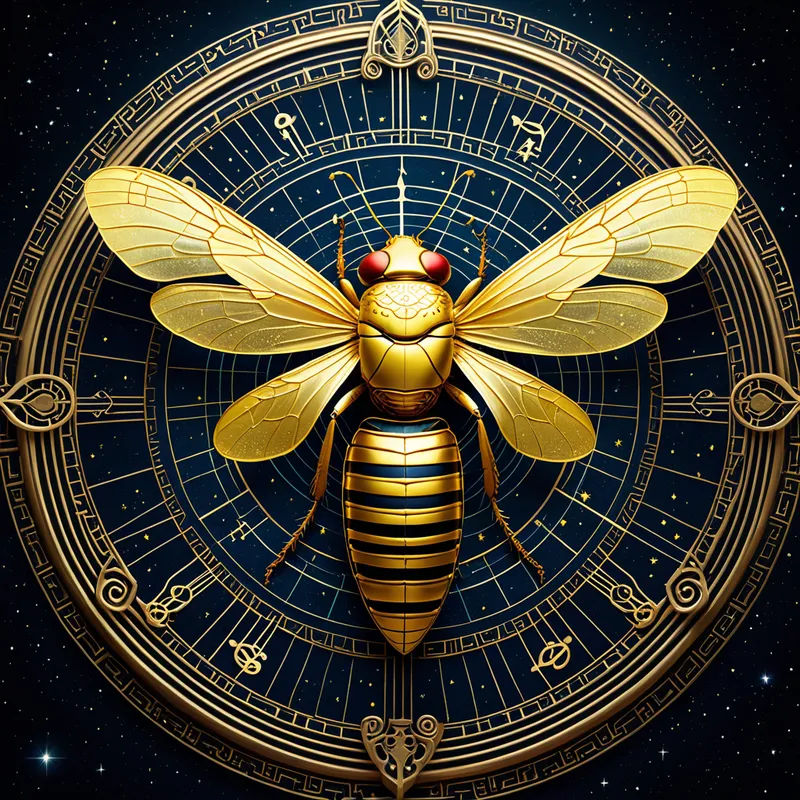
The Cicada itself is a complex symbol. Its famous life cycle—years spent underground as a nymph (a period of incubation and unseen development) followed by a brief, frenzied, singing adulthood in the light—mirrors the myth’s themes. It symbolizes artistic inspiration: the long, dark, solitary work of the soul (the nymph stage) that must occur before the song (the art, the insight) can be released to the world. It represents the voice that remains when the body is gone, the essence of a person distilled into their unique vibration or creative work.
Eos, the Dawn, symbolizes aspiration, new beginnings, and love that exists in a realm of pure potential (the dawn sky). Her fatal error is attempting to make a being of potential (a mortal) conform to a state of permanent actuality (immortality). She represents the divine or spiritual impulse that loves humanity but fails to understand its necessary limits.
The Dreamer's Resonance
When the myth of the cicada stirs in the modern unconscious, it often surfaces in dreams of profound transition, where the dreamer feels trapped in a state of endless, unproductive waiting or chronic decay. To dream of a cicada shell, empty and clinging to bark, speaks to a felt sense of having outgrown a former identity. The psyche is signaling that a long period of incubation is complete, but the dreamer fears the vulnerability of emerging into a new, untested form.
Dreams of a loud, incessant, mechanical buzzing or singing that one cannot locate or escape may reflect an inner voice—a talent, a truth, a trauma—that has been buried for too long and is now demanding expression. It is the "nymph" in the dark soil of the psyche, now mature and pressing upward. The somatic experience can be one of tightness in the throat (unspoken song) or a feeling of being encased, of wearing a shell that no longer fits. The dream invites the dreamer to identify what long-held wish has become a cage, and what essential self is ready to sing its way out, even if the song feels dry and strange at first.
Alchemical Translation
The alchemical journey modeled by the cicada myth is not one of heroic conquest, but of humble, essential transmutation. It is the path of the nigredo—the blackening, the decay of Tithonus—leading not to death, but to a radical dissolution of the ego’s demands.
Individuation is not about becoming ageless, but about becoming essential. It is the process of distilling the complex wine of the personality down to the single, potent note of the soul's signature song.
The first stage is the Inflation of the Wish: the ego, enamored with a divine ideal (Eos), believes it can and should attain permanent perfection. This leads to the Long Darkening: the curse of agelessness, a state of psychic stagnation where one is alive but not living, conscious but not growing. This is a necessary, if painful, mortificatio—a dying of the old mode of being.
The miracle of the myth is the Third Thing: the cicada. Alchemy seeks the lapis philosophorum, the philosopher's stone, which is often not a stone at all but a new, transcendent state of being. The cicada is this stone. It represents the birth of the Symbolic Life. When the literal, biographical life (the mortal Tithonus) becomes unbearable, the psyche offers a translation. The individual learns to live not for the preservation of the personal self, but as a vessel for a transpersonal function—to become the song, the art, the insight, the vibration that contributes to the whole.
For the modern individual, this translates to the movement from identifying with our suffering, our aging, our story ("I am a decaying Tithonus"), to identifying as the creative process that arises from it ("I am the song that my experience enables"). It is finding one's unique, perhaps dry and repetitive, but utterly authentic note, and offering it to the dawn chorus of the world. We are not asked to live forever, but to become, at last, what we essentially are: a brief, beautiful, and necessary music.
Associated Symbols
Explore related symbols from the CaleaDream lexicon: