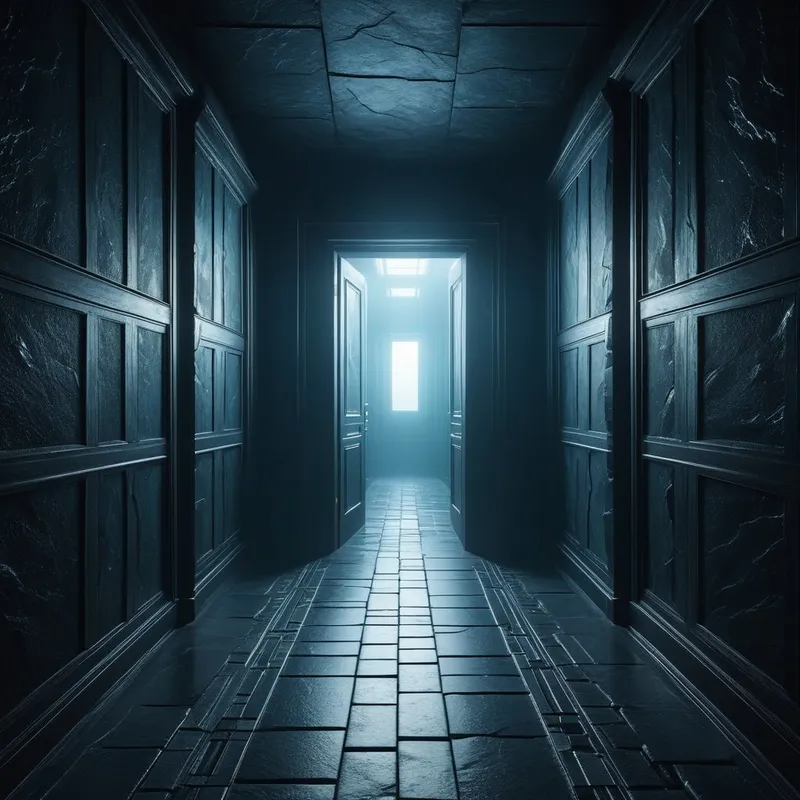
The Dream of Longing: The Somatic Compass to Wholeness
Longing is not a thought. It arrives first as a body-knowing, a deep somatic echo that vibrates in the hollows of the chest, a subtle pull behind the sternum. It is the ghost-limb sensation for a part of the self you have not yet met. This ache is not a sign of brokenness, but of a profound internal navigation system coming online. It is the psychic gravity of a disowned fragment—a memory, a potential, a capacity for love or rage or creation—tugging at the edges of your conscious world. Before the mind can articulate a desire, the body registers the absence. It is a homesickness for a place you have never been, a recognition of a face you have never seen, a melody you have never heard but know by heart. This is the visceral prelude: a quiet, persistent pressure, the internal sea pulled by a moon you cannot see.
The Dreamer's Log
The dreamer stands in a vast, silent hall. The walls are seamless, polished black stone. In the center of the empty space, suspended in a single shaft of dusty light, floats an ornate brass key. They know, with a certainty that aches in their bones, that this key fits a door of immense importance, but the hall has no doors, no keyholes, only endless, reflective walls.
Alchemical Interpretation: The key is not for escape, but for the activation of a hidden chamber within the self, a room whose walls the dreamer has mistaken for the boundaries of their entire world.

The False Lead
Do not mistake this profound, structural longing for mere dissatisfaction or a simple wish for a different life. It is not about wanting a new job, a new partner, or a new city, though the mind may desperately try to project the ache onto these tangible targets. That is the false lead—the consumerist mirage. The true longing is not for an external object to fill an internal void, but for the reintegration of a lost internal object: a silenced voice, a buried passion, a banished vulnerability. It is the difference between craving water and discovering you have been breathing only half the air. One is a need; the other is a revelation about the architecture of your existence.
Psychological Architecture
To engage with longing is to enter the shadowlands of the psyche, where the maps are written in sensation and symbol. This is the work of Individuation—not as a textbook concept, but as the lived, often painful, process of reclaiming exiles. Within the framework of your internal family, longing is the ambassador sent by a part of you that was sent away long ago for being too much, too intense, too needy, or too wild. Perhaps it was the boundless joy of the child that was deemed "impractical," the righteous anger that was punished as "disruptive," or the creative vision that was dismissed as "a fantasy."
This exiled part does not cease to exist. It lives in the psychic hinterlands, and its energy manifests as this persistent, objectless pull. The longing is its homing signal. The grief you feel is not for something you lost in the world, but for the part of yourself you abandoned in order to belong, to be safe, to be loved. The work is not to find the thing you long for out there, but to turn toward the ache itself, to follow its frequency back to the source within. It asks a terrifying question: What if the missing piece is not a person or a place, but a version of you that you were taught to disown?
Mythic Resonance
This is the eternal human firmware, coded into our oldest stories. We hear it in the haunting strains of Orpheus's lyre as he descends into the underworld, not to conquer, but to retrieve. His longing for Eurydice is the mythic container for the soul's longing to reclaim its beloved essence from the land of the forgotten dead. His fatal glance backward is not mere doubt, but the psyche's tragic inability to trust that what was lost can walk again in the full light of day. We see it, too, in the Buddhist parable of the hungry ghosts—the pretas—with their needle-throats and distended bellies, forever starving because they cannot ingest the nourishment before them. Their torment is a stark image of longing disconnected from its true source, perpetually seeking satiation in forms that can never satisfy the essence of the hunger.
Symbolic Nodes
Dreams of longing often speak in a specific symbolic lexicon:
- Unreachable Destinations: Trains missed, platforms receding, doors that vanish as you approach.
- Fragmented Communication: Phones with no signal, letters with ink that runs, voices heard through thick glass.
- Barren or Empty Vessels: Dry wells, empty cups, deserted houses with all the lights on.
- Distant Lights: A single window glowing on a far hillside, a star that pulses with personal significance, a beacon seen across an uncrossable chasm.
- The Unknown Figure: A person whose face is turned away, or whose features are blurred, but from whom emanates a profound sense of familiarity and heartache.
Archetypal Resonance
The energy of longing is most intimately aligned with The Lover Archetype. This is not merely the Lover of romance, but the archetype that values depth of connection, authenticity, beauty, and the ecstatic union of all parts of the self and the world. Its shadow manifests as obsession, promiscuity of attention, and a clinging dependency—all distortions of the core drive to merge and belong.
The Lover's resonance with longing is precise. Its somatic echo—the heart-hollow, the magnetic pull—is the Lover's compass, sensing the possibility of a deeper, more complete connection. The ache is the shadow of its ecstasy, the gap between the perceived self and the potential for wholeness. The alchemical potential lies in the Lover's capacity to appreciate the ache itself, to recognize it as the proof of a capacity for profound feeling and union. The task is to redirect the Lover's desire from an external object of completion inward, toward the courtship and integration of the exiled self, transforming a search for "the other" into a sacred marriage within.
The Alchemical Process
The transmutation of longing is an alchemy of attention. The base metal is the raw, painful ache of absence. The heat is applied by courageously refusing to anesthetize or project the feeling. This is the nigredo, the blackening: you must sit in the dark with the hunger and listen to its story without trying to feed it a substitute.
The pressure is the sustained focus on the question: "Who, within me, feels this?" You apply this pressure by gently inquiring of the sensation itself. As you do, a separation occurs. The pure, golden energy of the exiled part—its passion, its innocence, its truth—begins to distinguish itself from the leaden grief of its abandonment. This is the albedo, the whitening. The final stage, the rubedo, is the integration: consciously inviting that golden quality back into your daily life. It is letting the exiled artist doodle in the margins of your meeting notes, allowing the banished warrior to set a firm boundary, or letting the silenced child feel wonder at the shape of a cloud. The longing was the signal. The sovereign self is built by answering it.

The Integration Protocol
Question 1: When you feel the ache of longing, where exactly in your body does it reside? If that place had a voice, what single word would it whisper?
Question 2: What is one quality (e.g., wildness, tenderness, fierce conviction, playful silliness) that you deeply admire in others but feel is "not really you" or too risky to express fully?
Question 3: If your longing were not a problem to be solved, but a faithful guide, what forgotten territory within yourself is it trying to lead you back to?
Action 1 (Somatic Anchoring): Next time the longing surfaces, place your hand over its somatic location. Breathe into that space for three minutes. Do not try to change the feeling; simply give it the acknowledgment of your breath and touch, as you would a distressed child.
Action 2 (Unstructured Recalling): Set a timer for 10 minutes. Write with a pen on paper, starting with the sentence: "What I am truly hungry for is..." Do not stop writing, do not edit, do not lift the pen. Let logic fall away. Follow the ache into the nonsense, the fragments, the memories, the images.
Action 3 (Symbolic Invitation): Create a simple ritual. Light a candle to represent the guiding signal of your longing. Then, place an empty bowl or cup before it. Sit quietly and, in your mind, invite the exiled quality you identified to return. Imagine it filling the empty vessel. When it feels complete, blow out the candle and drink a glass of water, consciously absorbing that quality.
Final Validation
This work is not for the faint of heart. To court your own longing is to agree to feel the full depth of an absence you have spent a lifetime avoiding. It is to stand in the silent hall, holding the key, with no door in sight. Yet, this very act of turning toward the ache, of believing the somatic signal over the mind's frantic projections, is the first act of profound self-reclamation. The door does not appear until you stop looking for it on the walls you already know, and instead, trust that the key in your hand is meant for a threshold that will manifest only when you are ready to turn it inward. The longing is not your enemy. It is the most faithful part of you, calling you home.