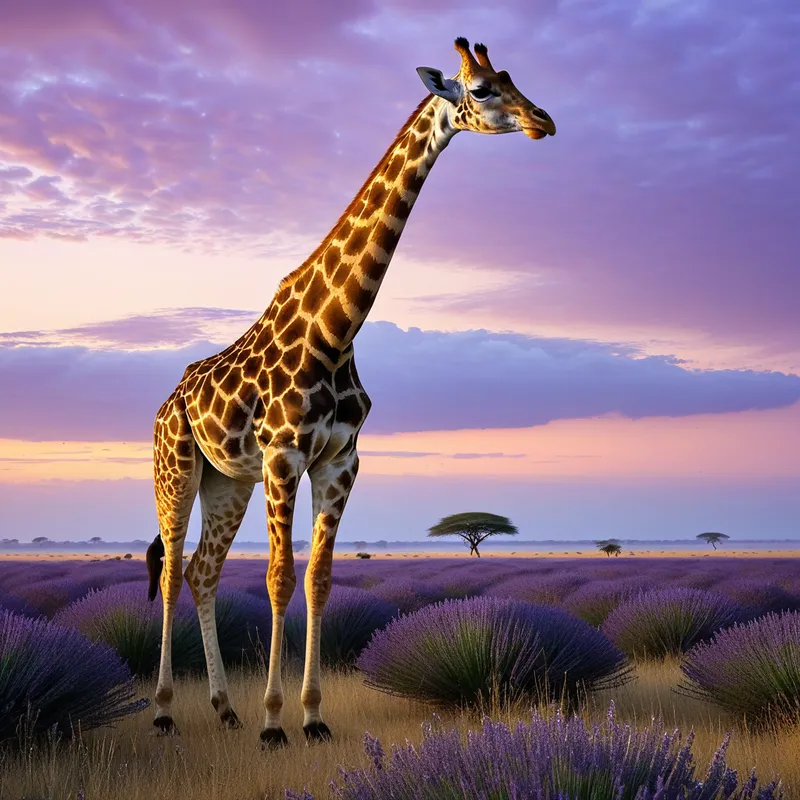
The Giraffe Myth Meaning & Symbolism
A myth of profound longing where the first giraffe is stretched by the gods to reach the heavens, becoming a bridge between earth and sky.
The Tale of The Giraffe
In the time before time, when the earth was still soft from the hands of the First Moulder, the sky was a jealous lover. It held the rain, the sun, and the secrets of the stars close to its breast, far from the dusty reach of the land. The creatures of the earth were low to the ground, their world bounded by the grass, the thorn, and the horizon.
Among them was a being of gentle spirit and quiet eyes. It was not the largest, nor the strongest. It grazed on the tender shoots, its form compact and close to the nurturing soil. But in its heart lived a terrible, beautiful ache—a longing not for the green things at its feet, but for the sweet, golden fruits that hung from the high branches of the acacia. These fruits glowed like captured sunlight, and their scent, carried on the rare breeze, was the very perfume of the sky itself. The creature would stand for hours, neck craned, watching the wind sway the bounty it could never touch.
This longing became its prayer. It did not roar or demand. It simply stood, in silent, patient yearning, offering its desire as the only sacrifice it had. The sky took notice. The earth felt its child’s quiet suffering. The wind carried the plea to the ears of the ancestors in the clouds.
One day, as the creature stood fixed in its ritual of want, the air grew thick and humming. A warmth, not of the sun, bloomed at the base of its neck. The earth beneath its hooves softened, becoming both anchor and cradle. Then, a gentle, inexorable pull began. It was not a tearing, but a stretching, a coaxing, as if its very essence was being drawn upward toward the object of its love.
Its neck elongated, vertebrae singing a new song of space and grace. Its legs strengthened and stretched, lifting its body from the dust of the common ground. The world shrank below—the grass became a carpet, the acacia’s lower branches now within reach. Still, the pulling continued, a divine patience matching its own. Higher. Until its muzzle, trembling, brushed the lowest-hanging fruit. It tasted not just sweetness, but the fulfillment of a soul-deep call.
Finally, the stretching ceased. The creature stood transformed, a living tower of quiet wonder. It could now browse the heavens’ bounty, its head in the realm of birds and clouds, its feet firmly on the earth that bore it. It had become the first Giraffe, the one who was stretched by longing. No longer bound to the horizon, it became the horizon—a walking bridge between the mud and the mystery, a testament that profound desire, sincerely held, can alter the very architecture of existence.
Cultural Origins & Context
This myth, in its many variations, is woven into the oral traditions of several pastoralist and savanna-dwelling peoples across East and Southern Africa, including some Bantu and Nilotic communities. It was never a single, fixed text, but a living story told by elders under the vast, starry sky, its details shifting like the landscape with the teller and the tribe. The giraffe was not merely an animal; it was a cosmological event made flesh.
The story served multiple societal functions. For children, it was a why story, explaining the unique physiology of the most visible and enigmatic creature on the savanna. For adults, it was a moral and spiritual compass. It was told to illustrate the virtues of patience, respectful aspiration, and the power of a heart-focused desire over brute force. In cultures deeply connected to their environment, the giraffe’s form was a daily reminder of a sacred principle: that the physical world is responsive to the spiritual condition, and that a bridge between the mundane and the divine not only exists but walks among us.
Symbolic Architecture
The myth’s power lies in its stark, elegant symbolism. The Giraffe is the embodied archetype of the Connector or the Mediator. Its elongated neck is no mere biological adaptation; it is a spiritual antenna, a ladder of aspiration.
The neck is the axis of longing, the physical spine of a psychic reach. It is the distance between what we are and what we sense we could be.
The creature’ initial small stature represents the human condition: grounded, limited, with desires that outstrip our immediate grasp. The unreachable acacia fruit symbolizes the numinosum—the divine, the transcendent, the source of ultimate nourishment that feels just beyond our capacity. The silent, patient longing is the essential prayer, the correct orientation of the soul. It is not a demand, but an open-handed yearning that makes the self available to transformation.
The act of stretching by the ancestral forces is the divine response. It signifies that the universe conspires to aid a sincere seeker. The transformation is not self-willed ego inflation, but a graceful yielding to a greater will that operates through our deepest desires. The resulting Giraffe, with its head in the clouds and feet on the earth, becomes the perfect symbol of integrated being—the individual who successfully brings heavenly insight down to ground level, who lives in both worlds without dissociation.

The Dreamer's Resonance
When this myth stirs in the modern unconscious, it often manifests in dreams of elongation, reaching, or bridging impossible gaps. One might dream of stretching one’s own neck, of growing taller to see over a wall, or of a staircase that extends into the clouds. These are not mere whimsy; they are somatic metaphors for a psychological process underway.
The somatic feeling is one of tension and release—the ache of a desire that is stretching the psyche beyond its comfort zone. The dreamer is in the midst of what James Hillman called “soul-making,” where a specific longing (for creative expression, spiritual understanding, a higher perspective in life) is actively reconfiguring their inner structure. The dream confirms the longing is valid and that the process, though potentially uncomfortable, is sacred. It is the psyche reassuring itself that growth is happening, that the horizon of the self is expanding. To dream of the Giraffe is to feel the gentle, inexorable pull of your own potential.

Alchemical Translation
For the modern individual navigating the path of individuation, the Giraffe’s myth is a masterful map of psychic transmutation. The “base metal” of our initial state is the limited ego, identified solely with its earthly concerns and immediate gratifications. The “gold” is the integrated Self, capable of holding both primal groundedness and transcendent awareness.
The alchemical process begins with the longing (the desiderium), which acts as the fire in the athanor. This is not a casual want, but a soul-deep hunger for the fruit of meaning. The critical stage is the patient standing, the mortificatio or surrender. Here, the ego must cease its frantic striving and simply hold the tension of the desire, allowing it to burn away impatience and entitlement.
The transformation occurs not in the grasping, but in the faithful standing within the ache of the unattained.
Then comes the divine stretching, the sublimatio. This is the uplifting of consciousness, the painful-yet-graceful expansion of perspective forced upon us by life itself—through loss, love, crisis, or insight. Our old compact form is altered. We are given a new vantage point. Finally, we achieve the coniunctio: the stable union of above and below. We become the Giraffe. We learn to feed on high insights (the acacia fruit) while remaining responsible and connected to our earthly reality (the solid ground). The neck, once a site of straining, becomes a channel of graceful connection. We become living bridges, and our unique height, born of our unique longing, becomes our gift—a reminder to all that the sky is not a ceiling, but a destination to which we are all, mysteriously, stretched.
Associated Symbols
Explore related symbols from the CaleaDream lexicon: