
The Little Mermaid Myth Meaning & Symbolism
A mermaid sacrifices her voice and endures agony for a human soul and a prince's love, finding transcendence not in union, but in her own spiritual evolution.
The Tale of The Little Mermaid
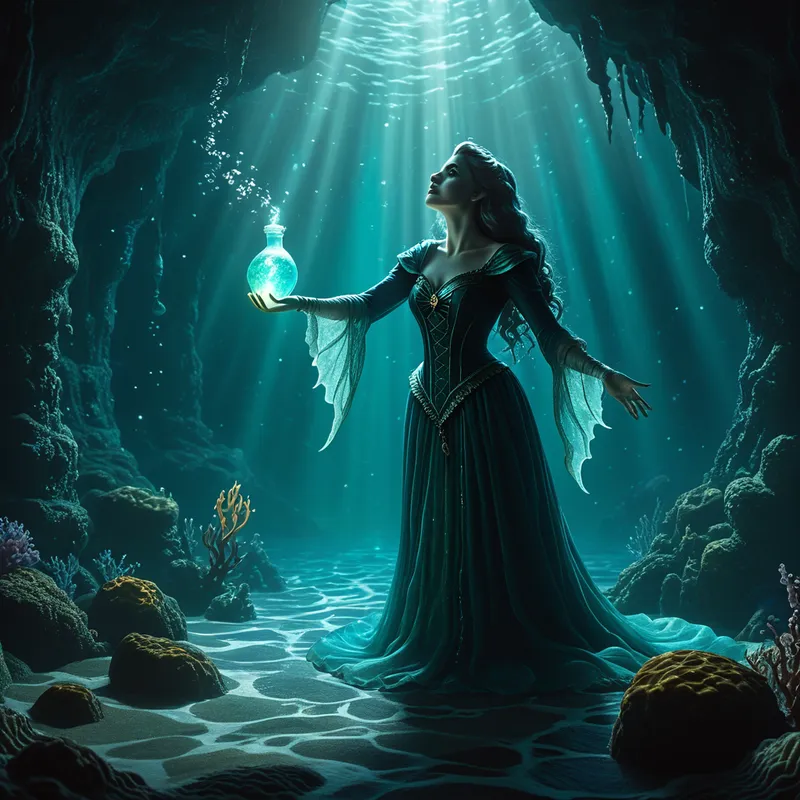
Beneath the indigo cloak of the sea, where sunlight fractures into dancing cathedral beams, lived the Sea King. In his deepest garden of whispering coral and sighing anemones dwelt his youngest daughter, a creature of such curious spirit that her only solace was a marble statue of a handsome youth, salvaged from a sunken ship. While her sisters adorned their grottos with treasures, she cultivated a garden of blood-red flowers, the color of the world above she ached to know.
On the eve of her fifteenth year, she rose. Breaking the silver skin of the ocean, she beheld a world of burning stars and crisp, singing air. And on a grand ship, lit with laughter and music, she saw him—a prince with eyes as dark as her depths. A storm, swift and brutal, shattered the revelry. As the ship was devoured, she dove through the wreckage, pulling the unconscious prince to shore. She laid him on white sand, watching as dawn painted his face, and when mortal women found him, she slipped back into the foam, her heart now anchored to a world where she could not breathe.
This longing became a sickness no sea-blossom could cure. In desperation, she sought the Sea Witch, who dwelled where no light dared venture, in a house of bleached bones. “I know your desire,” the witch hissed, her voice like grinding stones. “I can give you legs, a form to walk among them. But every step will feel as if you tread on sharp swords. And the price is your voice, the loveliest in all the ocean.” The mermaid, her eyes wide with terror and resolve, nodded. “More,” cackled the witch, “you will only gain an immortal soul if the prince loves you and weds you. If he weds another, at dawn following his wedding night, your heart will break and you will dissolve into sea foam.” With a trembling hand, the mermaid drank the potion, a fire that tore her tail in two. She washed ashore, mute and exquisite, a creature of silent agony.
The prince found her, a beautiful, voiceless enigma, and cherished her as one cherishes a strange and lovely pet. He loved her solemn eyes, her dancing despite the hidden knives in her feet, but he loved another—the maiden from the shore he believed had saved him. On the night of his wedding, the mermaid danced for the last time, her feet bleeding upon the deck, a final, silent elegy for a soul she would never claim. As the bridal ship sailed, her sisters surfaced, their hair shorn. “We traded our hair to the witch for this dagger,” they wept. “Strike the prince’s heart, let his warm blood fall on your feet, and you will become a mermaid again. Live out your three hundred years!” The mermaid took the blade, entered the bridal chamber, saw the prince sleeping with his head upon his new wife’s breast… and flung the dagger into the sea. At dawn, she felt her body dissolving into foam.
But she did not cease to be. Rising into the air, she heard ethereal voices. “You have suffered and raised yourself,” they sang. “Through your striving, you have earned the chance to earn an immortal soul through good deeds, a task of three hundred years. Rise, daughter of the air.” And so she ascended, not into oblivion, but into a new, aching possibility.
Cultural Origins & Context
This is not an ancient folktale dredged from the collective unconscious of a people, but the deliberate, painful creation of a single, profoundly sensitive man: Hans Christian Andersen. Written in 1837 and deeply autobiographical, the myth springs from the Romantic era, yet it subverts its own genre. While Romanticism often celebrated the fusion with the beloved as ultimate fulfillment, Andersen’s tale is one of unrequited love and spiritual ambition. Andersen, a socially awkward, homely man from poor origins who yearned for acceptance in high society (symbolized by the prince) and who harbored deep, often unreciprocated romantic attachments (including to both men and women), poured his personal agony of being the “other” into the mermaid’s silent suffering. The tale functions as a complex societal artifact: a moral fable for children about self-sacrifice, but for adults, a devastating portrait of the artist’s plight—to feel profoundly, to strive for a higher realm of existence (artistic immortality, a soul), and to pay for that aspiration with personal happiness, often misunderstood and voiceless in a world that cannot hear your true song.
Symbolic Architecture
The myth’s power lies in its stark, alchemical symbols. The Sea Kingdom is the realm of the unconscious, of pre-individuated bliss where one is connected to the family (the sisters, the father) but lacks a discrete, eternal self—a soul. The human world above is the realm of consciousness, spirit, and moral consequence.
The central sacrifice is not of the tail, but of the voice. To gain consciousness, one must often surrender the native, instinctual language of the unconscious.
The mermaid’s voice is her authentic self, her soul’s song. Trading it for legs is the brutal pact of socialization: we mute our deepest nature to walk in the human world, and every step toward acceptance is laced with hidden pain. The prince represents not just a romantic object, but the idealized animus—the bridge to the spiritual world she craves. His failure to recognize her is the tragedy of the conscious mind’s inability to comprehend the sacrifices the soul has made to reach it.
The transformation into foam is not a punishment, but a necessary dissolution. The old form—the identity of the suffering, yearning creature—must die. The Daughters of the Air represent a third, transcendent state: neither sea (unconscious) nor earth (conscious human), but spirit. They model the outcome of the individuation process: a painful, earned consciousness that works toward its own completion.
The Dreamer's Resonance
When this myth surfaces in modern dreams, it signals a profound somatic and psychological process of muted transformation. Dreaming of being unable to speak while trying to communicate a vital truth mirrors the mermaid’s voicelessness. It speaks to a time when the dreamer has sacrificed their authentic expression for acceptance in a relationship, career, or family system, and is now feeling the “knives underfoot”—the chronic, low-grade agony of inauthenticity.
Dreams of being between elements—partly in water, partly on land, comfortable in neither—point to a liminal state of identity. The dreamer is no longer who they were (the sea-creature) but not yet fully integrated into who they are becoming (the human with a soul). The specific image of watching a beloved from a distance, unable to bridge the gap, often relates less to the person and more to an unattained aspect of the Self—a wholeness that feels just out of reach. The somatic experience is one of constriction in the throat and pain in the feet, a body memory of the myth’s central trade.

Alchemical Translation
The mermaid’s journey is a perfect map of individuation, not as a glorious hero’s conquest, but as a lover’s painful sacrifice. The alchemical process begins with the nigredo: the blackening, represented by her descent into the Sea Witch’s abyssal grotto. Here, in the darkest part of the psyche, the deal is struck. The old, instinctual body (the tail) must be dissolved in the fiery potion of conscious choice.
The albedo, or whitening, is her life on land—a purification through suffering. Each painful step is the burning away of oceanic naivete, forging a will and endurance that her serene life under the sea never demanded.
Her refusal to kill the prince is the critical moment of rubedo, the reddening. It is the ultimate integration of shadow. The impulse for vengeance, for reclaiming her old life at the cost of another’s (the shadow’s solution), is presented to her by her own sisters—her own psychic family. By rejecting it, she does not merely choose “goodness”; she chooses a higher synthesis. She sacrifices not for the prince, but for her own ethical becoming. Her dissolution into foam is the death of the ego-attachment to the outcome. She wanted a soul through the prince. She gains the possibility of a soul through her own act.
The Daughters of the Air represent the citrinitas, the yellowing or spiritual dawn. Her work is now active, conscious, and oriented toward the future. For the modern individual, the myth teaches that the goal is not to win the prince—the perfect job, partner, or social standing—but to endure the transformative agony that the desire for those things initiates. Our true “immortal soul” is not granted by another’s love, but earned through the lonely, voiceless, and painfully conscious work of becoming ourselves, often in the very moment we let our deepest longing go.
Associated Symbols
Explore related symbols from the CaleaDream lexicon: