
Bird of Paradise Myth Meaning & Symbolism
A myth of a young man's ultimate sacrifice, transformed into the first Bird of Paradise, embodying eternal beauty and the soul's journey beyond the body.
The Tale of Bird of Paradise
Listen. Before the world was as it is, when the forest breathed with the spirits of the ancestors and the mountains were young gods, there lived a young man. He was not the strongest hunter, nor the most cunning storyteller, but in his chest beat a heart attuned to a different rhythm—the rhythm of the sky, the sigh of the wind through the kapok trees, the distant, aching cry of birds no one had ever seen.
He felt a constant, gentle pull, a homesickness for a place he had never been. While others danced to the drum, he heard a melody behind it. While others saw the green canopy, he glimpsed flashes of impossible color, just beyond sight. This longing grew, a vine wrapping around his spirit, until it became a quiet agony. He could no longer eat the food of the earth; he craved only light. He could no longer walk the familiar paths; his feet yearned for the empty air.
He went to the elders, his eyes holding the sheen of distant storms. “I must go,” he said, his voice barely a whisper. “The sky calls me home.” The elders, who knew the old ways, understood. They saw not madness, but a profound summons. They prepared him not for a journey of the feet, but of the soul. They painted his skin with sacred ochre and chalk, patterns that told the story of his life and the story of his becoming. They adorned him with shells and bones, the treasures of the earth he was to leave behind.
At dawn, he climbed to the highest cliff, where the world fell away into the mist-filled valleys. His family and village watched from below, their hearts a mixture of grief and awe. He did not look back. He raised his arms, not in surrender, but in greeting. The first ray of the sun broke over the mountain ridge and touched his painted chest.
And he stepped into the void.
He did not fall. The air, which had called him for so long, received him. The wind became his bones. The sunlight became his blood. The longing in his heart burst forth in a silent, radiant explosion. His earthly body dissolved—the ochre, the shells, the flesh—transmuted into something utterly new. From his back erupted plumes of living light: cascades of crimson, filaments of gold, shimmering capes of emerald and sapphire. His cry, once human, became the strange, beautiful call that echoes in the high canopy.
Where the young man had stood, now hovered the first Bird of Paradise. He dipped his glorious head once toward the people below—a final blessing, a final farewell—and then turned, catching a current of wind. He ascended, a living piece of the dawn, into the realm from which he had always been summoned, leaving behind only the memory of his sacrifice and the eternal, breathtaking beauty of his new form.

Cultural Origins & Context
This myth, in its many localized variations, is woven into the cultural fabric of numerous groups across Papua New Guinea, particularly in the highlands and lowland rainforests where these magnificent birds are endemic. It is not a singular, canonical text, but a living oral tradition, passed down through generations by elders and storytellers. Its transmission is performative, told during initiations, at communal gatherings, or in the quiet of the family hearth, its details shifting slightly like the patterns in river water, yet its core remains constant.
The myth functioned as a profound cosmological and social anchor. It explained the origin of the region’s most awe-inspiring natural phenomenon—the Bird of Paradise—linking it directly to human essence and ancestral action. More importantly, it served as a powerful narrative framework for understanding sacrifice, transformation, and the relationship between the individual and the community. The young man’s journey was not a rejection of his people, but an ultimate act of service, transforming personal yearning into a communal symbol of beauty and transcendence. His story validated deep, ineffable feelings of longing and difference, providing a sacred pathway for understanding them.
Symbolic Architecture
At its heart, this myth is an alchemical map of the soul’s journey from identification with the earthly ego to realization of its transcendent nature. The young man represents the individual psyche that feels fundamentally out of place in the mundane world—the seeker, the melancholic, the one who carries an unconscious memory of a more luminous state of being.
The most profound sacrifice is not of something you have, but of what you believe you are, to become what you truly are.
His “homesickness” is the call of the Self, in Jungian terms, the central archetype of wholeness. The forest and village represent the known world of the personal unconscious and collective cultural norms. The cliff edge is the liminal threshold, the point of no return in any profound psychological transformation. The leap is the ultimate act of faith—the surrender of the ego’s control and its attachment to a familiar, but limited, identity.
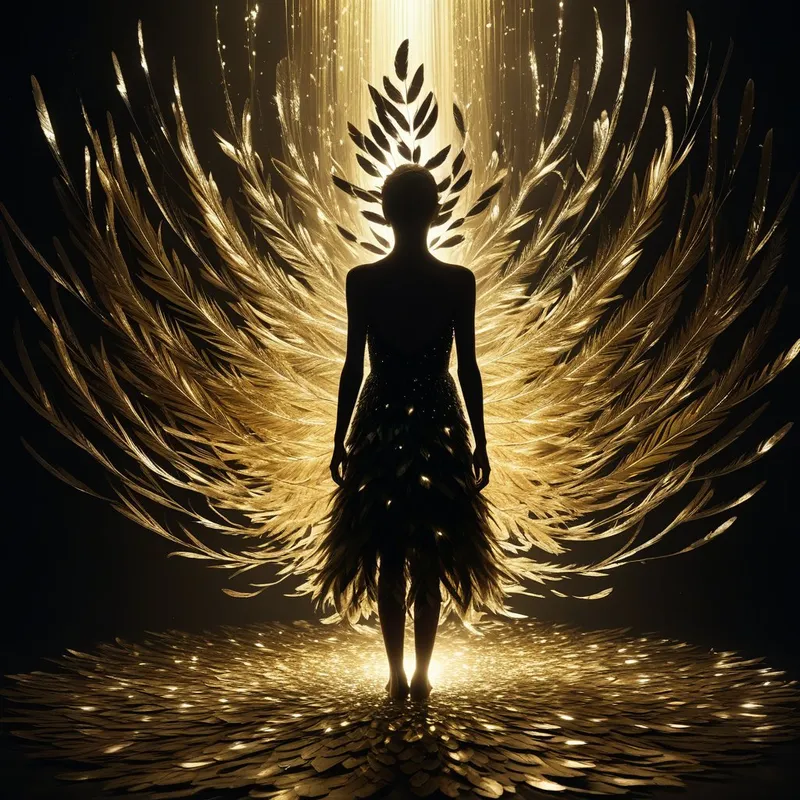
The transformation into the Bird of Paradise symbolizes the emergence of the true, radiant Self. The spectacular plumage is not mere decoration; it is the visible manifestation of inner complexity, unique beauty, and spiritual realization achieved through the ordeal. The bird’s eternal existence in the high canopy represents the soul’s abiding in a state of transcendent awareness, forever connected to, yet distinct from, the earthly realm.

The Dreamer's Resonance
When this mythic pattern stirs in the modern dreamer, it often signals a critical juncture in the process of individuation. To dream of a radiant, unearthly bird, or of preparing for a leap from a great height, is to encounter the psyche’s own call toward a more authentic existence.
Somatically, this may manifest as a literal feeling of “pulling” in the chest, restlessness, or a sense of constriction in one’s current life circumstances. Psychologically, the dreamer may be grappling with a deep, inarticulate yearning for a life that feels more meaningful, even if the path is unclear and requires leaving behind secure but soul-deadening situations—a career, a relationship, an old self-concept. The dream is the unconscious affirming the necessity of the leap. The fear of the fall is present, but so is the promise of the wings. The process underway is the dissolution of the provisional personality to make way for a more essential, spiritually-aligned identity.
Alchemical Translation
The myth of the Bird of Paradise is a perfect allegory for the alchemical nigredo and albedo, culminating in the glorious rubedo. The young man’s aching longing is the nigredo—the darkening, the melancholic prima materia of the soul that feels heavy and leaden with unfulfilled potential.
His decision to answer the call and the elders’ ritual preparation is the beginning of the albedo. This is the conscious engagement with the process: the introspection, the seeking of guidance (the elders), and the purification of intention. The painted patterns on his skin are like the alchemical sigils—a mapping of the inner journey onto the outer form.
The leap from the cliff is the moment of psychic death and rebirth, where the lead of the ego is subjected to the fierce heat of surrender.
This is the transformative fire. The actual metamorphosis is the rubedo—the creation of the philosophical gold. The radiant Bird of Paradise is the filius philosophorum, the divine child born from the union of conscious will and unconscious calling. For the modern individual, this translates to the arduous but beautiful work of shedding inauthentic layers of the personality—the roles, masks, and compromises—to discover and express one’s unique and innate brilliance. The myth teaches that this brilliance often feels like a calling from beyond oneself, and its realization invariably requires a sacred sacrifice of the familiar ground. We are asked to trust the void, for it is in the freefall of surrender that our true wings are forged.
Associated Symbols
Explore related symbols from the CaleaDream lexicon: