The Bamboo Cutter Myth Meaning & Symbolism
An old bamboo cutter finds a radiant infant in a glowing stalk, raising her as his daughter, only for her celestial origins to reclaim her.
The Tale of The Bamboo Cutter
Listen, and hear a tale not of earth, but of the space between heaven and the human heart. In a time when the mountains were young and the rivers sang clearer songs, there lived an old bamboo cutter, Taketori no Okina. His life was one of simple rhythm: the whisper of the wind through the groves, the clean scent of split cane, the patient accumulation of days.
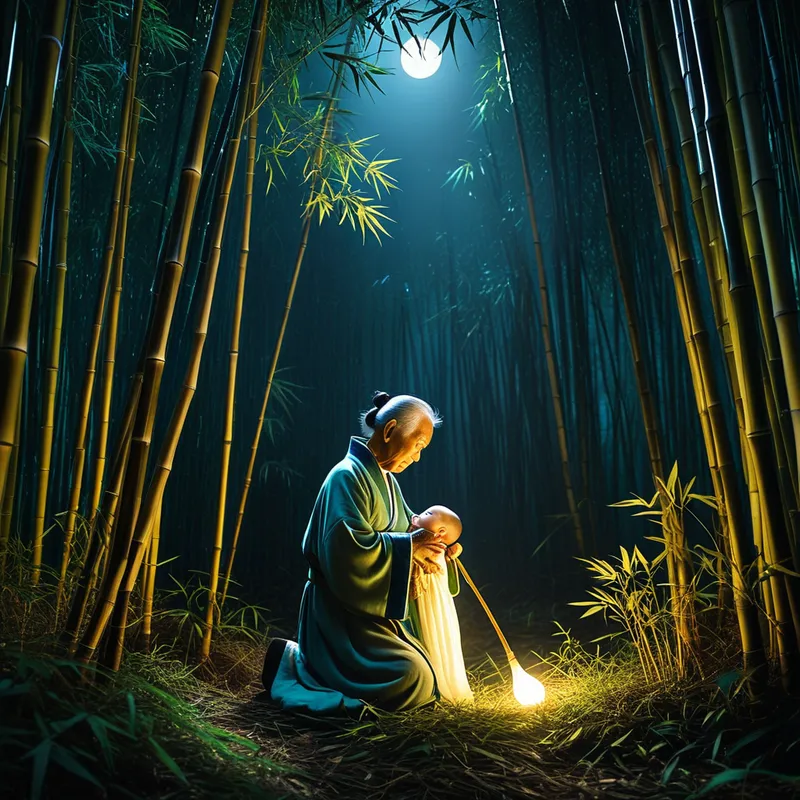
One day, as the low sun painted the world in long, golden shadows, he entered a particular grove. A single stalk of bamboo caught his eye, for from its base poured a light that was not of this world—a soft, phantasmal glow, as if it contained a captured moonbeam. Compelled by a awe he could not name, he took his blade and, with a reverent hand, split the stalk.
Inside, seated in a hollow of light, was a creature of impossible delicacy. A girl, no larger than his thumb, yet formed with a perfection that stole his breath. Her skin seemed spun from moonlight itself, and she radiated a gentle warmth. The old man, whose life had known the solid textures of earth and wood, wept with a sudden, fierce joy. He gathered her into his rough hands, as one would cradle a fallen star, and carried her home to his wife. They named her Kaguya-hime, the Shining Princess.
From that day, the old man’s fortunes changed. Each time he cut bamboo, he found a stalk filled with gold. Their poverty melted away, replaced by a mansion and silks. But the true treasure was the girl, who grew not as mortals do, but with a swift, unsettling grace. In mere months, she was a woman of breathtaking, unearthly beauty, whose presence filled rooms with a quiet luminescence and a sorrow that had no earthly source.
Her fame spread like wildfire, reaching the ears of the Emperor himself. Yet, to each noble suitor who came bearing poems and promises—and to the Emperor, who offered his very heart—Kaguya-hime set an impossible task. Bring me the stone bowl of the Buddha from India, she said to one. Fetch the jeweled branch from the mythical island of Hōrai, she demanded of another. She asked for the robe of the fire-rat, the dragon’s five-colored jewel, the easy birth charm from a swallow’s nest. These were not mere whims, but a desperate strategy. For she knew, in the silent chambers of her celestial memory, that these things did not, could not, exist in the mortal realm. She was building a wall of impossibility to keep the world at bay.
But walls, even celestial ones, cannot hold forever. As the full moon of autumn grew fat in the sky, a deep melancholy settled upon Kaguya-hime. She would sit for hours, gazing at the lunar disc, tears tracing silver paths down her cheeks. The dread she had long held secret could no longer be contained. She confessed to her weeping parents: she was not of this earth. She was a being of the Tsuki-no-Miyako, the Capital of the Moon, sent to this world as a transient exile. And now, her people were coming to take her home.
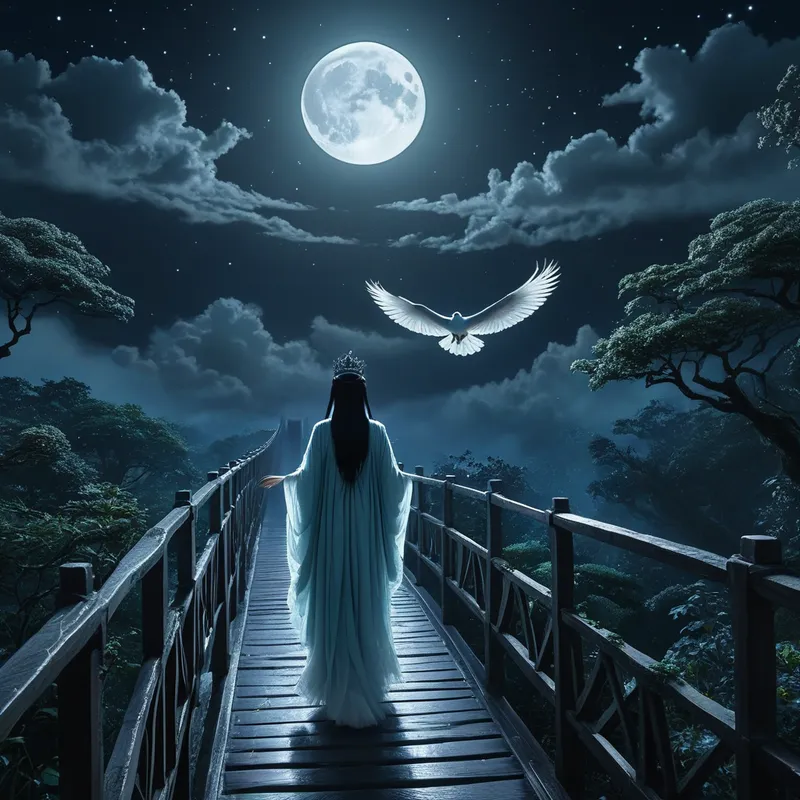
On the appointed night, the heavens themselves opened. The moon swelled, blindingly bright, and from its face descended a host of celestial beings, riding a bridge of luminous cloud. They were clad in robes of feathers and light, their faces serene and alien. In their hands they carried the Hagoromo, the feather mantle of return. As they draped it over Kaguya-hime’s shoulders, the last of her earthly sorrow and love began to drain away, replaced by the cool, empty peace of the cosmos. She offered her grieving father a letter and a vial of the Elixir of Immortality, then stepped onto the cloud-bridge. She did not look back. The procession ascended, growing smaller and smaller, until it was swallowed by the moon’s brilliant face, leaving the old man and his wife clutching tokens of a love that was now only a memory, under a moon that would never again look the same.
Cultural Origins & Context
This poignant narrative is, in fact, the cornerstone of Japanese monogatari literature: Taketori Monogatari, dating from the late 9th or early 10th century. While it draws deeply from the well of Chinese Daoist lore—particularly the imagery of celestial maidens, moon palaces, and elixirs of immortality—it is a fundamentally Japanese tale that was refined in the Heian court. Its societal function was multifaceted. On one level, it was a captivating romance and adventure story. On another, it served as a subtle critique of aristocratic ambition, as the suitors’ futile quests highlight the emptiness of worldly desire. Most profoundly, it gave narrative form to a core Buddhist truth: the inherent impermanence of all worldly attachments, no matter how beautiful. The tale was passed down not by bards in market squares, but read aloud in incense-filled chambers, its beauty and tragedy reflecting the elegant melancholy of the era.
Symbolic Architecture
The myth is a perfect vessel for profound human anxieties and longings. Kaguya-hime is the ultimate orphan archetype. She is the soul who feels it does not belong to this world, the sensitive child in a coarse family, the artist in a pragmatic society. Her radiant beauty symbolizes a purity of essence that is constantly threatened by contamination from the mundane.
The treasure found in the bamboo is not the child, but the crack in reality her presence creates—a glimpse of the numinous in the ordinary.
The bamboo stalk itself is rich symbolism: hollow, it represents a vessel; segmented, it shows the stages of life; flexible yet strong, it embodies resilience. It is the conduit between worlds. The impossible tasks she sets are not cruelty, but a profound psychological defense. They are the tests we create to prove our world is worthy of our secret, fragile selves, knowing it will likely fail. The final ascent is not a victory, but a resignation—the retreat of the soul into a protective, but isolated, transcendence when earthly integration seems too painful.

The Dreamer's Resonance
When this myth stirs in the modern unconscious, it often manifests in dreams of profound alienation or a summons from a distant, coldly beautiful place. One might dream of finding a mysterious, glowing object in a mundane setting (the office, the backyard), only to have authorities or faceless beings arrive to reclaim it. This is the somatic signal of a core self feeling exposed and vulnerable.
Alternatively, dreaming of watching a loved one ascend into the sky, unable to follow, speaks to the painful process of differentiation—when a part of our psyche (an ideal, a relationship, an old identity) must be released because its true origin is not in our current life. The dreamer undergoing this process often feels a deep, inexplicable grief upon waking, a homesickness for a home they have never known. It is the psyche processing the fundamental loneliness of individuation.
Alchemical Translation
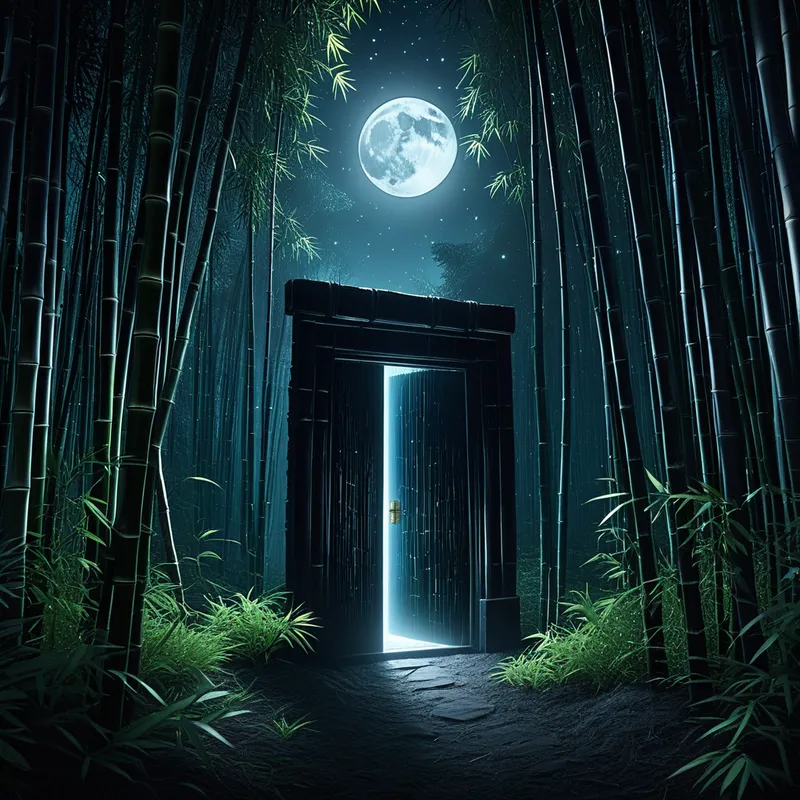
The alchemical journey here is not one of conquering a dragon, but of holding the tension between two irreconcilable realms: the celestial and the terrestrial. The initial stage is the nigredo: the cutting open of the bamboo, the shocking emergence of the divine child into a world utterly unprepared for it. This is the moment of awakening, often painful and disruptive.
The tasks set for the suitors represent the albedo, the endless, often futile-seeming work of attempting to translate the soul’s longing into worldly terms—seeking the perfect job, the ideal partner, the ultimate achievement to justify one’s feeling of being special. This stage is meant to fail, to burn away the ego’s attempts at possession.
The final transmutation occurs not in keeping the celestial, but in fully grieving its loss, thereby integrating its essence.
The true rubedo, the reddening, is achieved by the old bamboo cutter, not Kaguya-hime. He is the part of the psyche that must learn to love and nurture the transcendent, then let it go without bitterness. He is left with the Elixir—not consumed, but held. This elixir is the distilled memory of the encounter with the numinous. It does not grant literal immortality, but it transforms the one who holds it. The mortal life, once touched by the celestial, is forever altered; its very impermanence is imbued with meaning. The individual is no longer purely of this world, nor of the other, but becomes the bamboo stalk itself: the living, breathing, hollow space where the two worlds meet, and in that meeting, find a sorrowful, beautiful, and uniquely human grace.
Associated Symbols
Explore related symbols from the CaleaDream lexicon: