Bran's Voyage Myth Meaning & Symbolism
A warrior king sails to a magical island of timeless joy, only to be undone by a forgotten promise, revealing the cost of paradise.
The Tale of Bran's Voyage
Listen now, and let the hearth-fire grow low. I will tell you of a time when the world’s edges were soft, and the sea-road led not just to other lands, but to other whens.
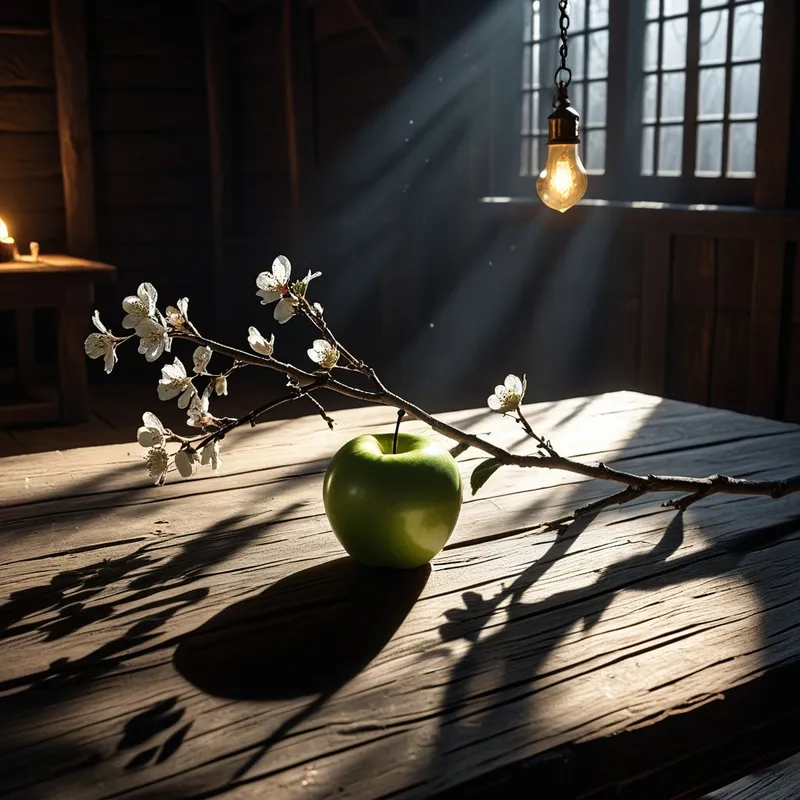
There was a king, Bran mac Febail, who walked one day near his own fort. The air was still, the world holding its breath. Then, he heard a music that was not of this earth—a melody so sweet it stilled the birds in mid-flight and made the very stones yearn. It came from behind him. He turned, and there, on the green grass, lay a branch of silver. From it hung white blossoms, and from the blossoms came that unearthly song.
As Bran stood, wonder-struck, a woman appeared. She was of the Túatha Dé Danann, clad in raiment that shifted like the sea. She sang to him, not with a human voice, but with the voice of the branch itself. She sang of a distant island, <abbr title="The "Land of Women," a paradisiacal Otherworld island in Irish myth">Tír na mBan, a place beyond sorrow, beyond age, where apple trees bore fruit year-round and joy was as constant as the sun on the waves. “Sail west, Bran,” her song commanded. “Sail towards the setting sun, and you will find it.”
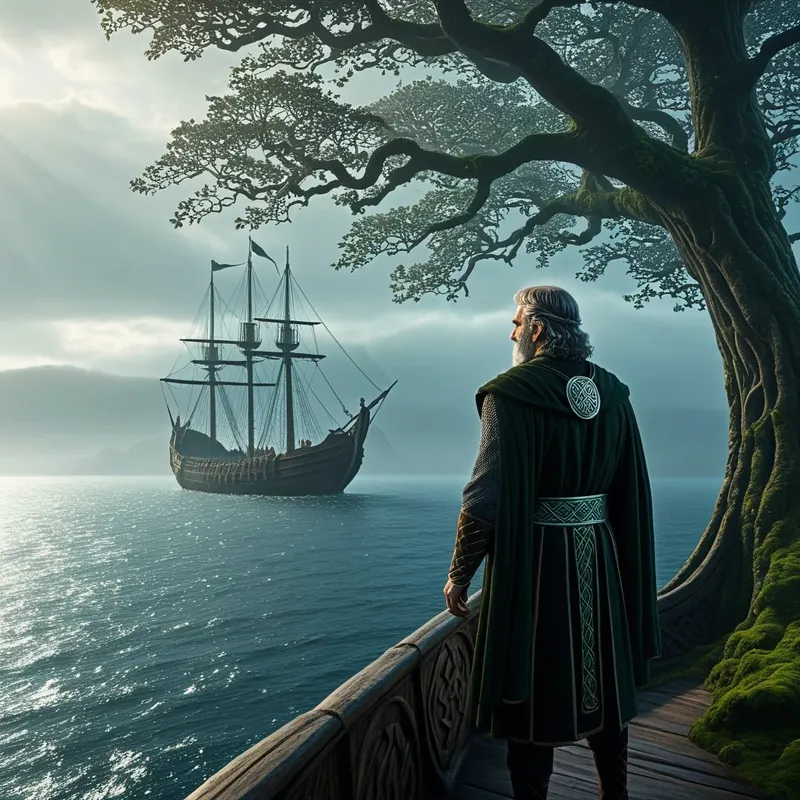
The song entered his bones. It became a thirst no earthly mead could quench. So Bran gathered three companies of nine men each—nine times three, a sacred number—and they launched their sturdy currach into the grey Atlantic. For two days and two nights they rowed into the unknown, the world of men fading behind them like a dream.
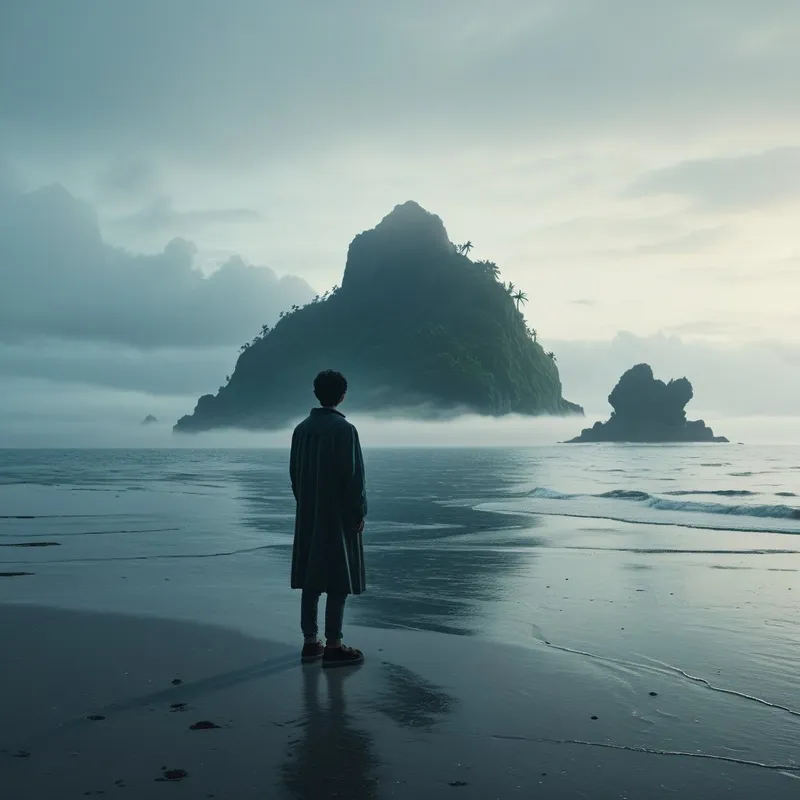
Then, on the third day, the sea mist parted. They saw it: an island, green and radiant, floating on the horizon. As they drew near, the woman who had sung to Bran stood on the shore, but now she was not alone. With her were many women, each more beautiful than the last, and their laughter was the music of the silver branch made flesh. They welcomed the voyagers with open arms, and led them into a hall where feasting knew no end. Time ceased its cruel march. A day was a year, a year a moment. In <abbr title="The "Land of Women," a paradisiacal Otherworld island in Irish myth">Tír na mBan, there was no illness, no conflict, no shadow of death—only the eternal, blissful present.
Centuries flowed like a gentle stream. Yet, in the heart of one of Bran’s men, a seed of homesickness took root. His name was Nechtan. He began to speak of Ireland, of the familiar hills and the smell of peat smoke. He pleaded to return, just for a day, to see the old shores. The women of the island warned them gravely: “If your feet touch the soil of the land you once knew, you will be subject to all the years you have evaded. They will fall upon you in an instant.”
But Nechtan’s longing was a tide too strong. Bran, perhaps moved by loyalty to his man, agreed. They set sail once more. As their boat approached the coast of Ireland, they saw people on the shore who looked strange, dressed in unfamiliar garb. Bran called out to them, announcing himself as Bran mac Febail, returned from a great voyage.
A man on the shore frowned. “We know of no Bran mac Febail,” he shouted back. “But in our oldest tales, there is a story of a Bran who sailed to the Otherworld long, long ago.”
Hearing this, Nechtan’s heart broke. He could bear it no longer. He leapt from the boat onto the sandy shore. The moment his feet touched the earth, he crumbled. Before Bran’s eyes, Nechtan withered, his body consuming centuries in a single breath, becoming a heap of dust. And Bran, still in his boat, knew he could never land. He and his remaining crew turned their vessel around and vanished back into the western mist, forever caught between worlds, a story sung by bards to those who still listen for the music of the silver branch.
Cultural Origins & Context
This haunting narrative is preserved in the Book of the Dun Cow (Lebor na hUidre), dating to the 11th century, though the tale’s roots are far older. It belongs to the echtrai (adventure) and immrama (voyage) genres of early Irish literature—stories that map not geography, but psychology and cosmology. These were tales told by the filid, the poet-seers, who served as the memory and spiritual guides of their people.
The function of such a myth was multifaceted. On one level, it was pure entertainment, a spellbinding adventure. On another, it was a theological and philosophical text. It articulated the Celtic conception of the Otherworld—not a distant heaven, but a parallel reality accessible through certain liminal zones (like the western sea) or states of mind (like the enchantment of music). It served as a cautionary tale about the nature of time, destiny, and the irrevocable consequences of certain choices. Most importantly, it validated the seeker’s impulse—the drive to go beyond the horizon—while solemnly outlining its ultimate price.
Symbolic Architecture
At its core, Bran’s Voyage is a masterful allegory of the human encounter with the numinous—the transcendent, awe-inspiring aspect of the psyche often personified as the Divine or the Eternal.
The silver branch is not an object, but a summons. It is the call of the Self, the total, integrated psyche, to the conscious ego (Bran). Its music is the irresistible pull of meaning, of a destiny that lies beyond the mundane concerns of kingship.
The sea voyage represents the journey into the unconscious. The crew of twenty-seven (three times nine) signifies a complete psychic unit embarking on this quest. <abbr title="The "Land of Women," a paradisiacal Otherworld island in Irish myth">Tír na mBan itself is the archetypal symbol of the anima—the feminine principle within the male psyche (and vice-versa in complementary tales). It represents a state of psychic wholeness, where opposites (joy/sorrow, life/death) are reconciled in timeless unity. It is the goal of the spiritual quest: paradise, nirvana, integration.
Yet, the myth’s profound genius lies in its second half. The homesickness of Nechtan represents the ego’s inability to fully relinquish its old identity. It is the part of us that, even in moments of profound peace, whispers of our former life, our attachments, our need for recognition in the world we knew.
The fatal touch of the homeland’s soil is the catastrophic re-identification with the personal, historical ego. It is the attempt to bring the eternal back into time, to make the ineffable understandable to the old, perishing self. The result is instant dissolution.
Bran’s final fate—to forever wander, unable to return to either world—is the most poignant symbol of all. He represents the individual who has been fundamentally altered by a transcendent experience. They can no longer fit into their old life (they are a legend on the shore), nor can they fully return to the blissful, unconscious state of paradise (they are exiled from the island). They become the eternal voyager, the carrier of the story itself.
The Dreamer's Resonance
When this myth stirs in the modern unconscious, it often manifests in dreams of profound ambivalence. One may dream of finding a perfect, idyllic place—a hidden room in a house, a serene garden—only to realize with dread that they must leave and can never find it again. Or they may dream of holding a beautiful, glowing object that begins to dissolve when they try to show it to someone from their waking life.
Somatically, this can feel like a deep, melancholic longing with no clear object—a “Sehnsucht.” Psychologically, it signals a critical phase in what Jung called the numinous inflation. The dreamer has perhaps touched a state of expanded awareness, a spiritual insight, or a creative flow that feels like paradise. The dreaming culture.") psyche is now working through the inevitable comedown: the painful re-engagement with the mundane, the fear that the experience will be lost, and the warning not to try to force that transcendent state back into the rigid containers of the old personality. The dream is the psyche’s way of processing the grief of transformation, of becoming a stranger to one’s former self.
Alchemical Translation
The alchemical process mirrored in Bran’s Voyage is the journey from nigredo (the blackening, the call to adventure) to albedo (the whitening, the purification on the island) but crucially stalling before a full rubedo (the reddening, the return with the elixir). It models a vital, if painful, stage of individuation.
The call of the silver branch is the prima materia, the initial raw material of the soul’s discontent with ordinary life. The voyage is the solutio—dissolution into the unconscious waters. The sojourn on the island is the coagulatio—a re-formation in a new, purified state. This is where many spiritual quests aim to end: in permanent enlightenment.
But true alchemical gold, the fully realized individual, is forged in the return. The myth shows us a failed return, and in that failure lies its deepest teaching.
The failed return of Nechtan illustrates the danger of the untransformed ego attempting to claim the treasure. It is the spiritual bypass, the attempt to wear enlightenment as a personality badge. The alchemical vessel shatters. Bran’s eternal voyage, however, represents a different outcome. He becomes the lapis exilis, the wandering stone. He does not possess the paradise, but he is transformed by it. His very being is now the vessel for the paradoxical truth: that the ultimate treasure changes the seeker into someone who can no longer live in the old world, yet must remain a wanderer between worlds.
For the modern individual, the myth advises: When you hear the music of your own silver branch—a calling, a vision, a profound love—sail towards it. Immerse yourself in its timeless joy. But do not seek to bring the island back as a trophy. Instead, allow the voyage to dissolve your old certainties. You may return to your “Ireland” not as a conqueror, but as a legend to yourself, forever altered, carrying the bittersweet wisdom of the voyager who has seen the other shore and knows the price of looking back. Your life itself becomes the currach on the endless sea, and your story, the only true homeland.
Associated Symbols
Explore related symbols from the CaleaDream lexicon: