
Mermaid Myth Meaning & Symbolism
A being of two natures, the mermaid embodies the soul's perilous longing for wholeness, caught between the deep unconscious and the world of form.
The Tale of Mermaid
Listen, and let the salt air fill your lungs. Let the horizon, that thin, impossible line between water and sky, hold your gaze. For in that liminal space, the oldest stories breathe. This is not a tale of one sea, but of all seas—the cold grey waters of the north, the warm, wine-dark seas of the south, the endless, whispering Pacific. It is the story of the one who is neither, and both.
In the silent, pressure-filled kingdoms of the deep, where sunlight is a forgotten memory and life glows with its own cold fire, there are those who listen. They listen to the groaning of the earth’s bones, to the songs of the great whales that map the abyss, and to another sound—a faint, rhythmic pounding that drifts down from the world above. It is the sound of waves breaking on land. It is the sound of a heart beating in a fragile cage of ribs.
One such listener we will call Anahita. From the wavering gardens of coral and the forests of kelp, she would rise, drawn by that distant pulse. Her form was a paradox of the deep: the graceful, powerful tail of the greatest fish, scaled in mother-of-pearl, and the torso of a woman, with skin that held the pallor of moonlight on water. Her sisters sang the songs of the tides and the migrations, but Anahita’s song had a hollow echo. It was a song of what if.
One night, during a storm that churned the sea to fury, a new sound pierced the deep. Not the predictable crash of waves, but the sharp, final scream of timber, and then… silence, followed by a slow, sinking rain of debris. And with it, a body. A man, his life fleeing him in silver bubbles. Without thought, driven by a pull older than reason, Anahita caught him. She bore him to the surface, to a sheltered cove where the storm’s rage was a mere whisper. She held his head above the water, watching the dawn bleed into the sky, a spectacle of color her world never knew. As the sun warmed his face, his eyes fluttered open. For a moment, two worlds met in a gaze—the infinite blue-green of the deep, and the finite, earth-brown of the land. He saw not a monster, but a savior of unearthly beauty. She saw not a strange, limb-ed creature, but life, warmth, a consciousness that mirrored her own.
He was taken by his people when a boat searched the cove. Anahita sank below the waves, but the cove, the dawn, the touch of sun on skin, and the echo of that human gaze became an obsession. She began her vigil. Every dusk, she would find the rock nearest his village and watch the lights kindle in the windows. She heard laughter, music—a different, structured song. She saw him walk on the shore, looking out to sea. The longing became a physical ache, a fissure in her soul. The deep songs of her sisters now sounded like dirges. The freedom of the ocean felt like a boundless prison.
The ancient ones of the sea, the Oceanids, whispered of a choice—a terrible, irreversible alchemy. To cross the boundary, to trade tail for legs, was possible. But the price was the very essence of her being: her voice, the instrument of her soul’s magic. And the new legs would bring not grace, but pain, as if walking on sharpened blades. Yet, the longing was a stronger tide. In a hidden cave, under a drowned moon, Anahita sang her last, most beautiful song—a song containing all her memories of the abyssal plains, the dancing phosphorescence, the quiet comfort of the deep—and offered it to the sea. The water took her voice, leaving her in silent anguish. And where her powerful tail had been, two strange, frail limbs appeared.
She washed ashore, found by him. A mute, beautiful stranger. The world of air was a shock—its noises were harsh, its gravity a cruel master. Every step was agony, a constant reminder of what she had sacrificed. She joined his world, a silent observer, loving him with a depth that was oceanic, but unable to speak her truth. She danced on her pain for him, and in her eyes, he sometimes saw a haunting, unplumbed sadness he could never understand. She had gained the object of her longing, but had lost the means to share her soul. She was in the world, but forever not of it, a stranger in both elements now, her true home and her true voice lost in the silent, sunless deep.

Cultural Origins & Context
The mermaid is a true citizen of the world’s mythology, appearing independently from the icy fjords of Scandinavia to the warm shores of the Caribbean, from the ancient Levant to the islands of Polynesia. In West Africa, the Mami Wata is a powerful and ambivalent deity of beauty, healing, and wealth, often demanding devotion. The Assyrian goddess Tiamat, though a more chaotic cosmic force, shares the aquatic, generative-destructive essence. In Europe, the tales were often warnings told by sailors—the Rusalka luring men to drown, or the Scottish Selkie who, though a seal-woman, embodies the same theme of stolen skin and trapped longing.
These stories were not mere fantasy; they were functional myths. For coastal and riverine communities, the sea was the ultimate source of bounty and terror. The mermaid mythologized this relationship. She explained drownings and shipwrecks. She served as a cautionary tale about the dangers of obsession and the perilous allure of the unknown. She was a personification of the sea itself—breathtakingly beautiful, seductive, but ultimately inhuman and deadly to those who would try to possess her. The stories were passed down on long voyages, in fishing huts, and by hearthsides, a collective way of processing humanity’s awe and fear of the vast, unconquerable element that covered most of the world.
Symbolic Architecture
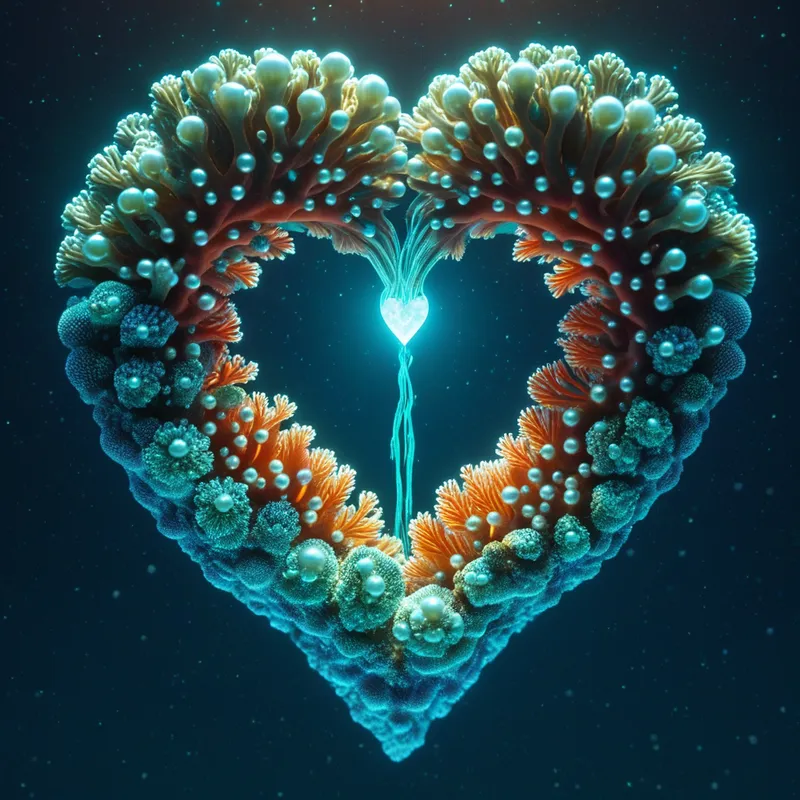
Psychologically, the mermaid is the quintessential symbol of the divided self, the soul caught between two irreducible natures. She is not a hybrid like a centaur, which is unified in its beast-power. She is a being of radical duality: the human above (consciousness, intellect, spirit) and the fish below (the unconscious, instinct, the primal emotional depths).
The mermaid’s tail is the dreaming body of the soul, her human torso the waking mind that yearns for a name, a place, a beloved.
The ocean is the unconscious itself—vast, teeming with life and mystery, the source of all creativity and terror. The land is the realm of consciousness, order, identity, and relationship. The mermaid’s eternal longing is the longing of the psyche for integration. She represents that part of us that is profoundly connected to the deep, instinctual, and emotional currents, yet feels a desperate pull to "come ashore"—to be known, to be embodied in the daylight world of ego and relationship.
Her loss of voice is the critical symbol. To gain the world of form, she must sacrifice her native tongue—the language of the soul, of dream, of pure emotion and instinct. This is the tragic cost of one-sided adaptation. We mute our inner truth to fit in, to be loved, to walk in the human world, but in doing so, we sever our connection to the nourishing, if sometimes terrifying, depths.
The Dreamer's Resonance
When the mermaid surfaces in modern dreams, she signals a profound somatic and psychological crossroads. She appears when the dreamer is experiencing a powerful, often painful, tension between two irreconcilable aspects of life. This could be between a creative calling and practical demands, between a deep emotional need and social expectations, or between spiritual longing and material existence.
Somatically, this may manifest as a feeling of being "neither here nor there," of restlessness, or of a specific, aching longing with no clear object—a "sea-longing." The dreamer might feel out of place, like a stranger in their own life. Dreams of being underwater yet able to breathe, or of trying to speak but having no sound come out, are direct echoes of the mermaid’s condition. The psyche is illustrating the cost of being divided. The mermaid in a dream is not a solution, but a vivid portrait of the problem—the beautiful, agonizing state of the unintegrated soul, calling for attention.

Alchemical Translation
The mermaid’s myth models not a successful individuation, but its most critical and perilous stage: the confrontation with duality and the recognition that wholeness requires a sacrifice of a previously held state. The alchemical parallel is the nigredo, the dark night of the soul where opposites clash.
The goal is not to choose the sea or the land, but to become the shore where both can meet.
For the modern individual, the "alchemical translation" of this myth lies in finding a third way. It is not about cutting off one's tail (denying the unconscious, the instincts, the deep emotional self) to walk painfully on land (a rigid, persona-driven life). Nor is it about drowning the conscious self in the oceanic unconscious (psychosis, addiction, escape). The work is to build a vessel—a conscious ego strong enough and permeable enough to engage with the depths without being dissolved by them.
This means developing a "language" that can translate between the two worlds. It might be art, active imagination, embodied practice, or deep relationship. It is the process of giving voice—not the siren song that lures one to destruction, but a new, grounded voice that can speak of the depths while standing on the shore. One must endure the pain of the divided state, the tension of opposites, until a new, more conscious relationship to both inner and outer worlds is forged. The integrated self is not a mermaid, but a sovereign who can swim in the depths and walk on the land, whose voice contains both the song of the whale and the speech of the human, who has made a home not in one element, but in the sacred, dynamic border between them all.
Associated Symbols
Explore related symbols from the CaleaDream lexicon: