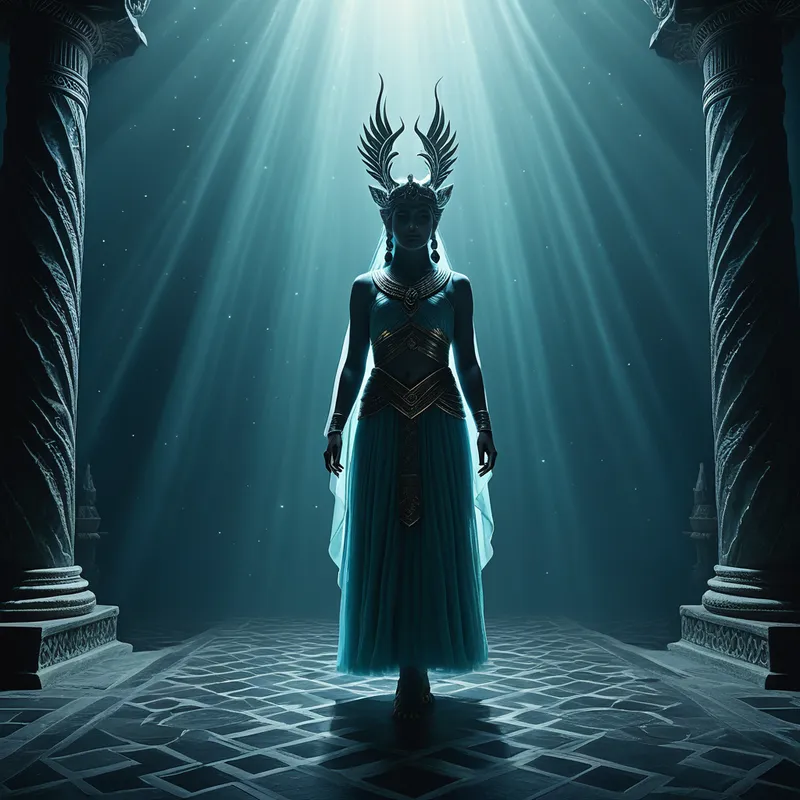
The Shaman's Underworld Descent
An Inuit shaman embarks on a dangerous journey to the underworld to retrieve souls, navigating spirit realms and confronting cosmic forces.
The Tale of The Shaman's Underworld Descent
The world above is locked in a terrible stillness. A sickness has taken root in the community, a wasting of the spirit that medicine cannot touch. A person lies listless, their breath shallow, their eyes seeing nothing of this world. The people know the truth: the soul has wandered, or worse, has been stolen. It has slipped down through the cracks in the ice, into the land beneath the land. Only the angakkuq, the shaman, can follow.
The preparation is a severing from the ordinary. In the dim, smoky warmth of the snow-house, the shaman sits in profound solitude, or surrounded by the rhythmic drumming and chanting of helpers. He fasts, he contemplates, he calls upon his tuurngait. The drum, the qilaun, becomes the heartbeat of the world, its steady pulse the only thread connecting him to the community he must leave behind. He enters a trance, a conscious dying. His body slumps, but his sight turns inward and downward.
The journey begins with a descent. He finds a passage—a crack in the sea ice, a whirlpool in a lead, the mouth of a seal’s breathing hole. It is a tunnel of pressure and darkness, a birth in reverse. The familiar world of sky, snow, and breath is stripped away. He emerges not into a fiery hell, but into a stark, inverted reflection of the world above: Adlivun. Here, the sea is the sky, and the land is barren, lit by a dim, phosphorescent glow. The air is thick and heavy, not with heat, but with the weight of silence and forgotten things.
The ruler of this place is Sedna, the Mother of Sea Beasts. But the shaman’s path first winds through her realm, facing its guardians. He may encounter the tupilak, malevolent spirits fashioned from bone and grievance, or the restless shades of those who died a bad death. His tuurngait clash with these beings in spectral combat, a battle of wills fought in the language of shape and energy. The shaman’s power is not brute force, but negotiation, cunning, and endurance. He must know the true names of things, sing the songs that placate or compel.
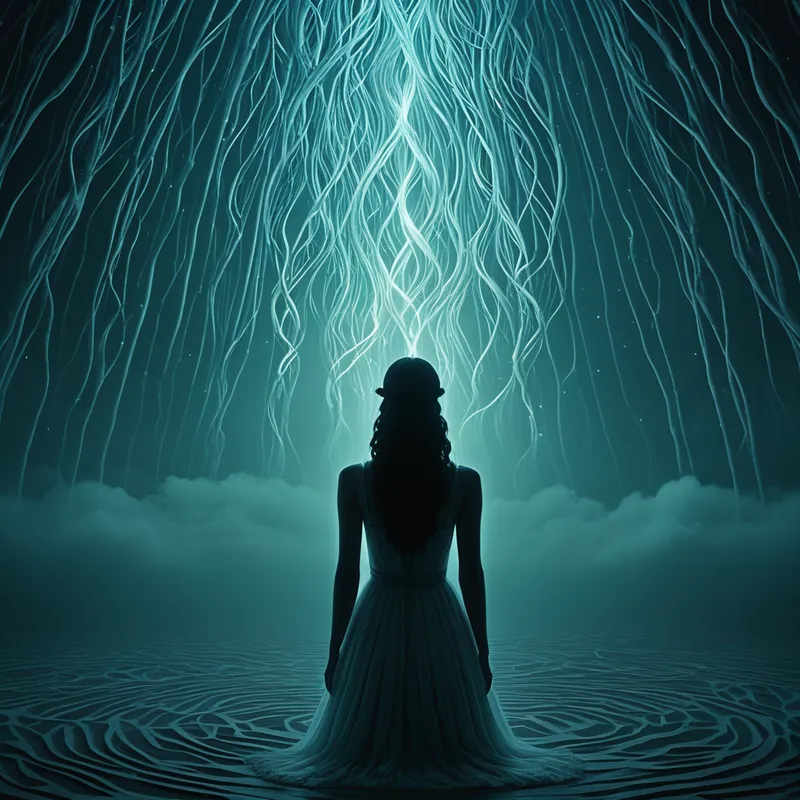
His ultimate trial is an audience with Sedna herself. She resides in a house of ice and stone, her great, tangled hair swarming with the impurities of humanity—the broken taboos, the disrespect shown to animals, the sins that cause scarcity. The lost soul is often caught there, a flicker amidst the greasy strands. The shaman must approach the fearsome goddess. He sings to her, massages her aching limbs (gnarled from her mythic fall), and with great patience and care, combats the filth from her hair. This is no heroic slaying, but a profound act of service and cleansing. He absorbs the community’s transgressions, becoming a vessel for its psychic poison to appease the cosmic order.
Only when Sedna is soothed does she grant permission. The soul, a wisp of light or a small, bird-like essence, is released. The shaman cups it gently, holding it within his own spirit. The return journey is fraught with peril, for the guardians of the threshold do not like to lose what they have claimed. He must race upward, following the thread of the drumbeat that still echoes from the world above, his tuurngait shielding him from grasping hands and chilling winds.
He gasps, convulses, and returns to his body in the snow-house. The journey is etched on his face—exhaustion, a distant terror, a hard-won peace. Leaning over the afflicted person, he breathes the soul back into its home. The person stirs, color returns, the eyes focus. The shaman has not conquered death, but has navigated its antechamber. He has restored balance, mended a tear in the fabric of life, and returned bearing the knowledge that the world below is always there, a necessary shadow to the world of light.
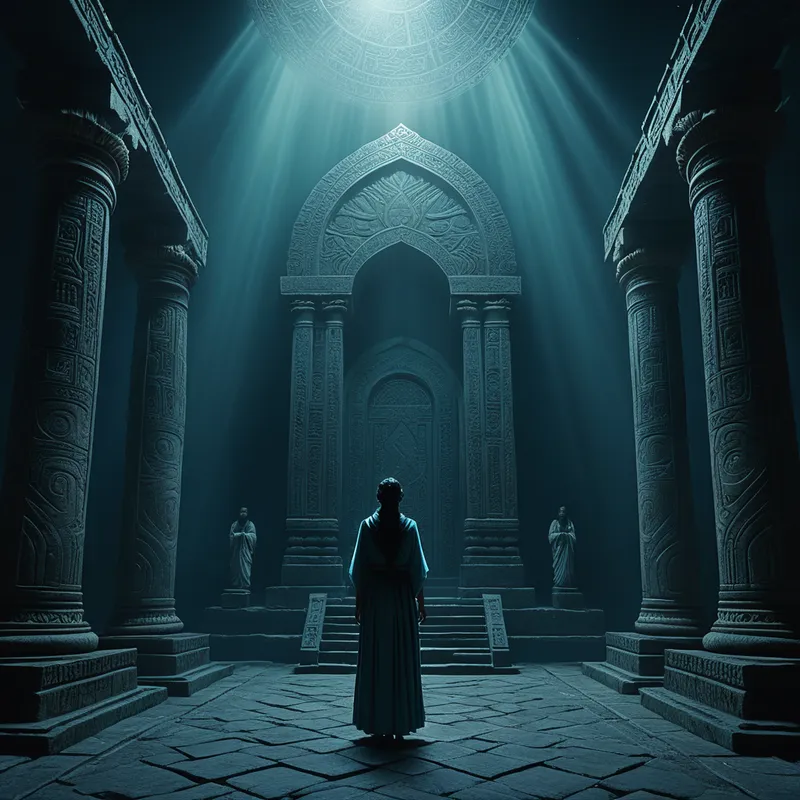
Cultural Origins & Context
This mythic pattern is not mere story but operational cosmology for Inuit peoples across the Arctic. Life in a world of extreme material precariousness—where survival hinges on the hunt, the weather, and the migration of animals—demanded an equally robust spiritual technology. The shaman’s descent was a critical social function, a direct intervention in the metaphysical causes of physical crisis. Illness, famine, and unexplained misfortune were often diagnosed as soul-loss, a concept reflecting the fragile integrity of the self in a world of visible and invisible forces.
The angakkuq was not a priest in a temple, but a practical specialist chosen by spirits, often through a traumatic initiatory illness or vision. His or her authority derived from direct experience of the spirit worlds and the ability to translate between them. The journey to Adlivun was the pinnacle of this work, requiring years of training, a powerful alliance with tuurngait, and immense personal courage. The myth is thus embedded in lived ritual; the tale is the map used for an actual voyage. It reaffirms a worldview where humanity is not above nature or the spirit world, but in constant, delicate negotiation with it. The well-being of the community literally depends on the shaman’s ability to navigate these relationships, to clean the collective shadow embodied by Sedna’s hair, and to restore the flow of life.
Symbolic Architecture
The underworld here is not a place of punishment, but of cause. Adlivun is where the consequences of human action accumulate, affecting the bounty of the world above. Sedna is not a devil, but a wounded, powerful reflector of human morality; her well-being directly correlates to the community’s fortune.
The descent is a movement into the collective unconscious, the submerged landscape where the psychic causes of physical symptoms reside. The shaman’s journey is an active engagement with the archetypal images—the Terrible Mother, the guardians, the lost child-soul—that hold the key to healing.
The ritual is a controlled disintegration. The shaman’s trance is a voluntary ego-death, a temporary dissolution of the bounded self to travel in the fluid realm of the spirit. The return and reintegration of the soul mirrors the shaman’s own return, both requiring a reconstitution of identity around the newly retrieved essence.
The combing of Sedna’s hair is a supreme act of participation mystique and shadow work. The shaman does not destroy the “filth” of broken taboos but takes it upon himself, transforming communal guilt through the ordeal of his journey. He becomes the scapegoat and the redeemer in one.
The Dreamer's Resonance
To encounter this myth in dream or active imagination is to confront one’s own “soul-loss.” It manifests as a pervasive ennui, a feeling of being haunted yet empty, of going through the motions while a vital part of the self is stranded in some inner Adlivun. The myth provides a template for the psyche’s own healing process.
The dreamer may find themselves at a frozen shore, staring into a dark hole in the ice, sensing something precious lost below. This is the call to the descent—an invitation, however terrifying, to recover a disowned passion, a silenced voice, or a frozen capacity for feeling. The guardians encountered—the monstrous tupilak—often personify specific fears or traumas that block access to the deeper self. Sedna represents the Great Mother in her demanding, non-nurturing aspect: the complex of life that feels withholding, angry, or cold because of our own neglected duties to the instinctual and natural world. To heal her is to attend to one’s own neglected depths.
Alchemical Translation
The shaman’s work is a perfect allegory for the alchemical opus. The nigredo, the blackening, is the descent itself—the confrontation with the dark, watery, chaotic underworld (Adlivun), the dissolution of certainty. The lost soul is the filius philosophorum, the divine child or true essence hidden in the prima materia of the unconscious.
The combing of the hair is the separatio and purificatio—the laborious sorting and cleansing of the gross, contaminated elements (complexes, neuroses) from the subtle, valuable ones. The shaman’s spirit-helper animals are the mercurial agents, the facilitating forces of transformation.
The retrieval and return is the albedo and rubedo—the whitening and reddening. The soul, now purified and redeemed, is integrated, bringing new life (the healed patient) and wisdom (the transformed shaman). The entire operation turns leaden despair (sickness, famine) into golden vitality (health, abundance) through the medium of the shaman’s courageous consciousness, which acts as the alchemical vessel.
Associated Symbols
Explore related symbols from the CaleaDream lexicon:
- Underworld — The realm beneath the conscious world, a place of shadows, causes, and the stored consequences of life, where what is lost or repressed awaits recovery.
- Shaman — The wounded healer and mediator who voluntarily traverses the boundary between worlds, translating the language of spirits into healing for the community.
- Soul — The essential, animating essence of a being, which can become detached or stolen, requiring a perilous quest for its retrieval and reintegration.
- Water — The primal, chaotic medium of the unconscious and the underworld; the sea-ice and ocean leads are the thresholds to the depths.
- Door — The permeable boundary between worlds, often a crack, hole, or whirlpool, representing the point of entry into the non-ordinary state of consciousness.
- Journey — The archetypal passage from a state of lack through trials and transformation to a state of wholeness, undertaken for a sacred purpose.
- Transformation Cocoon — The ritual space and trance state that facilitates the shaman’s metamorphosis, a temporary dissolution enabling passage to the spirit realm.
- Shadow — The accumulated “filth” in Sedna’s hair, representing the repressed transgressions, guilts, and broken taboos of the individual and collective psyche.
- Healing — The restoration of balance and flow between worlds, achieved not by eradication of disease but by retrieval and reconciliation of lost parts.
- Ritual — The precise, symbolic actions—drumming, chanting, fasting—that create the sacred time and space necessary to safely navigate a psychic ordeal.
- Dream — The analogue to the shamanic trance; a natural state of descent into the personal underworld where soul fragments and guiding spirits may be encountered.
- Moon — The celestial body governing tides, cycles, and the hidden, reflective realm of the unconscious, lighting the path through darkness with indirect, borrowed light.