Medusa Myth Meaning & Symbolism
A priestess violated and transformed into a monster, whose gaze turns men to stone, is slain by a hero wielding a mirrored shield.
The Tale of Medusa
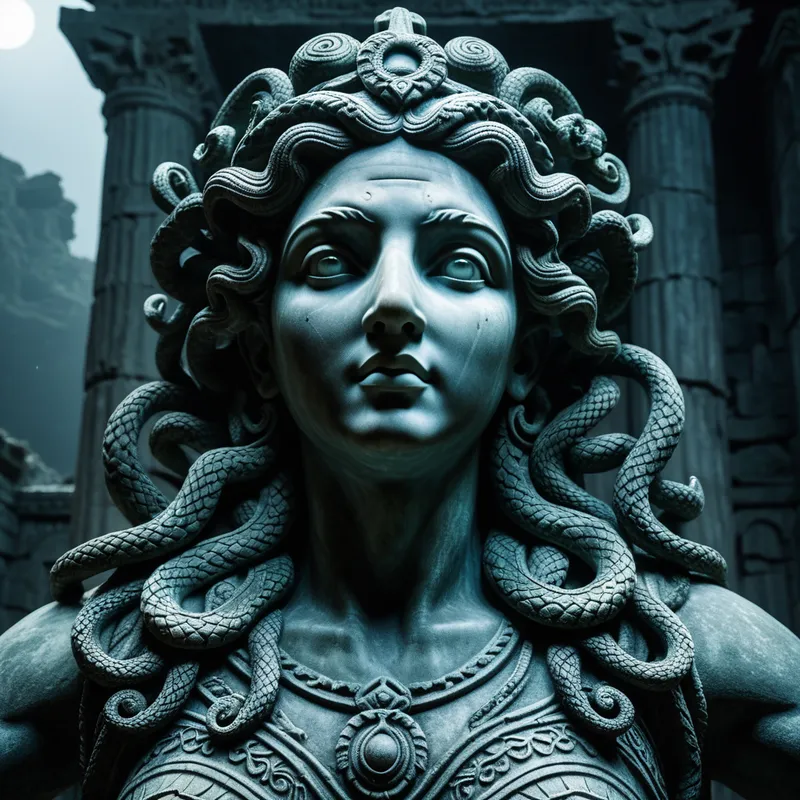
Listen, and hear a tale not of a monster, but of a made thing. Once, in the sun-drenched temples of Athens, there lived a priestess. Her name was Medusa, and her beauty was a hymn to Athena herself. Her hair flowed like dark water, and her eyes held the stillness of a sacred pool. She served in the goddess’s house, a vessel of divine grace.
But the sea is never still. Poseidon, the Earth-Shaker, whose heart is as tempestuous as his domain, saw her. Desire, raw and entitled as a tidal wave, took him. He did not woo; he claimed. In the very sanctuary of Athena’s temple, the god violated the priestess. The marble floor, witness to prayers, was stained with a different sacrament.
And then, silence. Not the silence of peace, but of a verdict. The goddess appeared, not to the god—for gods answer to no one—but to the woman. Athena’s gaze fell upon her defiled priestess, and where there might have been compassion, there was cold, divine wrath. The punishment was a transformation. Medusa’s lament became a hiss. Her beautiful hair twisted and knotted into a nest of live, venomous serpents. Her skin, once soft, turned to scales. And her eyes—those pools of stillness—became weapons. To look upon her face was to be seized by a terrible stillness oneself, flesh and blood transmuted to cold, unseeing stone.
She was exiled to the edge of the world, to a sunless cave on the shores of Oceanus. There, with her two immortal Gorgon sisters, she dwelled. Her very presence curated a garden of statues—heroes, adventurers, all who sought her head as a trophy, frozen in their final moment of ambition.
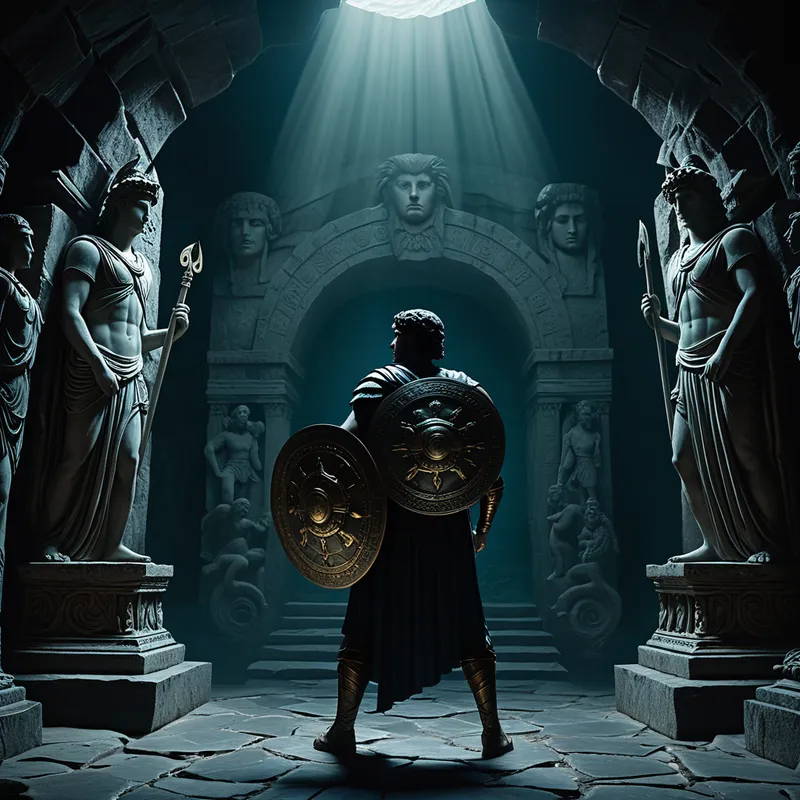
Enter the hero, Perseus, sent on a deadly quest. He came not with brute force, but with cunning gifts from the gods: winged sandals, a helm of darkness, a magical sack, and most crucially, a shield of polished bronze from Athena. He did not face her. He descended into the gloaming of her cave, a place humming with the sleep of monsters and the weight of petrified gazes. Using the shield as a mirror, he navigated by reflection. He saw her sleeping form, the serpents coiled in slumber. In one swift, guided motion, looking only at the mirrored image, he swung the adamantine sickle. The head was severed. From the bleeding neck sprang the winged horse Pegasus and the giant Chrysaor. Perseus seized the head, its power undimmed, and fled the waking wrath of her sisters, using the Gorgon’s own gaze as his ultimate weapon on the journey home.
Cultural Origins & Context
The myth of Medusa is woven from threads far older than classical Hellenic culture. Scholars trace her roots to pre-Greek, possibly Minoan, goddess figures and apotropaic (evil-averting) demons. The Gorgoneion—the grotesque, glaring face with protruding tongue and serpent hair—was a ubiquitous protective symbol, carved on shields, temple pediments, and doorways to frighten away evil. Medusa’s story was codified in Hesiod’s Theogony and later immortalized in Ovid’s Metamorphoses, which emphasized her victimhood and Athena’s harsh punishment.
Told by bards and written by poets, the myth functioned on multiple levels. On the surface, it was a thrilling hero narrative for hoplites and youths, validating cunning over brute strength and divine favor. On a deeper, societal level, it served as a cautionary tale about sacred boundaries, the perils of divine wrath, and the terrifying, untamable power of the feminine when violated and exiled from the sanctioned order. She became the ultimate "other," a being whose very nature defined the limits of the human and the civilized.
Symbolic Architecture
Medusa is not merely a monster; she is a complex symbol of violated sovereignty and the terrifying power that violation unleashes. Her gaze, which turns men to stone, is the central metaphor.
To be turned to stone is to be confronted with the unbearable truth of one’s own rigidities, defenses, and frozen potentials. It is the petrification of the soul.
The serpents in her hair are profoundly ambivalent. They are symbols of chthonic wisdom, rebirth (shedding skin), and primal, unmediated life force—but here, they are twisted into a crown of terror, representing the chaotic, "monstrous" transformation of trauma. She embodies the sacred rage that arises when innocence is profaned, a rage so potent it cannot be faced directly.
Perseus’s mirrored shield is the key to the myth’s psychological insight. One cannot confront the full, horrific face of trauma, rage, or the shadow directly without being paralyzed by it. The shield represents reflection, indirect perception, and the mediating function of consciousness (symbolized by Athena, goddess of wisdom). The hero must use technē (craft, skill) and divine guidance to navigate the encounter, integrating the power (the severed head) without being destroyed by its raw, frontal force.
The Dreamer's Resonance
When Medusa appears in the modern dreamscape, she rarely comes as a simple monster to be slain. She manifests as the dreamer’s own petrifying gaze—the paralyzing shame, the frozen rage, the trauma that feels unspeakable and turns one’s inner life to cold stone. To dream of being unable to look at something, or of turning others to stone, speaks to a fear of one’s own destructive power or the chilling effect of unprocessed pain.
Dreams of snakes, particularly entangled in hair or near the face, can signal the awakening of instinctual, kundalini-like energy that feels frightening and "monstrous" because it challenges the dreamer’s controlled self-image. A dream Medusa is often an invitation to acknowledge a profound violation—of boundaries, trust, or self—and to witness the terrifying, potent, and ultimately transformative force that has been born from that wound. She appears when the psyche is ready to stop fleeing its own cave and begin, however cautiously, to look at the reflection of its pain.

Alchemical Translation
The alchemical journey modeled here is the transmutation of victimhood into empowered sovereignty, and of paralyzing trauma into a tool of discernment. The prima materia is the violated self (the beautiful priestess). The divine "punishment" is the nigredo, the blackening—the descent into monstrous, chaotic form. This is not a moral judgment but a psychic fact: deep violation does transform us, often into something we and others perceive as monstrous, rage-filled, and dangerous.
The goal is not to slay the monster, but to behead it—to separate its transformative power from its paralyzing, identificatory grip.
Perseus represents the conscious ego, undertaking the perilous journey into the underworld of the unconscious (the cave). The mirrored shield is the capacity for self-reflection, perhaps aided by therapy, art, or mindful practice—the tools that allow us to observe our trauma without being fully consumed by its affective storm. The act of beheading is the crucial differentiation: it is not the annihilation of the wound, but the conscious separation from being defined by it. The severed head, retained in the magical pouch, becomes the aegis—a protective, empowering talisman. The liberated Pegasus symbolizes the creative spirit that can spring from the blood of our deepest wounds.
Thus, the individuation process is to journey to our own Gorgon’s cave, to use reflection to confront the face of what has petrified us, and to perform the sacred severance. We integrate the power of that gaze—the fierce, boundary-setting, truth-seeing power born of suffering—without letting it turn our entire being to stone. We become, like Athena, who later wears the Gorgoneion on her breastplate, the ones who can wield the reflected gaze of wisdom, born of a profound and terrible understanding.
Associated Symbols
Explore related symbols from the CaleaDream lexicon:
- Haired
- Awful
- Killer
- Bitch
- Darkened Cheek
- Tangled Hair
- Mesmerizing Eyes
- Freeze
- Poison Ivy
- Viper
- Frilled Lizard
- Moccasin Snake
- Jellyfish
- Serpent's Eye
- Basilisk Stare
- Gorgon Gaze
- Goalie Mask
- Cleopatra's Asp
- Evil Eye Pendant
- Glistening Ice Room
- Serpent-Headed Graffiti
- Veiled Face
- Hannya Mask
- Numb Feeling
- Interface Freeze
- Reflex
- Clot
- Glance
- Paralysis
- Displacing
- Icefall
- Terror
- Disgust
- Resentment
- Formalin
- Dazzle