Moses on Sinai Myth Meaning & Symbolism
A prophet ascends a sacred mountain to meet the divine, receiving the law for his people and forever altering the relationship between humanity and the absolute.
The Tale of Moses on Sinai
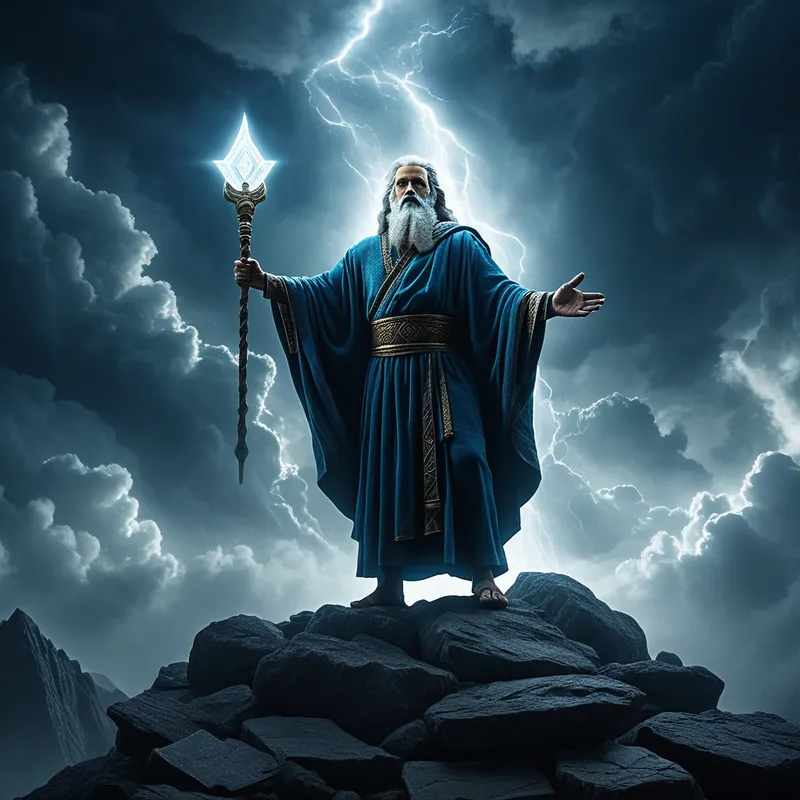
The air on the plain was thick with dust and awe. A people, newly born from the iron womb of Egypt, camped at the foot of a mountain that did not touch the sky—it was the sky’s jagged, terrifying anchor. Moses felt the weight of them, a million heartbeats of fear and hope, pressing against the silence of the stone. For three days, they purified themselves, washing bodies and intentions, as the mountain itself began to tremble. It was not an earthquake of the earth, but of reality. A thick, impenetrable cloud descended, swallowing the peak, and from within came the sound that was no sound: the blast of a shofar growing louder and louder until the people trembled in their tents, begging for the voice to stop.
Then, the YHWH called Moses to the summit. He began to climb, leaving the world of men below. The path was not of rock, but of increasing solitude. The higher he went, the thinner the air of ordinary life became. He entered the cloud, a darkness so total it was a presence, charged with a fire that did not consume but illuminated nothing but itself. Here, in the heart of the thunder and the quaking, the Voice spoke. It gave boundaries to chaos: “I am.” It carved ethics from the void: “You shall not.” The words were not heard with ears but felt in the marrow, laws written not on parchment but on the fabric of being itself.
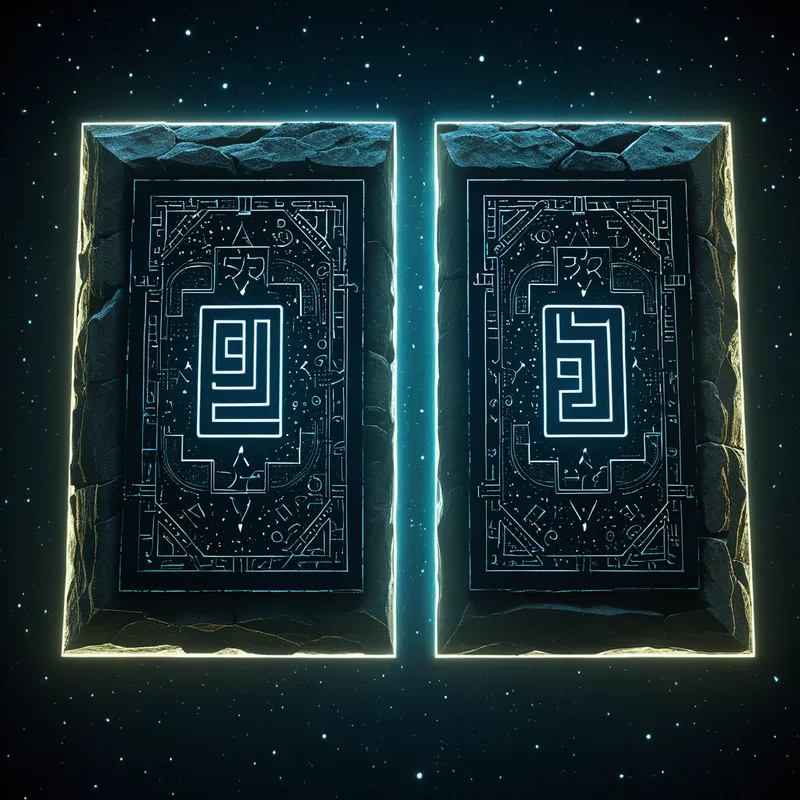
For forty days and forty nights, Moses dwelt in this unbearable intimacy. The people below, their fear curdling into panic, forged a god they could see and touch—a calf of gold. The covenant was shattered even as it was being inscribed. The Glory of the Lord burned with a jealous fire. Moses descended, the two tablets of testimony in his arms, their faces bearing the finger-work of God. He saw the revelry, the betrayal, and in a fury of shattered faith, he cast the tablets down, breaking them at the mountain’s foot. The law was given, and in the same breath, humanity proved it could not bear its weight.
Yet the story was not of final rupture, but of impossible reconciliation. Moses returned to the summit. He argued with the Divine, not for mercy for himself, but for the stubborn, flawed people below. “If you will not forgive them, blot me out from your book.” And there, in a cleft of the rock, as the Glory passed by, Moses was allowed to see not the Face, but the Back—the aftermath of goodness, the trail of steadfast love. He returned, his own face shining with a reflected light so terrifying he had to veil it. He carried new tablets, carved not by God alone, but by his own hand, a collaboration between the eternal and the human. The law was re-established, not in perfection, but in mercy.
Cultural Origins & Context
This foundational narrative is sourced from the books of Exodus and Deuteronomy in the Torah. It is the central theophany—the appearance of God—in Judaism, forming the bedrock of the Mosaic covenant. Historically situated in the context of a newly liberated tribal confederation seeking social and theological cohesion, the myth served a critical sociological function. It provided a divine origin for the legal and ethical codes that would bind the community, setting them apart from other nations. It was transmitted orally by priests and storytellers before being codified in written scripture, its recitation during festivals like Shavuot ensuring its living presence in the cultural psyche. For early Christianity, the event was reinterpreted through the lens of Christ as the new Moses and the mediator of a new covenant, with the law fulfilled through grace, yet the archetypal pattern of divine-human encounter remained paramount.
Symbolic Architecture
The myth is a masterclass in symbolic tension. The mountain, Sinai, is the axis mundi, the point where heaven and earth, the eternal and the temporal, meet. It represents the ultimate threshold of consciousness.
To ascend the mountain is to leave the collective consensus of the plain and venture into the realm of direct, unmediated experience of the Other.
Moses embodies the archetypal mediator, the part of the psyche capable of enduring the terrifying confrontation with the Self (in the Jungian sense of the wholeness of the psyche, which includes the divine). The forty days symbolize a complete period of incubation and transformation, a psychic death and rebirth. The tablets of the law are the crystallized structure emerging from the formless encounter—the necessary boundaries (ego, ethics, principles) that make conscious life possible. The shattering of the first tablets represents the inevitable failure of the pure, divine pattern when it meets unintegrated human nature (the Golden Calf, symbol of the regressive pull of unconscious idolatry and instinct). The second set, carved by Moses, symbolizes the law internalized, the divine pattern made relatable and sustainable through human effort and the hard-won grace of forgiveness.
The Dreamer's Resonance
When this myth stirs in the modern dreamer, it signals a profound encounter with the numinous—the holy or terrifyingly other—within their own psyche. Dreaming of ascending a terrifying but compelling mountain, of being called into a cloud or storm, or of receiving a heavy, inscribed object speaks to a moment of potential revelation. The somatic experience is often one of awe mixed with dread, a feeling of being both chosen and annihilated.
Psychologically, this is the process of confronting a core, life-altering truth about oneself or one’s path. The “Golden Calf” moment in a dream—perhaps symbolized by a crowd celebrating something hollow, or a cherished ideal revealed as false—marks the dreamer’s recognition of their own betrayal of their deeper calling, their capitulation to a easier, more collective idol. The dreamwork involves holding the tension between the lofty revelation and the flawed human reality, navigating the grief of the broken tablets toward the possibility of a second chance, a law written with one’s own hand.
Alchemical Translation
The alchemy of Sinai is the transmutation of raw, overwhelming experience (the prima materia of divine fire and thunder) into a durable, guiding structure for the soul (the philosophical stone of conscious law). It models the individuation journey perfectly.
First, the nigredo: the call to ascent, the dark cloud, the terrifying dissolution of old certainties as one enters the unknown of the Self. Then, the albedo: the reception of the pure, white-hot truth of one’s own nature and destiny—the tablets. This is followed by the crucial citrinitas, the yellowing or testing: the descent to find the “golden calf” of one’s own shadow, the parts of the personality that prefer easy idols to hard-won truth, shattering the initial, idealized revelation.
The final stage, the rubedo or reddening, is not a return to the peak for another perfect gift, but the arduous, collaborative work of re-carving the law. It is the integration of the experience into a livable, human form.
The veil Moses wears symbolizes the necessary mediation—we cannot live permanently in the blinding light of the Self. We must translate its revelations into a form that can engage with the world. The modern individual’s Sinai is any profound encounter that demands they become a lawgiver to their own soul, forging a personal covenant between their highest calling and their humble, flawed humanity. The shining face is the evidence of this transformation: a character tempered by direct encounter, bearing a light that is both one’s own and mysteriously reflected from a source beyond.
Associated Symbols
Explore related symbols from the CaleaDream lexicon: