Justice Myth Meaning & Symbolism
A myth of the cosmic lawgiver, the sword of discernment, the scales of consequence, and the eternal truth that every action seeds its own harvest.
The Tale of Justice
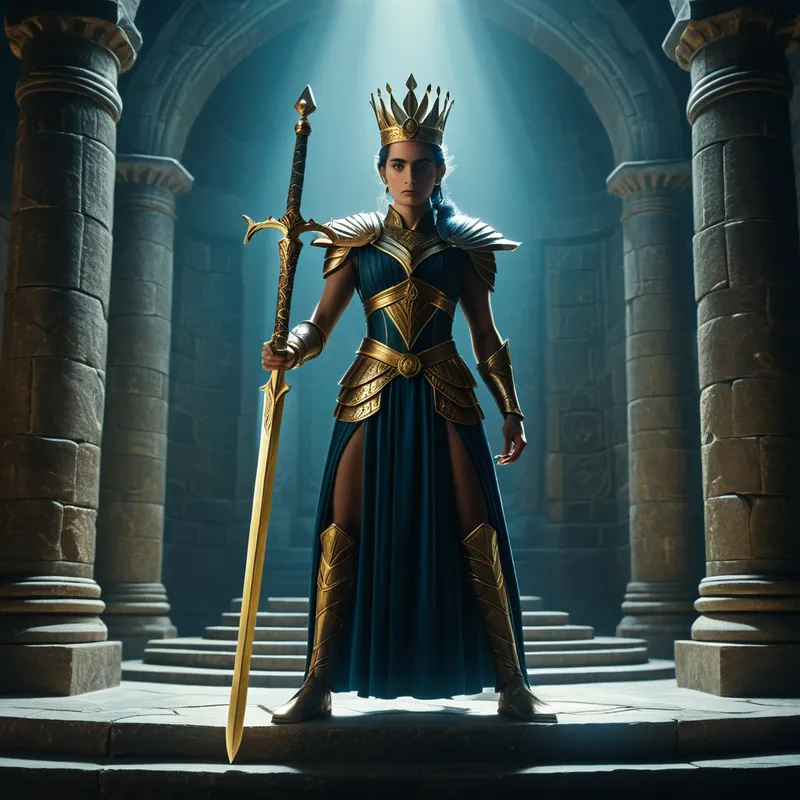
Listen. In the hall of the world’s heart, where time is not a river but a still pool reflecting all that was and will be, there sits a sovereign. They are neither man nor woman, but the essence of law itself, carved from the silence between stars. Their throne is not of gold, but of grey stone, cool and eternal, set beneath a vaulted ceiling that shows not a painted heaven, but the slow, wheeling dance of constellations.
Before them, on a floor of polished obsidian, stand two pillars. One is white as bleached bone, the other black as a moonless midnight. Between them hangs a veil, thin as a moth’s wing, shimmering with all the colors of human choice. The air here smells of ozone after a storm, of old parchment, and of cold, clean earth.
The sovereign does not speak. Their eyes, the color of a winter sky at dawn, see not the surface of things, but the root. In their right hand, they grip the Sword of Truth. It is held upright, its point aimed at the distant, fixed star around which all orbits turn. Its blade is not polished to a shine; it is dull steel, for it reflects nothing but the essential form. Its edge is so keen it can sever a thought from a lie, an action from its excuse.
In their left hand, they hold the Scales of Equilibrium. The pans are of beaten gold, but they are empty. They wait. They are infinitely patient. The chain from which they hang is linked with rings of silver and iron, woven into the very fabric of the hall.
And then, a petitioner comes. Not with footsteps, but with a presence—a life, a story, a knot of deeds and desires. They stand in the space between the pillars. The sovereign’s gaze falls upon them, and it is not a judgment, but an unveiling. From the petitioner’s breast, intangible yet visible, two substances flow. From one side, streams of light and shadow, actions taken, words spoken, intentions pure and impure. From the other, the echoes of those actions, the consequences received, the joys and wounds inflicted by others.
These streams pour into the waiting scales. The left pan receives the seed. The right pan receives the harvest. The sovereign does not move. The sword does not waver. There is only the agonizing, exquisite suspense of the balance. The chain creaks, a sound like the turning of a great wheel. The pans tremble, seeking the level. When they finally settle, it is with a silence so absolute it becomes a sound of its own—the tone of cosmic truth. There is no punishment meted, no reward granted. There is only the undeniable, perfect equation, laid bare in the stillness. The petitioner sees it, knows it in their marrow, and is transformed not by sentence, but by sight. The veil between the pillars shimmers, and they pass through, carrying the knowledge of their own balance into whatever comes next.

Cultural Origins & Context
The figure of Justice, as the eighth Major Arcana, finds its deepest roots not in a single culture, but in the confluence of ancient streams of thought. It is a synthesis of Egyptian Ma’at, the goddess of cosmic order and truth; of the Greek Themis and Dike, representing divine law and mortal justice; and of the medieval allegorical Virtues that adorned cathedrals and illuminated manuscripts. In the early Tarot decks of 15th-century Italy, such as the Visconti-Sforza, Justice appears as an empress-like figure, a civic virtue governing fair rule.
The myth was passed down not through epic poetry, but through the silent language of iconography on painted cards, used initially for games and later for contemplation. It was told by artists, mystics, and cartomancers who understood the cards as a Book of Wisdom. Its societal function was dual: as a mirror for princes (a reminder of the ruler’s ultimate accountability to a higher law) and as a mirror for the soul (a map for the individual’s inner moral and karmic reckoning). It served as a cultural anchor point for the idea that order is not imposed, but is an inherent, measurable principle of the cosmos.
Symbolic Architecture
The myth of Justice is an archetypal blueprint for the psyche’s innate structuring principle. It is not about human legal systems, but the law of cause and effect as it operates in the moral and psychic universe.
Justice is the universe’s unwavering echo. It is the law that every action, every thought seeded in the inner world, must eventually meet its own reflection in the outer.
The sovereign figure represents the Self, the inner ruler that transcends the ego’s biases. Their androgyny signifies that true justice is beyond gender, culture, and personal identity; it is a universal principle. The Sword symbolizes active discernment, the intellect’s capacity to cut through complexity, deception, and self-justification to reach the naked truth of a situation. It is vertical, connecting heaven and earth, implying that true judgment aligns with a higher order.
The Scales represent the principle of equilibrium and measurement. They are the psychic apparatus that weighs intention against outcome, effort against reward, debt against payment. They speak to the soul’s accounting. The Two Pillars (often corresponding to Jachin and Boaz from mystical tradition) represent the binary pairs of existence (active/passive, conscious/unconscious, mercy/severity) between which the drama of choice and consequence plays out. The Throne of stone signifies that this law is foundational, the bedrock of reality itself.

The Dreamer's Resonance
When this myth stirs in the modern dreamscape, it often manifests as dreams of being on trial, of being weighed or measured, or of discovering incontrovertible evidence. The courtroom may be bizarre—a childhood classroom, a corporate boardroom transformed, or a vast, empty hall. The dreamer is both the accused and the witness.
Somatically, this can feel like a tightening in the chest, a literal “weighing on the heart,” or a sense of profound exposure. Psychologically, this is the process of self-judgment emerging from the unconscious. It is not about guilt from an external authority, but about the psyche’s own imperative for integrity. The dream signals that the dreamer is at a point of moral or ethical reckoning, where a past action, pattern, or ignored truth is demanding acknowledgment. The scales in the dream are measuring the gap between the dreamer’s self-image and their actual behavior, between what they profess and what they practice. The anxiety is the ego’s resistance to this inner audit conducted by the sovereign Self.
Alchemical Translation
The alchemical work modeled by the Justice myth is the transmutation of chaos into order within the personal psyche. It is the stage in individuation where one must consciously assume responsibility for one’s entire psychic reality.
The “lead” of the prima materia is the tangled, unconscious mass of our actions, reactions, projections, and repressed shadows. The “fire” is the piercing gaze of the Sword—the courageous application of conscious awareness and ruthless self-honesty. The “vessel” is the Scales—the mindful space of reflection where we hold our deeds and their consequences in balanced observation, without denial or self-flagellation.
The alchemy of Justice is the realization that we are not sentenced by the universe; we are presented with the immutable equation of our own being. Freedom lies not in changing the equation, but in understanding it so completely that our future choices arise from alignment.
The triumph is not a verdict of “innocent,” but the achievement of inner sovereignty. The ego surrenders its role as a biased advocate and learns to serve the inner sovereign. The individual stops blaming external circumstances or other people for their internal state and recognizes their own authorship in the drama of their life. This creates a profound inner stability—the stone throne—from which one can engage the world with clarity, responsibility, and the authentic power that comes from being in right relationship with one’s own truth. The veil between the pillars then becomes the threshold to a more conscious, integrated way of being, where one lives not in fear of judgment, but in respectful dialogue with the eternal law of consequence.
Associated Symbols
Explore related symbols from the CaleaDream lexicon: