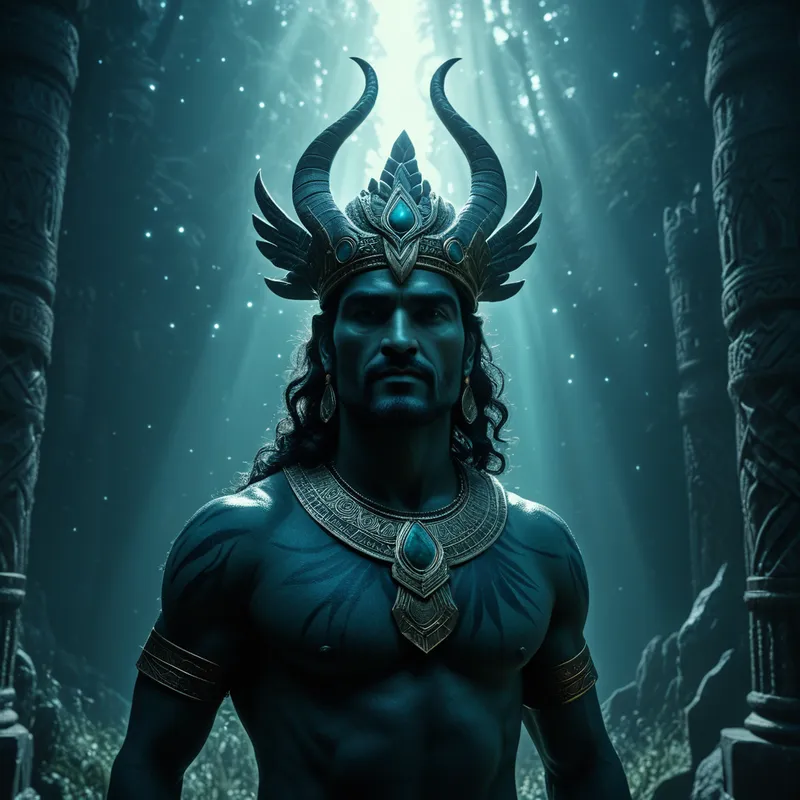
Nanna the Moon God
Nanna, the Sumerian moon god, governed time, wisdom, and fate, illuminating the night with divine authority and celestial mystery.
The Tale of Nanna the Moon God
In the beginning, before the ordering of days and nights, the great sky god An looked upon the primordial waters of Abzu and the fierce earth goddess Ki. From their union sprang the air god Enlil, who cleaved heaven from earth with a storm. And in that new space, where the dome of the sky met the lap of the world, another light was kindled. This was Nanna, the first child of Enlil and the grain goddess Ninlil, conceived in shadow and destined to illuminate it.
Nanna was not born in a blaze, but in a slow, waxing glow. His light was a softer, more contemplative radiance than his brother Utu’s piercing gaze. He was given dominion over the night, a realm of dreams, omens, and hidden movements. Each evening, he would embark on his journey across the celestial ocean in a magnificent magur boat, a crescent-shaped vessel of lapis lazuli and gold. As he sailed, his light—silver, cool, and penetrating—would spill over the sleeping land of Sumer, etching the contours of rivers and ziggurats in ghostly silver.
His primary home was the great city of Ur, the seat of his earthly power and his sublime temple, the E-gish-shir-gal. Here, he was not a distant observer but a divine king, a judge, and a father. With his wise and powerful consort, Ningal, he fathered the brilliant Utu and the fierce love-and-war goddess Inanna. His family drama was the drama of the cosmos itself: the passionate, chaotic force of Inanna ever testing the measured, cyclical order of her father’s domain.
Nanna’s greatest power was his governance over time. His cyclical phases—the slender crescent, the full, pregnant orb, the slow wane into darkness—became the first calendar for humanity. He measured months, dictated festivals, and ordained the proper times for sowing and reaping. He was the great counter, the silent accountant of destinies. Kings derived their legitimacy from him, seeking his approval through oracles and divination, for to understand the moon’s will was to glimpse the weave of fate itself. In the deepest night, under his watch, the fabric of time was both measured and unmade, revealing its fluid, dream-like nature.
Cultural Origins & Context
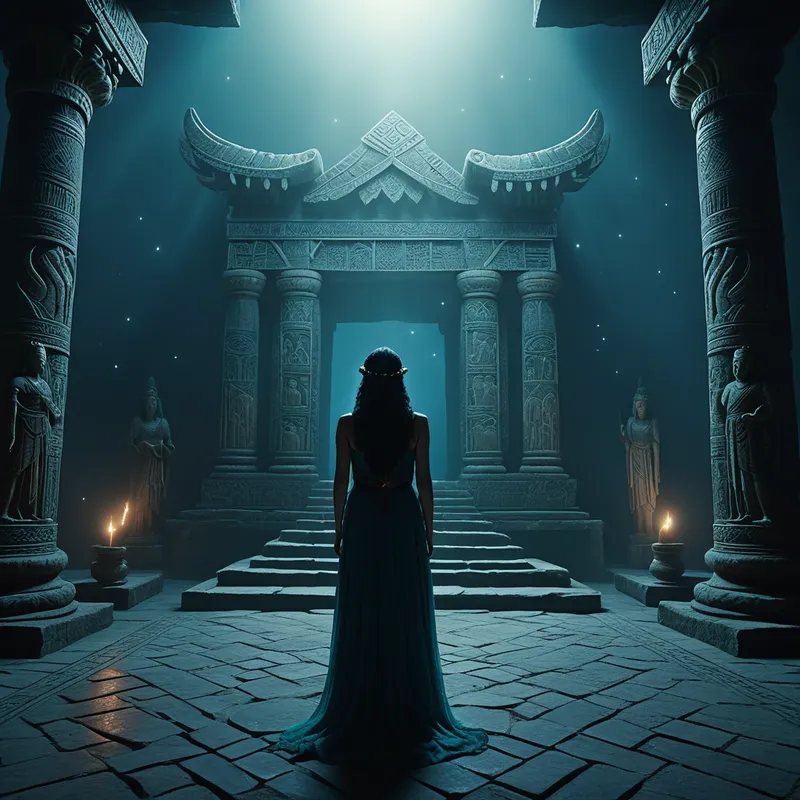
Nanna, later known as Sin, was one of the most ancient and enduring deities of the Mesopotamian pantheon. His worship centered in Ur, which rose to prominence during the Early Dynastic period (c. 2900–2350 BCE) and remained a major cult center for over two millennia. The mighty Ziggurat of Ur, dedicated to him, physically anchored his celestial journey to the earthly plane, a stairway of baked brick aspiring to touch his silver light.
In the pragmatic and celestial-minded world of Sumer, Nanna was not merely a poetic symbol. He was a foundational administrative and social force. The lunar calendar he governed regulated every aspect of civic and agricultural life—tax collection, legal contracts, religious ceremonies, and royal coronations all hinged on the beginning of the new month, marked by the first sighting of the crescent moon. His priesthood was a powerful institution, and his oracles were sought for matters of state. He was "the lord of the month," "the luminous boat of heaven," and "the herdsman of the black-headed people" (the Sumerians), a paternal guardian whose light was a law.
His mythology is deeply interwoven with the concept of divine kingship. The Third Dynasty of Ur (c. 2112–2004 BCE), a period of Sumerian renaissance, explicitly styled its kings as the chosen representatives of Nanna, their authority flowing directly from the moon god’s sanctification. This bond between the cyclical, renewing moon and the legitimacy of the ruler underscored a worldview where cosmic order (me) and earthly order were reflections of one another.
Symbolic Architecture
Nanna’s essence is an architecture of paradox: a light that reveals by veiling, a measure of time that demonstrates its fluidity, a masculine deity embodying cyclical, receptive wisdom. He is the illuminator of the unconscious night, casting not the sun’s clarifying truth, but the moon’s suggestive, symbolic truth.
He is the archetypal Sage, not through declarative knowledge, but through patient observation of cycles. His wisdom is accretive, layered like the lunar phases, built from witnessing endless repetitions of birth, fullness, decay, and rebirth.
His primary symbols construct a profound cosmology. The crescent moon is his boat, the magur, carrying the light of consciousness through the dark waters of the unknown. The full moon is his crown and his eye—a state of complete, reflective awareness, the peak of his illuminating power. The waning and dark moon speak of his journey into the underworld, a necessary dissolution where knowledge is digested in darkness before re-emergence. The bull is often associated with him, representing both fecundity (the crescent horns) and the stubborn, enduring strength of cyclical time.
His light is reflective, not generative. He does not create light but borrows and transforms the sun’s, teaching that all understanding is ultimately reflective—a mediation of a source we cannot gaze upon directly. He is the psyche’s capacity for introspection.
This reflective quality ties him to fluids—rivers, tides, and the celestial ocean he sails. His light on water creates a shimmering, unstable truth, mirroring the nature of insight gained in the dream state or through divination: real, but elusive, changing with the slightest ripple of perception.
The Dreamer's Resonance
To encounter Nanna in the inner landscape is to encounter the principle of psychological timing. He governs the natural, often slow, rhythms of the psyche—the incubation period of an idea, the unconscious processing of grief, the cyclical return of moods or memories. He opposes the ego’s desire for linear, immediate progress, insisting instead on the right phase for action or understanding. A decision made under the new moon will have a different character and outcome than one made under the full moon.
He represents the luminosity of the unconscious. While the personal and collective unconscious is often pictured as a dark sea, Nanna suggests it is not merely a void but a space illuminated by a different quality of light. Dreams, intuitions, and synchronicities are the moonlight of the soul—revealing shapes, outlines, and possibilities without burning away the mystery. He legitimizes the knowledge that comes in the night, the "nocturnal epiphany."
As the father of Inanna (passion, impulse) and Utu (conscious judgment, justice), Nanna sits at the root of the psyche’s great dynamics. He is the containing, cyclical order from which both raw desire and clear discrimination emerge. The individual struggling to integrate powerful emotions (Inanna) or to find ethical clarity (Utu) must first consult this inner lunar principle: What is the phase? What has the cycle been? What timing does the deeper self insist upon?

Alchemical Translation
The alchemical process mirrored in Nanna’s journey is the opus contra naturam—the work against nature, which is also a work through nature’s cycles. His voyage is the soul’s work of distillation and reflection.
The silver of the moon is the alchemical Luna, representing the receptive, feminine, and purifying principle within all matter and psyche. It is the metal of the soul, as gold is of the spirit. Nanna’s process is the silvering of the lead of unconsciousness, bringing it to a state of reflective awareness.
His cyclical death and rebirth—the dark moon—is the essential nigredo, the blackening, the dissolution of fixed forms and conscious knowledge into the prima materia of the soul. This is not a failure but a necessary return to the source for renewal. The crescent that follows is the albedo, the whitening, the first emergence of a purified, reflective consciousness from that darkness.
"He sails the boat of lapis lazuli on the waters of the Abzu." This is the image of the spirit (lapis lazuli, celestial stone) navigating the depths of the unconscious (Abzu). The goal is not to conquer the depths but to be carried by them, allowing their rhythms to guide the vessel of consciousness to its destined wharf.
Ultimately, Nanna’s alchemy is one of measure and fluidity. He imposes the measure of the month, the cycle, the term, yet his medium is the fluid night and the tidal waters. He teaches that true order is not rigid but rhythmic, not imposed from without but revealed from within the flow of time itself. To integrate Nanna is to find the innate tempo of one’s own being.
Associated Symbols
Explore related symbols from the CaleaDream lexicon:
- Moon — The primary celestial body of reflective light, governing cycles, tides, and the unconscious rhythms of time and dream.
- Silver — The metal of the moon, representing purity, reflection, psychic receptivity, and the soul's luminous quality.
- Boat — The crescent moon as a vessel journeying through the night sky, symbolizing the soul's navigation of the dark waters of the unknown.
- Circle — The perfect shape of the full moon, representing wholeness, cyclical completion, and the eternal return inherent in time.
- Water — The celestial ocean and earthly tides governed by the moon, symbolizing the fluid, emotional, and unconscious medium of life.
- Mirror — The moon as a reflector of the sun's light, representing introspection, the nature of indirect knowledge, and the psyche's capacity for self-reflection.
- Time Travel Device — The moon's phases as the original calendar and measure of destiny, a natural mechanism for moving consciousness through different qualities of time.
- Dream — The domain illuminated by moonlight, where the logic of the unconscious unfolds and symbolic truths are revealed.
- Fate — The moon's ancient association with measuring and ordaining the lengths of life and the destinies of kings and commoners.
- Temple — The ziggurat of Ur, the E-gish-shir-gal, as the earthly anchor of the celestial, a place where cosmic time is made manifest in ritual.
- Sumerian Tablet — The medium for recording lunar omens, calendars, and hymns, embodying the god's role in ordering knowledge and civilization through time.
- Timeless Hourglass — The paradox of the moon, which measures time in relentless cycles yet, in its eternal repetition, points to a realm beyond linear progression.