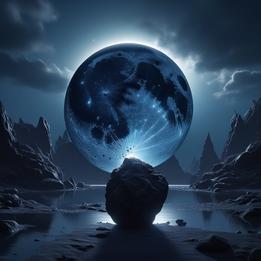
Moon Dream Meaning
The Moon symbolizes intuition, emotional depth, and the cyclical nature of life, often reflecting the inner self and subconscious desires.
Common Appearances & Contexts
| Context | Emotion | Interpretation |
|---|---|---|
| Full Moon | Empowered | Experiencing clarity and heightened emotions or realizations about one's life. |
| New Moon | Hopeful | Representing new beginnings or opportunities, indicating a time for setting intentions. |
| Moonlight | Calm | Finding peace and illumination in dark times, suggesting guidance and clarity in personal matters. |
| Eclipsed Moon | Anxious | Indicating feelings of uncertainty or blockage in one's emotional life or intuition. |
| Crescent Moon | Curious | Signifying growth and exploration, encouraging the dreamer to move forward in their emotional journey. |
| Falling Moon | Fearful | Feeling a loss of control over one's emotions or fears about the future. |
| Moonscape | Wonder | Experiencing a surreal escape, indicating a desire for exploration of the unknown facets of life. |
| Dark Moon | Confused | Confronting deep-seated fears or unresolved issues, encouraging introspection. |
| Moon and Stars | Inspired | Suggesting creativity and the power of dreams, encouraging the pursuit of aspirations. |
| Moon Phases Changing | Reflective | Acknowledging the natural ebb and flow of emotions and life circumstances. |
| Hiding from the Moon | Avoidant | Indicating a desire to avoid facing certain feelings or truths about oneself. |
| Moonlit Water | Serene | Symbolizing emotional clarity and purification, often indicating healing. |
| Talking to the Moon | Lonely | Expressing a need for connection or guidance, suggesting the search for answers within. |
| Chasing the Moon | Determined | Symbolizing the pursuit of dreams or desires despite challenges. |
| Drawing the Moon | Creative | Suggesting an active engagement with one's inner world and creative expression. |
Interpretive Themes
Self-Awareness
ConfidenceThe moon can focus attention on internal awareness or reflection.
Power Dynamics
ConfidenceThe moon highlights shifts in control or authority.
Uncertainty
ConfidenceThe moon can intensify ambiguity or lack of clarity.
Integration
ConfidenceThe moon can link disparate parts of the dream into a whole.
Cultural Lenses
Global/Universal Perspective
Full Hub →Universal symbol of cycles, femininity, intuition, and the unconscious. Historically linked to lunar deities (e.g., Artemis, Selene). Ritually significant in calendars and fertility rites. Emotionally evokes mystery, change, and reflection.
Jungian Perspective
Full Hub →Archetype of the feminine principle (anima), the unconscious mind, and cyclical transformation. Represents hidden aspects of the psyche, intuition, and emotional tides. Historically tied to lunar mythology as a symbol of renewal.
East Asian Perspective
Full Hub →Symbol of yin energy, femininity, and enlightenment in Chinese/Japanese traditions. Historically celebrated in Mid-Autumn Festival with mooncakes. Ritually associated with family reunion and poetic inspiration. Emotionally signifies harmony and tranquility.
South Asian Perspective
Full Hub →Linked to Hindu deities like Chandra (moon god) and Shiva's crescent. Historically used in Vedic astrology (jyotisha). Ritually important in festivals (e.g., Karva Chauth). Emotionally represents calmness, mind, and romantic love in poetry.
Middle Eastern Perspective
Full Hub →Historically central in Islamic lunar calendar for Ramadan and Eid. Symbol of divine guidance and timekeeping. Pre-Islamic moon worship (e.g., Allah as moon god debated). Emotionally evokes spirituality, renewal, and community rituals.
European Perspective
Full Hub →Historically tied to pagan moon goddesses (e.g., Diana) and werewolf folklore. Ritually used in witchcraft and harvest moons. Emotionally associated with madness (lunacy), romance, and Gothic mystery in literature and art.
African Perspective
Full Hub →Symbol of creation and time in myths (e.g., Zulu moon goddess). Historically used in lunar calendars for agriculture. Ritually linked to initiation ceremonies and storytelling. Emotionally represents ancestral connection, fertility, and night wisdom.
Latin American Perspective
Full Hub →In Aztec/Maya cultures, moon goddesses (e.g., Coyolxauhqui) symbolized cycles and sacrifice. Historically used in lunar calendars. Modern Día de la Luna rituals blend indigenous and Catholic elements. Emotionally tied to femininity and nature.
Freudian Perspective
Full Hub →Symbol of femininity, motherhood, and sexual cycles. Interpreted as representing the female reproductive system or unconscious desires. Historically linked to Freud's emphasis on latent sexual content in dreams and primal instincts.
Gestalt Perspective
Full Hub →Represents the dreamer's unfinished emotional cycles or hidden aspects of self. Interpreted as a projection of feelings about change, intuition, or femininity. Focuses on personal symbolism and present emotional context.
Cognitive Perspective
Full Hub →Reflects memory consolidation of lunar experiences or metaphors for change. Historically tied to cognitive theories of dream simulation. Emotionally processes themes of time, illumination, or uncertainty through neural networks during sleep.
Evolutionary Perspective
Full Hub →Symbol rooted in ancestral survival: lunar cycles guided hunting, migration, and reproduction. Historically essential for nighttime navigation. Emotionally evokes primal awe and fear, linked to adaptive responses to darkness and natural rhythms.
Zhou Gong Perspective
Full Hub →In Zhou Gong's Dream Interpretation (Chinese classic), the moon symbolizes maternal figures, family harmony, or official success. Historically used in imperial divination. Ritually significant for predicting fortune. Emotionally indicates yin energy and subtle influences.
Interpret Your Full Dream
Beyond this symbol, every dream carries a unique story. Share your dream for a personalized AI-powered interpretation.