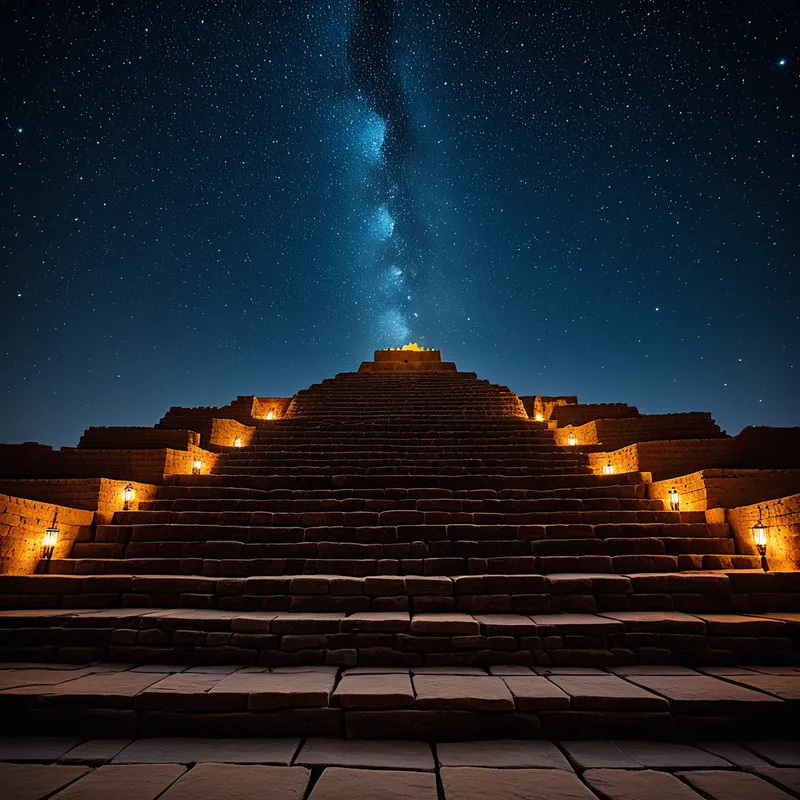
Ziggurat of Ur Myth Meaning & Symbolism
A tale of a sacred mountain built to touch the heavens, uniting gods and humanity through ambition, devotion, and cosmic order.
The Tale of Ziggurat of Ur
Hear now, and listen with the ears of the river silt and the baked brick. In the land between the two great rivers, Tigris and Euphrates, where the sun’s hammer fell upon the plain, there rose a hunger not of the belly, but of the soul. It was a hunger for the face of the divine.
The city was Ur, and its heart was a whisper of dust and ambition. Its people looked upon the flat, unyielding earth and saw a prison. They looked upon the vast, untouchable sky, the domain of Anu, and felt a terrible separation. The moon, Nanna, sailed his silver boat across the night, but his light felt distant, administrative, cold.
Then came the vision, not in a dream, but in the collective breath of a king and his people. The king, the Ensi, felt the weight of his duty—to be the rope that binds earth to heaven. He heard the command not in words, but in the very geometry of the world: Build a mountain where there is none. Create a place where the descending god may alight, and the ascending prayer may be heard.
And so the toil began. It was not the work of slaves, but of a city in concert with its gods. Farmers left their fields in season, their hands trading ploughs for moulds. They mixed the mud of the Edin with chopped straw, the breath of the earth. They formed bricks, millions of them, and baked them in kilns until they were the color of the sun’s own flesh. The air grew thick with the smell of fire, clay, and human sweat—a sacred incense.
Tier by tier, the mountain grew. The first tier was the world itself, broad and firm, painted black for the fertile underworld. The second tier rose, painted red for the bloody struggle of mortal life. The third, the final ascent, was a brilliant, blinding white, for the pure realm of the heavens. A single, steep staircase pierced the center of each face, converging towards the summit, a path only for the purified.
At the top, they built the Gigunû, a small, exquisite house of blue-glazed brick. It stood empty, yet full of potential. It was a bed made for a god, a throne set for the moon. When the work was done, and the last brick sealed with bitumen from the far north, a silence fell deeper than any before.
Then, at the appointed hour, the En ascended. He climbed the black stair, the red stair, the white stair, his robes heavy with ritual. He entered the Gigunû. And there, in that charged emptiness, he performed the rites. He offered the finest oils, the sweetest meats, the most plaintive music. He did not summon Sin like a servant. He prepared a home worthy of a guest.
And the connection was made. The Ziggurat did not touch the physical sky. It did something greater. It became an Axis Mundi, a fixed point in the chaos. From that day, the people of Ur knew the gods were not absent. They were accessible. The mountain was proof. The city had built a ladder, and for a moment, with every ritual and every prayer sent skyward from its base, heaven and earth held hands.
Cultural Origins & Context
The Ziggurat of Ur, built in the 21st century BCE by King Ur-Nammu, was not merely an architectural feat; it was the central theological and social engine of the city-state. The myth surrounding it is not a single narrative text like the Epic of Gilgamesh, but a living story encoded in its very construction and function. It was passed down through ritual, through the training of priests, and through the awe of every citizen who looked upon its mass.
Its societal function was multifaceted. Politically, it cemented the king’s role as the divinely appointed intermediary, his ability to commission such a structure proving his favor with the gods. Economically, it organized the entire population around a common, sacred goal, mobilizing resources and labor in a display of collective power. Spiritually, it answered a profound existential need in Mesopotamian cosmology, which viewed the universe as a precarious order (Me) constantly threatened by chaos. The Ziggurat was a bulwark against that chaos, a permanent, physical assertion of divine order on the human plane. It was where the Melammu, the terrifying radiance of the gods, could be safely encountered and managed for the benefit of all.
Symbolic Architecture
The Ziggurat is a symbol of the human psyche’s deepest structural impulse: to create order from chaos, and to consciously mediate between different levels of reality.
The sacred mountain is not found; it is built. The connection to the divine is not given; it is engineered through will, toil, and precise ritual.
Its three tiers are a map of reality: the Kur (the unconscious, the foundational earth), the mortal world (the conscious ego, the realm of struggle and desire), and the abode of the gods (the super-conscious, the realm of archetypes and cosmic principles). The staircase is the path of consciousness itself, the arduous process of ascending from instinctual drives to higher understanding. The empty shrine at the summit is perhaps the most profound symbol. It represents the potential for the numinous, the prepared vessel. It does not force the divine to appear; it creates the perfect condition for its visitation. This is the essence of sacred space—not a cage for God, but a tuned instrument for resonance.
Psychologically, the Ziggurat represents the constructed Self. It is the ego’s lifelong project of building a stable, hierarchical structure of personality that can integrate the depths of the unconscious (the black tier), navigate the complexities of life (the red tier), and occasionally touch moments of transcendence or profound insight (the white tier).
The Dreamer's Resonance
When the Ziggurat appears in a modern dream, it rarely manifests as a perfect, historical monument. It appears as the need to build, or as an impossible staircase. The dreamer may be hauling heavy, mud-made bricks under a hot sun, embodying the somatic weight of a life project that feels both sacred and exhausting. They may be lost in a labyrinth of staircases within the structure, speaking to confusion about the correct path to one’s “summit” or life’s purpose.
A crumbling Ziggurat signifies a crisis of personal order—a belief system, career, or relationship structure that is destabilizing. Dreaming of the empty shrine at the top can evoke feelings of profound loneliness or existential doubt (“I built all this, for what?”), but also the pristine potential of a new phase awaiting its essential inspiration. The dream is an image of the psyche’s own architecture. Its condition in the dream reports directly on the dreamer’s current sense of structural integrity, ambition, and their perceived connection (or disconnection) to something greater than their daily concerns.
Alchemical Translation
The myth of the Ziggurat models the alchemical process of Coagulatio—the making solid of spirit. Individuation, the process of becoming a whole, integrated Self, is not a passive awakening; it is an active, often grueling construction project.
The first matter is the mud of the unconscious—formless, potential, and chaotic. The straw is the structuring principle of consciousness, the ego that gives it form. The fire of effort and discipline bakes it into a durable brick of experience.
Each brick laid is a conscious choice, a hard-won insight, a disciplined habit, or a faced shadow. The building requires a blueprint—the guiding myth or values one lives by (the king’s divine command). The labor is the daily work of therapy, reflection, creative practice, or ethical living. The ascent is not linear; one must constantly traverse between tiers, bringing nourishment from the heights back down to the foundations, and hauling material from the depths up to be transformed.
The ultimate goal is not to permanently reside in the shining shrine at the top—that is the realm of inflation, of identifying with the archetypes. The goal is to have built a stable, functioning structure that allows for ritual travel between all levels. The integrated individual is the priest-king who can descend into the mud of their own emotions and instincts, operate effectively in the red world of action and relationship, and ascend periodically to the white shrine for vision and renewal, always returning to govern the whole city of the self. The Ziggurat stands not as a monument to a finished self, but as the living process of self-creation, the eternal human project of building a soul that can touch the sky while remaining rooted in the earth.
Associated Symbols
Explore related symbols from the CaleaDream lexicon: