Medicine Wheel Myth Meaning & Symbolism
A sacred circle of life, a map of the cosmos and the self, teaching balance, wholeness, and the eternal dance of the four directions within and without.
The Tale of the Medicine Wheel
Listen. The wind does not blow in one direction alone. The sun does not rise in the west. The river does not flow without banks. In the beginning, there was a great forgetting. The People walked, but they walked in circles. They saw the sky, but not its connection to the earth. They felt joy and sorrow, but as strangers to each other. They were pieces of a song, each singing a different note, and the harmony was lost.
A time of great wandering came. A seeker, a man with eyes that held the quiet of deep lakes, walked away from the campfires. His heart was heavy with the question that has no words, only a hollow feeling in the chest. He climbed to where the eagle makes its home, to a high place where the world falls away in all directions. There, exhausted, his spirit thin as mist, he lay upon the bare rock as the sun died in a blaze of fire.
In the cold, star-pierced darkness, a voice spoke. It was not a voice of air, but of stone and root and starlight. "You seek the center," it said, "but you look with only one eye. Open them all."
A great trembling took the mountain. From the north, a blast of wind, clean and sharp, carrying the breath of the white buffalo and the wisdom of winter's long silence. From the east, a gentle light, the first thought of dawn, the yellow glow of new understanding and innocence. From the south, a warmth, the red heat of passion, growth, and the trusting heart of a child. From the west, a deep shadow, the indigo of introspection, of waters that hold secrets and the necessary descent into the unknown.
These powers did not battle; they danced. They wove around the man, not as a storm, but as a ceremony. They showed him: the north was his mind, his clarity. The east was his spirit, his illumination. The south was his body, his connection. The west was his emotion, his depth. And he, the trembling man on the rock, was the still point where they met.
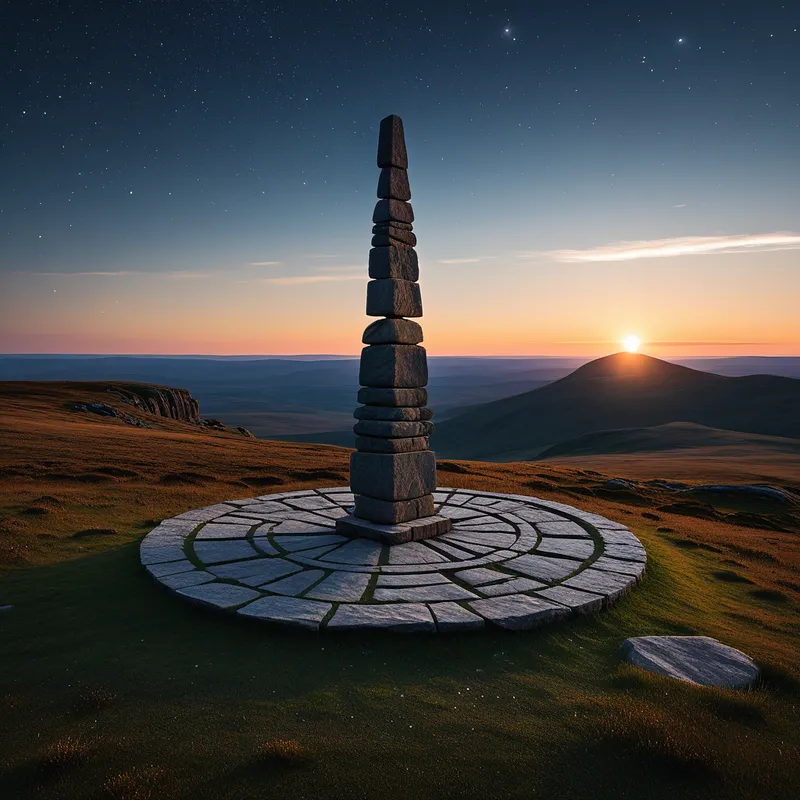
As the first sliver of sun cracked the eastern sky, he moved. Not with thought, but with knowing. He gathered a stone, grey and solid as the north's wisdom, and placed it. He gathered a stone, touched with the east's first light, and placed it opposite. A red stone from the southern clay, an obsidian stone from the western night. Between them, he built a small cairn, a pile of stones that was himself, the anchor. Then, with a breath that came from the very core of the world, he connected them with lines of smaller stones, creating a sacred circle crossed by the great roads of the four winds.
He looked upon what his hands had made, and for the first time, he did not feel like a fragment. He felt whole. The circle was not a wall, but a map. A map of the cosmos. A map of the seasons. A map of a human life. He descended from the mountain, not with an answer, but with a living question in the shape of a wheel. And he taught the People that to walk in beauty is to walk the wheel, to honor each direction within, and thus find the center, which is everywhere.

Cultural Origins & Context
The Medicine Wheel is not a single, monolithic myth from one nation, but a profound, shared spiritual concept found across many Plains and Great Basin tribes, including the Lakota, Cheyenne, Shoshone, and others. Its transmission was not through a singular sacred text, but through oral tradition, ceremony, and direct instruction from elders and medicine people. These teachings were often given in specific, sacred locations—natural stone circles on high vistas that served as astronomical observatories, calendars, and sites for vision quests.
Its societal function was multifaceted: it was a cosmological model, a teaching tool, a ceremonial space, and a guide for living in balance. It encoded practical knowledge of the seasons for hunting and planting, social laws for community harmony, and spiritual protocols for personal growth. The wheel was a living symbol, its meanings layered and adapted within each tribal tradition, yet always pointing toward the fundamental principles of interconnectedness, cyclical time, and the quest for walking in beauty.
Symbolic Architecture
At its heart, the Medicine Wheel is a mandala of the self and the universe. It is a symbolic architecture for wholeness, organizing the chaos of existence into a coherent, balanced pattern.
The center is not a place you arrive at, but a state of being you cultivate by acknowledging and integrating all the directions of your soul.
The four cardinal directions are its primary pillars. The East represents the spirit, illumination, birth, and the yellow dawn of new beginnings. The South signifies the heart, emotion, passion, and the red warmth of relational life. The West embodies the body, the subconscious, introspection, and the dark waters of the unknown. The North symbolizes the mind, wisdom, clarity, and the white breath of ascetic truth.
The hero of the myth is not a warrior who slays a beast, but a seeker who becomes a hollow bone—a conduit for these cosmic forces. His journey is one of disorientation to reorientation, from a fragmented consciousness to an embodied understanding of the sacred circle. The conflict is internal: the alienation of living from only one aspect of the self. The resolution is the act of construction—the external, physical manifestation of an internal, psychic integration.
The Dreamer's Resonance
When the pattern of the Medicine Wheel appears in modern dreams, it signals a profound somatic and psychological process of re-centering. The dreamer may find themselves standing within a vast circle, at a crossroads, or observing a spinning mandala. This is not a random symbol, but an emergent blueprint from the deep unconscious, attempting to restore order during a period of fragmentation or one-sided development.
The somatic experience can be one of powerful, almost gravitational pull from different directions—a feeling of being torn between intellectual pursuits (North), spiritual yearnings (East), relational demands (South), and depressive or introspective pulls (West). The dream is the psyche's attempt to map this inner chaos. To dream of successfully walking the wheel, or of finding a calm center within it, indicates a movement toward synthesis. It is the unconscious affirming, "You contain multitudes, and they can coexist in harmony." The dream invites the dreamer to consciously identify which "direction" they have neglected or over-emphasized in their waking life, and to begin the work of respectful re-integration.
Alchemical Translation
The alchemical process modeled by the Medicine Wheel is the opus contra naturum—the work against the fragmented nature of the modern ego. Our contemporary psyche is often a battlefield of competing values: mind versus heart, action versus reflection, spirit versus flesh. The Wheel presents a model of psychic transmutation where opposition becomes complement.
Individuation is the lifelong ceremony of walking the wheel, placing a stone of acknowledgment at each station of the self until the circle is complete and the center holds.
The first stage is Nigredo: the "blackening" or disorientation of the seeker on the mountain, the felt sense of being lost and incomplete. The Albedo or "whitening" is the dawning realization, the reception of the four winds—the differentiation of the psychic functions (thinking, feeling, sensation, intuition) that Jung identified. The Citrinitas or "yellowing" is the act of construction, the labor of consciously building the symbolic structure in one's life, making the unconscious pattern conscious through ritual, art, or disciplined self-reflection.
Finally, the Rubedo or "reddening" is the achievement of the living center. This is not a static perfection, but a dynamic equilibrium. The integrated individual becomes the central cairn. They can engage the clarity of the North without losing the compassion of the South, access the vision of the East without forsaking the grounded introspection of the West. They become a true individual—in-dividuus—"undivided." The wheel turns, the seasons change, challenges arise from different quarters, but the centered self, having made peace with all its directions, can meet them with a wholeness that is the ultimate medicine.
Associated Symbols
Explore related symbols from the CaleaDream lexicon: