Loro Jonggrang Myth Meaning & Symbolism
A princess's impossible demand for a thousand temples in one night becomes a curse of stone, weaving a legend of love, vengeance, and eternal waiting.
The Tale of Loro Jonggrang
Listen, and let the smoke of time clear. In the land of Mataram, where the volcanoes breathe and the rice terraces gleam like steps to the sky, there lived a princess whose beauty was a song that silenced the world. Her name was Loro Jonggrang. She was the light of the Pengging court, her father’s jewel, and her heart was a garden no man had yet walked.
But shadow followed light. From the north came Bandung Bondowoso, a prince of immense power, whose army swept through the land like a monsoon flood. In a clash that shook the earth, he defeated her father, the king. The palace stones still wept with the memory of blood. Bandung Bondowoso stood victorious, and his eyes fell upon the princess. Her beauty was a conquest he had not planned, a fire that consumed his warrior’s heart. He desired her, not as a prize of war, but as the capstone of his new kingdom.
Loro Jonggrang looked upon the slayer of her father and felt only a cold, hard stone form in her breast. Love? It was impossible. But to refuse a conqueror was to invite a second destruction. So, from the depths of her grief and cunning, she wove a condition, a task so impossible it was a refusal veiled in silk. “You may have my hand,” she said, her voice like distant wind chimes, “if you can build for me one thousand temples before the rooster crows at dawn.”
Bandung Bondowoso, whose will was as strong as the mountains, accepted. He was no ordinary man. He commanded a legion of demos and jinn, spirits of earth and shadow. As the sun sank, he summoned them. The night erupted into a symphony of creation. Stones flew from the earth, fitting themselves together without mortar. Spires pierced the star-flecked sky. The air thrummed with the sound of chiseling and incantation. One temple, then ten, then a hundred rose from the plain. The world was being remade in a single night.
From her chamber, Loro Jonggrang heard the relentless rhythm of construction. Despair began to coil around her heart. He would succeed. The impossible was bending to his will. Then, a spark of ancient wisdom flickered. She ordered her maidens to light great fires in the courtyard and to begin pounding rice with their heavy mortars. Thump-thump-thump went the pestles. Swish-swish went the winnowing baskets. And she herself took a lamp to the highest tower.
She saw the eastern horizon—still dark, still starry. She raised her lamp high, a false star in the human realm. Then, she spread her shawl and beat it upon the balcony, sending a sound like great wings flapping across the land. The roosters in the villages, deceived by the light and the noise of industry, awoke. One crowed, then another, then a thousand, a cacophonous chorus heralding a false dawn.
The spirits stopped. Their work was unfinished. Bandung Bondowoso, surveying the plain, counted the temples. Nine hundred and ninety-nine. One temple short of the promise. The final, perfect temple that would have been their marriage bed stood incomplete, a skeleton against the paling sky. He understood the trickery. A fury, colder and more terrible than any battle rage, filled him. He turned to the princess, who stood watching with defiant sorrow.
“You have made a stone of your heart,” he declared, his voice echoing in the sudden silence. “So stone you shall become, to complete the thousandth temple.”
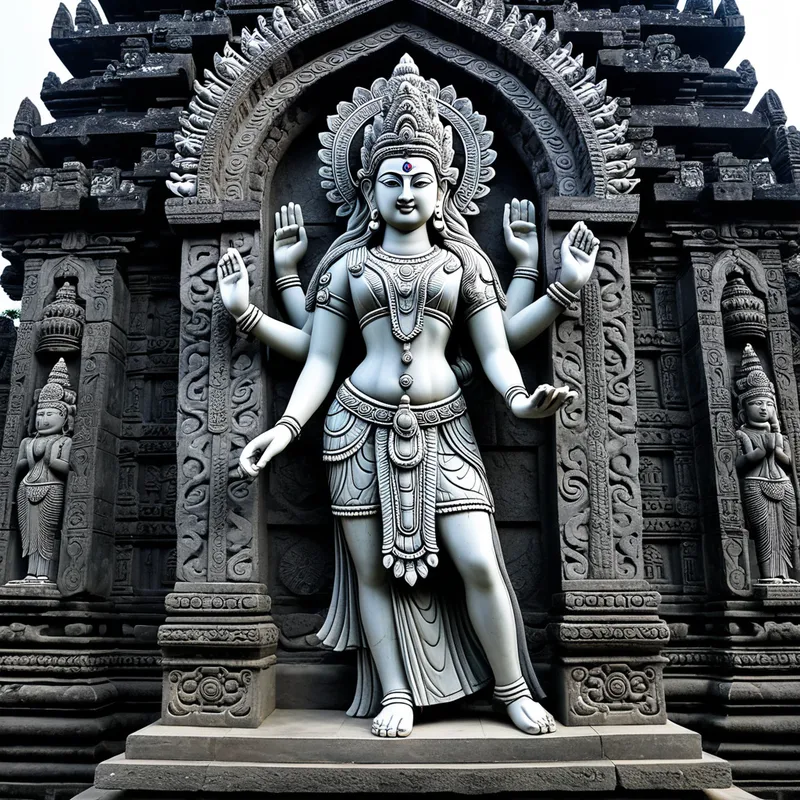
He raised his hand, and a wave of petrifying power washed over her. Where Loro Jonggrang stood, a magnificent stone statue now resided, the final figure in the grand temple complex. Her beauty was eternal, yet forever captive, a silent goddess in a house of her own demanding. To this day, they say she stands in the Prambanan complex, the thousandth statue, waiting for a dawn that will never truly come.
Cultural Origins & Context
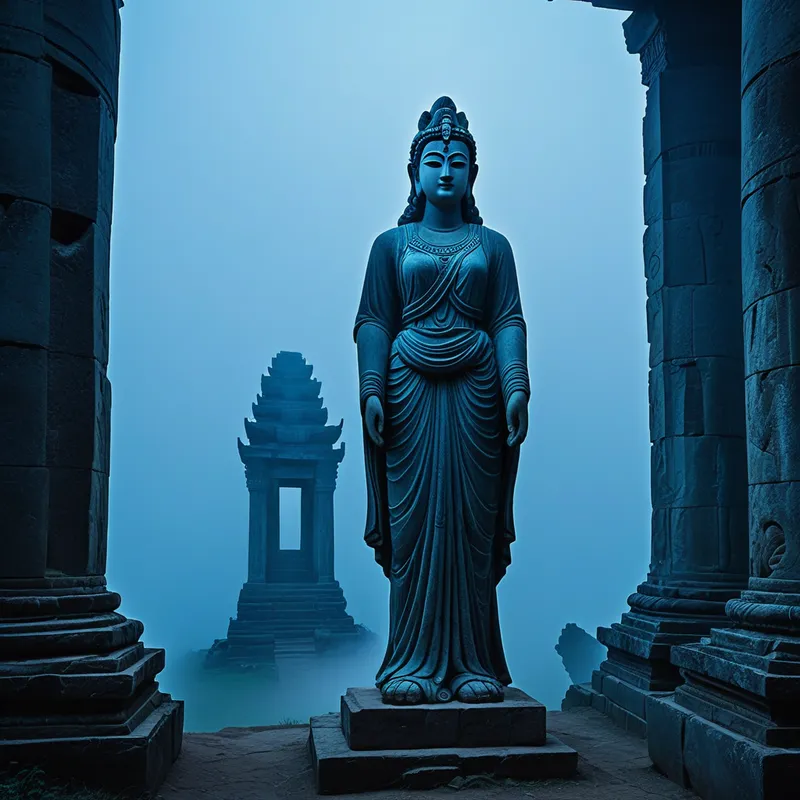
This myth is rooted in the rich soil of Central Java, specifically the region around the magnificent Prambanan temple complex. It is a wayang legend, passed down orally through generations by storytellers, dalangs (puppet masters), and in the chronicles of babad literature. The tale functions as an etiological myth, providing a folk explanation for the origin of the temple’s statues and layout. Historically, it may encode the memory of conflict between the Hindu Mataram kingdom and a neighboring realm, with the transformation symbolizing a cultural or religious integration. The story served to reinforce societal values: the consequences of oath-breaking, the awesome (and dangerous) power of supernatural forces, and the tragic cost of unresolved conflict between duty, love, and vengeance. It is a narrative deeply intertwined with the Javanese landscape, making the very stones speak of human passion.
Symbolic Architecture
At its core, the myth of Loro Jonggrang is a profound drama of creative and destructive forces locked in a fatal embrace. It is not a simple love story, but a collision of archetypal wills.
Loro Jonggrang represents the Animus-driven feminine principle in its most formidable aspect: the sovereign who cannot be possessed. She is the land itself, the kingdom of Mataram, which must be won not by force but by sacred agreement. Her impossible demand for a thousand temples is the soul’s ultimate test, a call for a creation so grand it mirrors the divine. When she resorts to trickery, she activates the Shadow aspect of the Trickster, using cunning to preserve her autonomy, but at a catastrophic price.
Bandung Bondowoso is raw, masculine libido and will-to-power, the builder-king. His ability to command spirits signifies a psyche that has harnessed the unconscious, elemental forces (the demos) for a conscious goal. His task is an alchemical opus: to transmute the raw materials of the earth (stone, spirit, night) into a structured, sacred reality (the temples) to win the anima, the soul-image.
The tragedy is that the creation, though magnificent, is built on a foundation of violence and unmet grief. The final, petrifying act is not just vengeance, but the ultimate failure of relationship: when the dynamic tension between masculine and feminine, builder and beholder, breaks down, both parties are frozen in static, eternal form.
The incomplete thousandth temple is the central symbol. One thousand represents perfection, completion, the return to the divine unity. Nine hundred and ninety-nine is the eternal near-miss, the sublime frustration that defines so much of human endeavor. Loro Jonggrang becomes the thousandth statue—the soul itself turned into an artifact, beautiful but lifeless, completing the set numerically but sacrificing its own fluid, living essence.
The Dreamer's Resonance
When this myth stirs in the modern unconscious, it often manifests in dreams of impossible tasks, relentless pressure, and petrification. To dream of being Loro Jonggrang is to feel oneself in a situation where one’s deepest self or values are under siege by an overwhelming, perhaps logically persuasive, external force (a job, a relationship, a societal expectation). The dreamer may feel they have set an impossible condition for their own happiness or safety, and now watch in dread as it is nearly met.
The somatic sensation is often one of freezing, of breath held, of a heart turning to cold stone. It speaks to a psyche using cunning (the false dawn) to delay an inevitable integration or commitment, because the foundation feels tainted by past injury (the slain father). The petrification in the dream is not punishment, but a stark depiction of the psychological state: emotional numbness, creative block, or the feeling of being trapped in a role. The dream asks: What part of you have you turned to stone to survive? What magnificent creation is being built on a foundation you cannot bless?
Alchemical Translation
The individuation process modeled here is brutal and instructive. It begins in the nigredo, the blackening: the defeat of the old king (the old conscious order, the father complex) and the ensuing grief. Bandung Bondowoso’s night of building is the albedo, the whitening—a frenzied, heroic attempt to create a new conscious structure (the temples of the differentiated personality) to win the soul.
The breakdown occurs because this creation attempts to bypass the mortificatio, the necessary death and putrefaction of the old wounds. Loro Jonggrang’s grief is not integrated; it is the unacknowledged shadow of the new kingdom. Her trickery is the psyche’s flawed attempt to force a solutio (dissolution) of the project, to return to a state of potential. But a forced dissolution is not a true transformation.
True alchemical gold—the integrated Self—is not produced by merely building a thousand perfect temples, nor by cleverly sabotaging the builder. It is born from the sacred marriage (coniunctio) of the builder’s will and the beholder’s blessing, which requires both parties to descend into and honor the shared shadow of their history.
For the modern individual, the myth warns against building a life (career, identity, relationship) on unlamented loss or unintegrated trauma. The “thousand temples” of achievement will forever feel one short, and the soul will remain a beautiful, frozen statue within its own creation. The path forward requires thawing that stone. It means acknowledging the Bandung Bondowoso within—the driven, conquering will—and the Loro Jonggrang within—the grieving, cunning sovereign. It means allowing the false dawn to pass, and waiting in the true darkness for a genuine reconciliation, where the final temple can be completed not as a prison, but as a sanctuary for a living soul.
Associated Symbols
Explore related symbols from the CaleaDream lexicon:
- Temple — The impossible creation, a structure of sacred order and consciousness built to win the soul, yet forever incomplete without the soul's willing participation.
- Stone — The petrified heart, the final state of grief and defiance, and the enduring but lifeless material of an unresolved past made eternal.
- Dawn — The deceptive moment of reckoning; a false promise of completion that triggers a premature and catastrophic conclusion to the creative act.
- Shadow — The unintegrated grief and vengeance that motivates both the princess's trickery and the prince's final curse, poisoning the potential for union.
- Ritual — The nocturnal, spirit-led act of creation; the precise, magical operation that attempts to bypass human emotion through supernatural force.
- Goddess — Loro Jonggrang as the eternal feminine, transformed from a living woman into a static, worshipped icon, representing the soul made artifact.
- Trickster — The cunning deception of the false dawn and the pounding rice, representing the psyche's use of clever, indirect means to avoid a direct confrontation with power.
- Sacrifice — The ultimate sacrifice is not of life, but of vitality; the princess sacrifices her humanity to stone to avoid a marriage, and the prince sacrifices his chance at union for vengeance.
- Order — The drive to impose a perfect, numerical, architectural order upon the chaotic night, a masculine principle that seeks to contain and structure the world.
- Grief — The unmourned loss of the father-king, the foundational wound that fuels the princess's resistance and ensures the new creation is built on unstable ground.