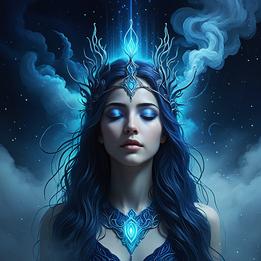
Anima
The feminine archetype within the male unconscious, representing soul, creativity, and connection to the inner world.
Anima Dream Meaning
The feminine archetype within the male unconscious, representing soul, creativity, and connection to the inner world.
Interpretive Themes
Mythological Resonance
Psyche
GreekThe mortal woman whose name means 'soul,' undergoing trials to reunite with Eros, representing the integration of human consciousness with divine love.
Inanna
SumerianThe goddess of love and war descending to the underworld, shedding her attributes to confront her shadow sister Ereshkigal and be reborn whole.
Cultural Lenses
Jungian Perspective
View Context →Central archetype in analytical psychology representing the feminine aspect of male psyche, essential for individuation. Historically rooted in alchemical traditions, now a cornerstone of depth psychology and personal growth work.
Freudian Perspective
View Context →Viewed through Oedipal lens as mother complex or unresolved childhood attachments. Modern Freudians see it as manifestation of repressed desires and early object relations influencing adult relationships.
Gestalt Perspective
View Context →Seen as disowned feminine aspects needing reclamation. In therapy, clients dialogue with Anima figures to integrate projected qualities and achieve psychological completeness in present awareness.
Cognitive Perspective
View Context →Interpreted as cognitive schema organizing feminine concepts. Modern view sees it as mental framework influencing perceptions of women, relationships, and self-concept through learned associations and beliefs.
Evolutionary Perspective
View Context →Viewed as adaptive mechanism for mate selection and social bonding. Represents evolved psychological templates for recognizing fertility cues and forming cooperative partnerships across human evolutionary history.
Global/Universal Perspective
View Context →Cross-cultural symbol of feminine principle appearing as goddesses, muses, and soul guides. Historically present in creation myths worldwide, now recognized in global spiritual practices as yin energy.
East Asian Perspective
View Context →Manifests as yin principle in Taoism, Kuan Yin in Buddhism. Historically central to balance philosophies, modernly integrated into mindfulness practices and gender harmony concepts in psychology.
South Asian Perspective
View Context →Appears as Shakti energy in Hinduism, the creative feminine force. Historically worshipped in goddess traditions, modernly represents spiritual power and psychological integration in meditation practices.
Middle Eastern Perspective
View Context →Manifests as Sophia wisdom in Gnostic traditions, Lilith in Jewish folklore. Historically complex feminine symbols, modernly reinterpreted in mystical Judaism and Islamic Sufism as soul wisdom.
European Perspective
View Context →Appears as muse in Greek mythology, fairy queens in Celtic lore. Historically artistic inspiration sources, modernly studied in literary analysis and depth psychology as creative feminine archetypes.
African Perspective
View Context →Manifests as mother goddesses like Mawu, river spirits. Historically central to creation stories and community rituals, modernly preserved in diaspora traditions and feminist spiritual movements.
Modern Western Perspective
View Context →Reconceptualized beyond gender binaries as inner feminine in all humans. Historically Jungian concept, now expanded in transpersonal psychology and integrated into therapeutic approaches for emotional intelligence.
Historical Authorities
Want a deeper analysis?
Get a personalized interpretation of your entire dream including this symbol.
Interpret My DreamThe Oracle's Prediction
Combine multiple symbolsA significant relationship will deepen through emotional vulnerability.
Timeframe
Lunation (~29 Days)
Intensity
Deep
A powerful creative inspiration will emerge from dreams or meditation.
Timeframe
Immediate (Next 48h)
Intensity
Deep
Common Appearances & Contexts
| Context | Emotion | Interpretation |
|---|---|---|
| Context Meeting a woman | Emotion Fascination | Interpretation Anima projection occurs. |
| Context Creative breakthrough | Emotion Inspiration | Interpretation Anima as muse. |
| Context Relationship conflict | Emotion Frustration | Interpretation Unintegrated Anima manifests. |
| Context Spiritual vision | Emotion Awe | Interpretation Anima as guide. |
| Context Emotional turmoil | Emotion Confusion | Interpretation Anima demands attention. |
| Context Artistic creation | Emotion Joy | Interpretation Anima expressed freely. |
| Context Life transition | Emotion Anxiety | Interpretation Anima integration needed. |
| Context Meditation dream | Emotion Peace | Interpretation Anima harmonized within. |
| Context Mythological encounter | Emotion Wonder | Interpretation Archetypal Anima appears. |
| Context Childhood memory | Emotion Nostalgia | Interpretation Early Anima formation. |
| Context Nature immersion | Emotion Connection | Interpretation Anima as earth spirit. |
| Context Conflict resolution | Emotion Relief | Interpretation Anima integration achieved. |
Interpret Your Full Dream
Beyond this symbol, every dream carries a unique story. Share your dream for a personalized AI-powered interpretation.