Ishtar's Descent
The Babylonian goddess of love descends into the underworld, confronting death and transformation in a myth about power, loss, and renewal.
The Tale of Ishtar's Descent
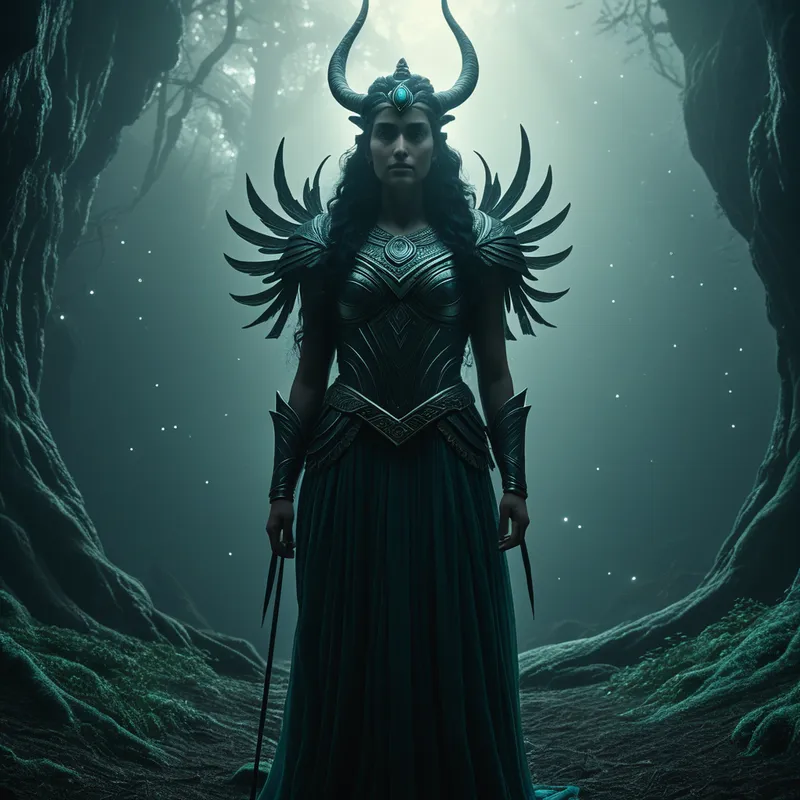
The tale begins not in darkness, but in the brilliant, restless light of the upper world. Ishtar, the goddess of love, fertility, war, and political sovereignty, whose very presence is the force of attraction and conflict that binds the world, turns her gaze downward. Her heart is fixed on the Kur, the land of the dead ruled by her sister-queen, Ereshkigal. The text is silent on a single, simple motive; it speaks of a complex, divine compulsion. Perhaps it is to confront the silent power of her shadow sister. Perhaps it is to reclaim her lost lover, the shepherd-god Tammuz, whose annual death was already mourned. Or perhaps it is the inevitable journey of a power that has known all of heaven and earth, now drawn to know the final, forbidden realm.
Adorned with the seven divine mes—the crown of the plains, the rod of lapis lazuli, the twin stone pendants—she approaches the great gate of the underworld. She demands entrance from the gatekeeper, Neti, who is thrown into turmoil by the arrival of this luminous, disruptive force. He scurries to his mistress, Ereshkigal, who is seized by a rage as deep as the abyss she rules. "Bolt the seven gates against her!" she commands. "At each gate, strip her of one of her powers."
And so, the great stripping begins. At the first gate, her towering crown is removed. At the second, the rods of lapis. At the third, the twin stones. Gate by gate, the ornaments of her identity are taken: the rings from her fingers, the breastplate from her chest, the girdle of birthstones from her hips. Finally, at the seventh and innermost gate, the last garment, the robe of her divine essence, is removed. Naked, shorn of all title and attribute, Ishtar enters the throne room of Ereshkigal, who fixes her with the eye of death. Ishtar rushes forward, but Ereshkigal unleashes her sixty maladies, striking Ishtar down, turning her into a swollen, lifeless corpse hung upon a hook.
Above, all life begins to wither. With Ishtar imprisoned in the land of no return, the processes of attraction, procreation, and generation cease. The bull does not mount the cow, the man does not approach the woman. The great god Ea, hearing the lament of the world, fashions Asushunamir, a being of ambiguous beauty and cunning. Sent to the underworld, this trickster pleads with Ereshkigal, whose guard is momentarily lowered. Asushunamir receives the waters of life. Sprinkled upon Ishtar’s corpse, they revive her.
But the laws of the underworld are absolute; no one leaves without providing a substitute. As Ishtar is conducted back through the seven gates, each of her adornments is returned. She emerges, but she does not emerge alone. Behind her, demons cling to her heels, demanding a replacement. Her eyes fall upon Tammuz, her lover, who in her absence did not mourn but sat upon her throne in splendid robes. In a moment of cold, divine justice, she consigns him to take her place. Thus, the cycle is sealed: life descends into death, and from death, life is redeemed, but always at a cost. The myth ends not with a victory, but with the establishment of a rhythm—a sacred, terrible, and necessary exchange between the realms of the blooming and the buried.
Cultural Origins & Context
The myth of Ishtar’s Descent is preserved primarily on fragmentary cuneiform tablets from the first millennium BCE, though its roots reach deeper into Sumerian tradition as the story of Inanna and Dumuzi. It existed not as mere entertainment but as a foundational theological and cosmological text. In the Babylonian worldview, the universe was a precarious balance of divine powers. Ishtar (the Akkadian counterpart to Sumerian Inanna) was not a gentle goddess of affection; she was the terrifying and glorious force of ishtaru—the principle of attraction, discord, fecundity, and political might. Her domain was the raw, creative, and destructive power of desire itself.
Her counterpart, Ereshkigal, was not merely a monster of gloom. As queen of the Kur, she presided over the ultimate order: the final accounting of all lives. Her realm was one of stark equality and silence, where dust was the common fare and darkness the common cloth. The tension between the sisters is the tension between two sovereign, complementary, and opposed forms of power: the dynamic, generative power of the living world and the static, absorptive power of the dead. The myth provided a narrative for the seasonal cycle of fertility and decay, explaining the death of vegetation (Tammuz) and the barren seasons. More profoundly, it articulated a core truth of Mesopotamian life: that vitality and sovereignty are never absolute. They are contingent, requiring negotiation with the very realms of loss and negation they seem to oppose.
Symbolic Architecture
The myth’s power lies in its stark, almost architectural symbolism. The journey is a precise, ritualized deconstruction.
The seven gates are the seven layers of the constructed self. Each adornment—crown, scepter, jewel—represents a role, a power, a social or psychic identity. To enter the realm of the unadorned soul, the realm of the absolute other, all these must be surrendered. Ishtar does not fight the stripping; she submits to it. The descent is an involuntary initiation into a state of being where all that one does and has is meaningless; only what one is remains, and that is revealed to be vulnerable, mortal, and subject to annihilation.
The figure of Ereshkigal is crucial. She is not a villain, but the embodiment of a necessary, terrible truth. She is the unconscious shadow of the luminous goddess, the keeper of all that is repressed, forgotten, and ended. Her rage at Ishtar’s intrusion is the fury of a boundary violently crossed, the outrage of silence confronted with sound, of stasis confronted with dynamism. Their confrontation is not a battle, but a recognition—a fatal mirroring.
The revival through Asushunamir, the beautiful androgynous trickster, signifies that salvation from absolute negation never comes through direct force. It comes through cunning, through ambiguity, through a third thing that belongs to neither world fully and can therefore move between them. The "waters of life" are not seized; they are obtained through a plea that touches even the heart of the queen of death, revealing her own latent grief and loneliness.
Finally, the substitution of Tammuz establishes the myth not as a story of personal salvation, but of cosmic law. Life is bought with life. Renewal requires sacrifice. The ego, having been to the brink of annihilation and returned, often projects that death onto another—a scapegoat, a loved one, a part of the self—to preserve its own hard-won continuity.
The Dreamer's Resonance
When this myth stirs in the modern psyche, it rarely appears as a literal narrative. It emerges in the feeling of a profound, involuntary descent. It is the dream of losing one’s job, status, relationships, or health—the progressive stripping away of everything that once defined a "self." It is the depression that feels like a hook in the gut, suspending the animating spirit in a cold, dark place. It is the midlife crisis where all former achievements taste of dust, and one is forced to confront the Ereshkigal within: the accumulated grief, rage, and neglected truths that have been ruling from the shadows.
Ishtar’s journey maps the process of a necessary psychological death. The conscious personality, inflated with its own powers and attributes (the mes), must eventually confront the unconscious counterpart it has ignored or feared. This confrontation is never polite; it is a catastrophic inversion. What was light becomes dark, what was active becomes passive, what was fertile becomes inert. The dreamer in this state feels "killed" by life, by fate, by their own hidden depths. The return—the healing—is never a return to the old self. It is a rebirth contingent on finding an "Asushunamir," a new perspective or creative insight that can negotiate for the waters of life. And it always leaves a trace, a "demon" of guilt, memory, or responsibility—the part of the self or one’s history that must be acknowledged and tended to, lest the cycle become mere repetition of trauma.
Alchemical Translation
In the alchemical opus, Ishtar’s Descent is the nigredo—the blackening, the putrefaction. The shining prima materia (the adorned goddess) is subjected to a descent into its own base matter, where it dies, dissolves, and loses all distinguishing form. This is not a failure, but the essential first step toward any true transformation.
"The queen of the underworld is the caput mortuum, the dead head or remnant of the initial substance, but she is also the vessel that contains the secret of life. To revivify the corpse, one must not attack the vessel but appeal to its own latent longing. The trickster’s plea is the alchemist’s prayer, a precise word or action that turns the process toward the albedo, the whitening."
The myth encapsulates the alchemical truth that the agent of transformation is often the very thing that appears to be the agent of death. Ereshkigal, in striking Ishtar down, initiates her transformation. The power structure of the psyche is overthrown, not to install a new tyrant, but to establish a dialogue between the upper and lower realms. The final stage is not a triumphant ascension but the creation of a circulatory system—the circuitus spiritualis—where life descends into matter (Tammuz’s death) and is eventually reborn from it, in an eternal, sacred exchange. The goal is not to escape the cycle, but to sanctify it, to understand that the soul’s power is forged in its repeated journeys through the realms of both love and loss.
Associated Symbols
Explore related symbols from the CaleaDream lexicon:
- Descent — The voluntary or involuntary journey into the depths of the unconscious, the past, or a state of dissolution, necessary for profound transformation.
- Gate — A threshold of transition and testing, often guarded, representing the points of passage between major states of consciousness or being.
- Underworld — The psychic realm of the dead, the repressed, the forgotten, and the foundational truths that underlie the visible world.
- Crown — The symbol of conscious identity, achieved status, and worldly power, which must often be relinquished to gain deeper wisdom.
- Mirror — The instrument of reflection and confrontation, often revealing the shadow self or the true, unadorned state of being, as in the face-to-face meeting of sisters.
- Stripping — The ritualized removal of defenses, roles, and attributes, a necessary vulnerability for authentic encounter or rebirth.
- Substitution — The psychological mechanism of offering another part of the self or another person to carry a burden of guilt, fate, or sacrifice to enable one's own renewal.
- Water of Life — The primordial, animating essence that restores consciousness and vitality, obtained not by force but by cunning or grace from the deepest sources.
- Corpse — The state of psychic death, inertia, and suspension, a potent transitional phase where the old form is dissolved before reconstitution.
- Cycle — The eternal, rhythmic pattern of descent and return, death and rebirth, binding opposing realms into a single, dynamic process.
- Shadow — The unconscious counterpart to the conscious personality, often perceived as dark, threatening, and powerful, holding disowned qualities and potentials.
- Trickster — The ambiguous, shape-shifting archetype that operates between fixed orders, using cunning and paradox to retrieve what is lost or to facilitate transformation.