Guinevere and Lancelot Myth Meaning & Symbolism
A queen, a knight, and a king. A love that shatters a kingdom, revealing the impossible tension between the heart's law and the crown's.
The Tale of Guinevere and Lancelot
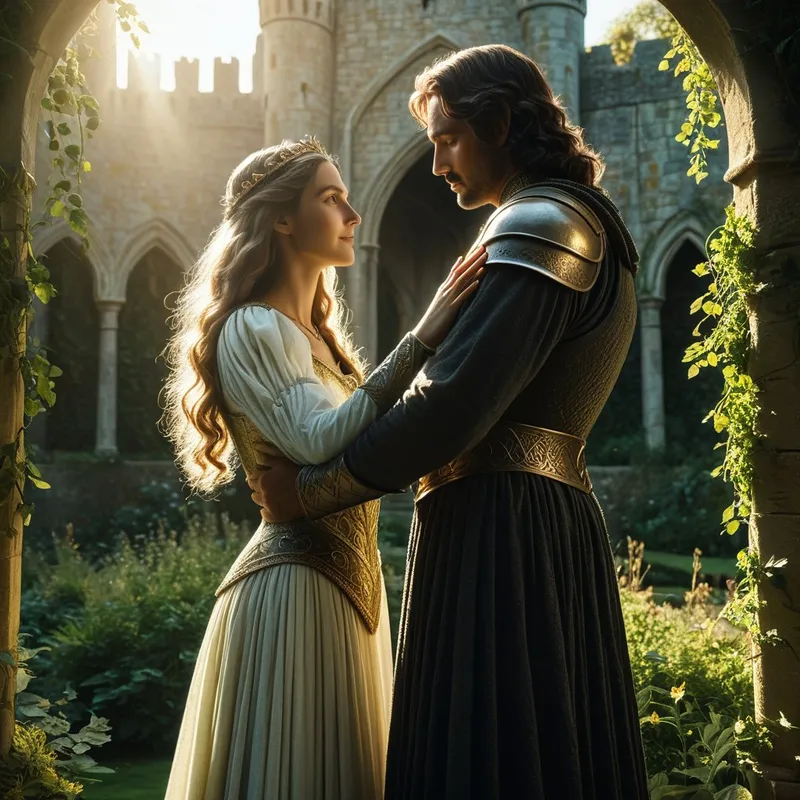
Listen, and hear the tale that cracks the foundation of the world. In the high summer of Camelot, where justice flowed like clear water and the sun seemed to shine by decree, there sat a king. Arthur Pendragon, his brow heavy with the crown pulled from the stone, ruled with a hand both firm and fair. By his side was Guinevere, her beauty not merely of face but of spirit, a light that seemed to make the stone halls breathe. Their union was the keystone of the realm, a promise of order made flesh.
Then, from across the sea, came the shadow that was also a sun. Lancelot du Lac, fostered by the Lady of the Lake herself. His skill in arms was a kind of poetry, his virtue so fierce it cast a chill. He knelt before Arthur, and the king saw in him the perfect knight, a brother in arms. He placed him at the Round Table, a circle meant to have no head, yet Lancelot became its heart.
But the heart has its own geography. It began not with a thunderclap, but with a glance held a moment too long in the torch-lit hall. A brush of fingers when passing a cup. A shared, silent understanding of a jest in a crowded room. In the green quiet of the gardens, away from the eyes of court, words were finally spoken—soft, desperate, and irrevocable. This was no base treachery, but a love that arrived like a sovereign power, commanding allegiance over all other oaths. It was a secret kingdom within the kingdom, built of stolen hours and fraught silences.
The golden age of Camelot was gilded with this lie. For years, the court buzzed with whispers that never reached the king’s ears, or that he chose not to hear. The tension was the very air they breathed—a sacred, agonizing balance between public glory and private ruin. But secrets, like water, find their cracks. The king’s own kin, the venomous Sir Mordred, laid the trap. The lovers were discovered.
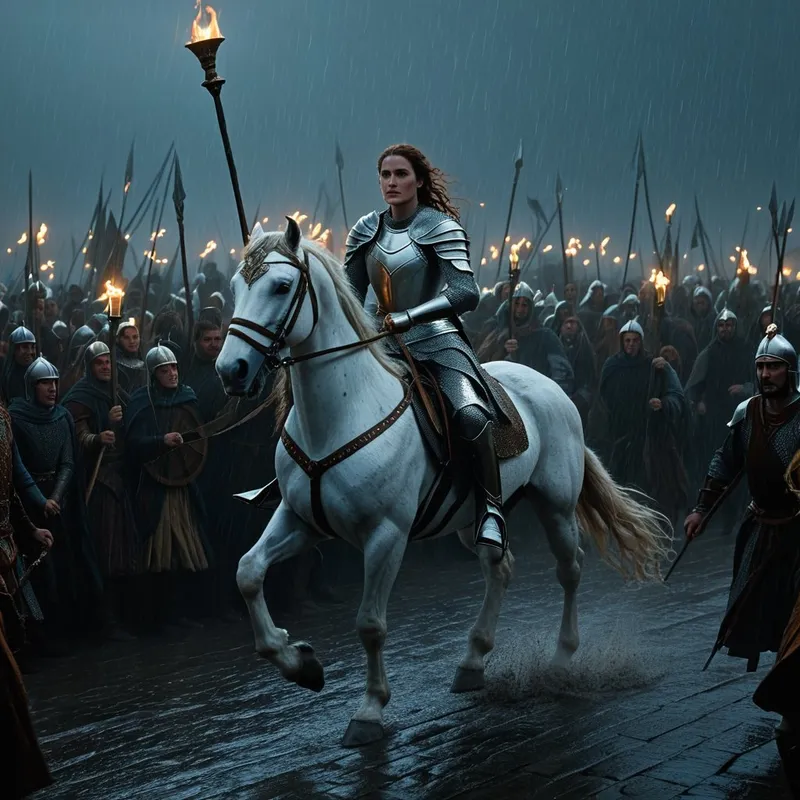
The law of Camelot was clear. The queen was condemned to burn. As the pyre was lit in the city square, a collective gasp held the crowd. Then came the drum of hooves. Lancelot, in a fury of grief and steel, broke through the guard, a force of nature defying the decree of man. He rescued his queen, but in that violent salvation, he slew fair Gareth and others, brothers of the Round. The sacred fellowship was not merely broken; it was bloodied.
Guinevere fled to a nunnery at Amesbury, trading her crown for a veil, seeking a penitence as absolute as her passion had been. Lancelot, exiled, became a hermit of the spirit, his mighty arm now lifting only in prayer. And Arthur, the once and future king, was left with a hollow throne and a gathering storm. The great betrayal was complete, not in malice, but in the tragic fulfillment of an impossible love, leaving a perfect kingdom in ashes and a lesson written not in ink, but in tears and fire.
Cultural Origins & Context
The myth of Guinevere and Lancelot is not a single story but a tapestry woven over centuries. Its earliest threads are found in Welsh triads and chronicles, where Guinevere (Gwenhwyfar) is a figure of sovereignty, but her story lacks Lancelot. He is a French invention, introduced by the 12th-century poet Chrétien de Troyes in his Lancelot, the Knight of the Cart. Here, the ethos of fin’amor (courtly love)—a highly ritualized, often adulterous devotion of a knight to a lady—was grafted onto the Arthurian world.
The tale was then amplified and moralized in the vast 13th-century prose cycles, like the Vulgate Cycle and the Post-Vulgate, where it became the central crack that brings down the Fellowship of the Round Table. Told by bards in halls and scribes in monasteries, it served multiple functions: as thrilling romance, as a cautionary tale about the conflict between personal desire and public duty, and as a theological metaphor for the fall from grace. It asked a society built on feudal oaths and Christian morality a devastating question: what happens when the heart’s deepest vow contradicts the vow that sustains the social order?
Symbolic Architecture
At its core, this is not a simple morality play about sin. It is a profound map of the psyche’s civil war. Arthur represents the ego and the ruling principle—order, law, and conscious identity (the King). Guinevere symbolizes the anima, the soul-connection and the realm of feeling that the king must integrate to rule a whole kingdom (the Queen). Lancelot is the hero archetype, the dynamic, striving spirit of the individual.
The tragedy occurs when the hero, tasked with serving the king, falls instead into identification with the king’s own unconscious longing. He does not bring the anima to the king; he steals her away.
The Round Table itself is a symbol of psychic wholeness, a mandala of the integrated self. The love affair is the shadow that the conscious order (Arthur) cannot acknowledge, yet upon which its very vitality may secretly depend. The betrayal is the inevitable eruption of this repressed content, shattering the fragile unity. Guinevere’s final retreat to the nunnery and Lancelot’s to the hermitage represent the introversion of these powerful forces—love and heroic spirit—when they are severed from their rightful place in the governance of the self.
The Dreamer's Resonance
When this myth stirs in modern dreams, it rarely appears as medieval pageantry. Instead, one may dream of being trapped in a loveless, yet perfectly respectable, partnership while feeling a soul-deep pull toward another. One might dream of a workplace where loyalty to a boss or company (Arthur) conflicts with a passionate commitment to a personal project or colleague (Lancelot/Guinevere). The somatic feeling is often one of exquisite tension, a guilty thrill intertwined with a sense of impending doom.
Psychologically, this dream pattern signals a critical juncture in the dreamer’s process of differentiation. The conscious personality has established an order (a career, a lifestyle, a self-image), but the soul—the anima or animus—is in rebellion, seeking a deeper, more passionate connection that the current “kingdom” cannot accommodate. The dream is not necessarily prescribing adultery, but highlighting a profound betrayal of one’s own inner needs and authentic affections for the sake of an imposed or outdated structure of duty.

Alchemical Translation
The alchemical process mirrored here is not the creation of gold, but the individuation—the forging of a Self that can hold its contradictions. The initial state is the nigredo, the blackening: the devastating collapse of Camelot, the death of the old, idealized self (the perfect king, the perfect knight, the perfect queen).
The fire that was meant to consume Guinevere becomes the alchemical fire that reduces the old psychic structures to ash, creating the fertile prima materia for transformation.
Guinevere’s cloister and Lancelot’s hermitage represent the albedo, a purification through separation and repentance. This is not a moral punishment, but a necessary withdrawal of projections. The passionate force (Lancelot) and the soul-image (Guinevere) must be withdrawn from the outer object and internalized. The final stage, the rubedo or reddening, is the integration. It is the realization that Arthur, Lancelot, and Guinevere are all aspects of one psyche.
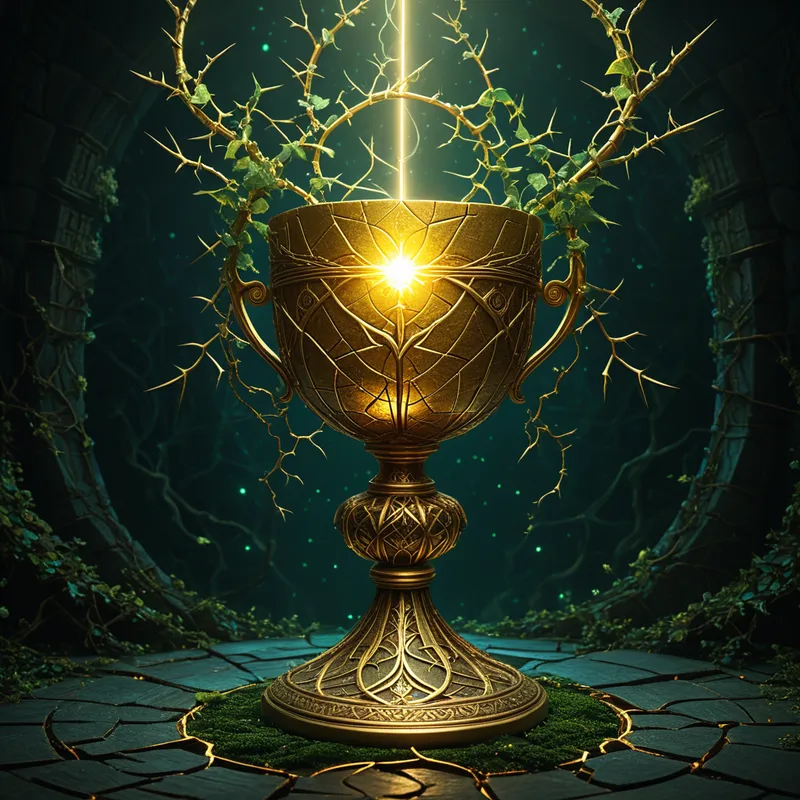
For the modern individual, the myth models the agonizing but necessary death of an inauthentic life structure. It calls for the courageous acknowledgment of one’s deepest loves and loyalties, even when they conflict with one’s current “kingdom.” The triumph is not in the illicit union, but in the subsequent breakdown and the slow, painful rebuilding of a personality where the king (conscious will), the queen (soulful connection), and the knight (passionate action) are reconciled within a single, more conscious, and more compassionate Self. The Grail that is sought thereafter is not a cup, but this hard-won wholeness.
Associated Symbols
Explore related symbols from the CaleaDream lexicon: