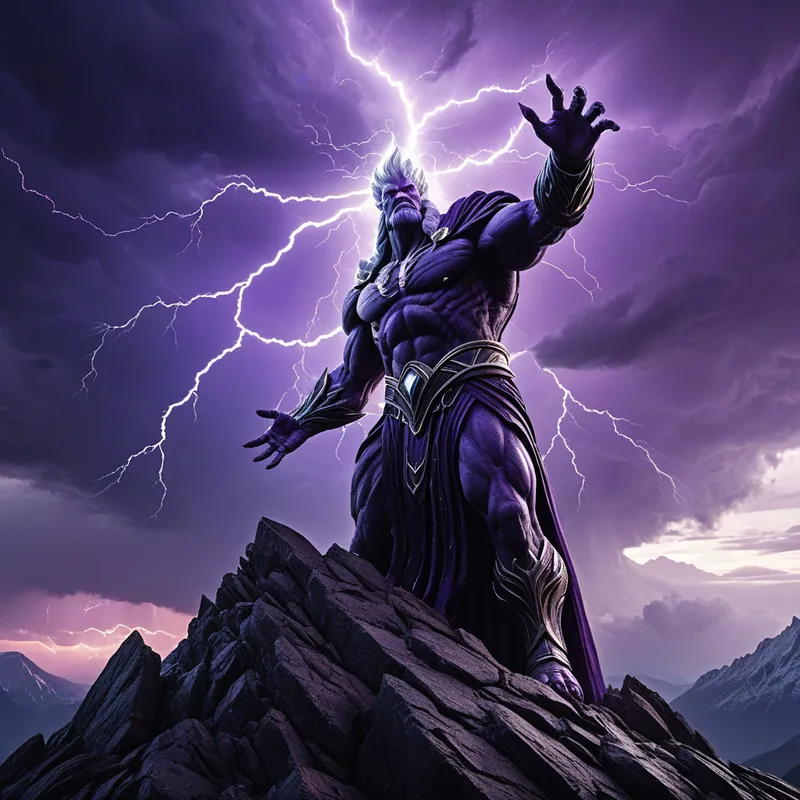
Thunderclap Myth Meaning & Symbolism
A myth of a primordial sound so profound it shatters stasis, heralding creation, revelation, and the irreversible awakening of the psyche.
The Tale of Thunderclap
In the time before time, when the world was a single, silent thought hanging in the void, there was only the Great Hum. It was not a sound, but the potential for all sound—a deep, resonant stillness that held everything and nothing in perfect, dreaming balance. The mountains were soft suggestions. The rivers were ideas of flow. The creatures, including the first people, moved through this muted world like shapes in deep water, their hearts beating to the slow, somnolent rhythm of the Hum.
They knew no fear, but also no joy. They knew no conflict, but also no song. Their world was a beautiful, eternal stasis. The Sky Ancestor watched this from the vault of the heavens, and in its vast consciousness, a strange new feeling stirred—not malice, but a terrible, necessary love. It saw that without rupture, there could be no creation. Without noise, there could be no music.
So, the Sky Ancestor gathered the substance of its own being, the tension between what-is and what-could-be. It drew this tension into a single, focused point in the center of the silent sky, a point that swallowed the feeble light and pulsed with unbearable pressure. The people below looked up, not with understanding, but with a primal, wordless dread that tightened their chests. The Great Hum began to waver, to thin, like a membrane stretched too tight.
Then, it came.
It was not merely heard. It was felt. The Thunderclap was the universe breaking its own shell. It was a white-hot spear of pure vibration that pierced the ears, the mind, and the soul. The sound tore the fabric of the Hum, and in its wake was not silence, but a million new sounds: the crash of the first true mountain falling, the shriek of the first wind, the roaring birth-cry of the first river carving its path. The people fell to the ground, not in worship, but in a shock so total it was a kind of death. The old, quiet world was gone. In its place was a world of sharp edges, brilliant colors, terrifying distances, and overwhelming sensation.
From the point of the Clap, the First Word echoed. It was not a word of any language they knew, but its meaning was seared into their newly awakened spirits: Awake. And they were. They looked at each other with new eyes, hearing their own voices for the first time—voices now capable of weeping, of shouting, of singing. The Thunderclap was the end of the dream, and the violent, glorious beginning of everything else.
Cultural Origins & Context
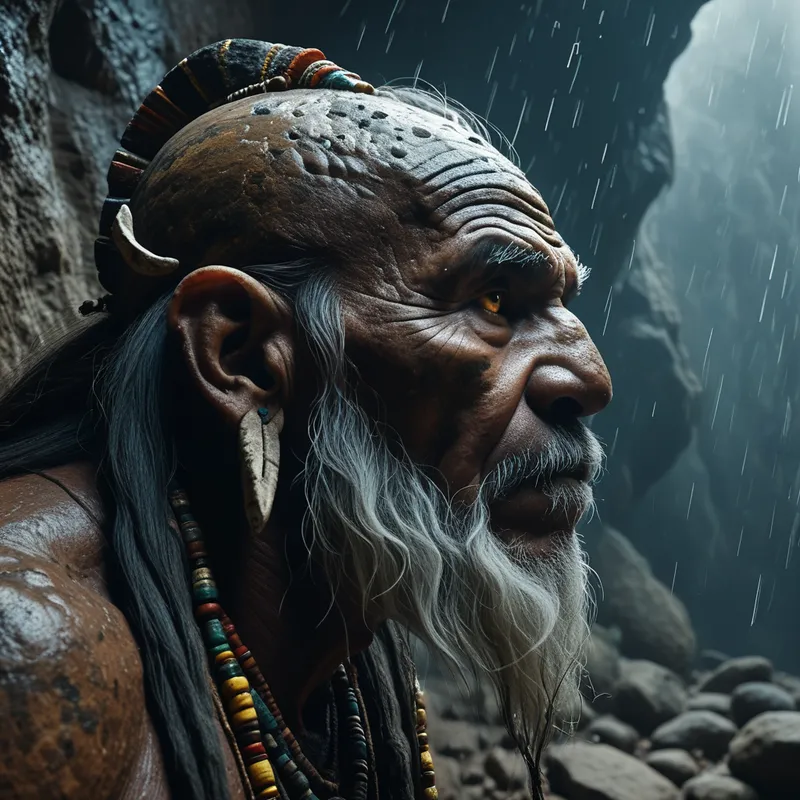
The myth of Thunderclap is not the property of a single tribe or nation, but a profound archetypal narrative that echoes across continents. We find its essence in the Dreamtime stories of Australia, where ancestral beings' movements and conflicts sound the world into form. It resonates in the Norse Mjölnir's Crash, a defensive, ordering force against chaos. It whispers in the Vedic hymns to Indra, whose thunderbolt (vajra) slays the serpent of stagnation (Vritra) to release the waters of life.
This was a story told not to explain meteorology, but to explain consciousness itself. It was recited by shamans and elders at liminal times: at the onset of puberty rites, before great hunts or journeys, or during eclipses. Its function was initiatory. The telling was meant to re-create, in a controlled ritual space, that primordial shock—to remind the community that their very state of being, with all its pain and beauty, was born from a catastrophic rupture of a prior, simpler state. It served as the foundational justification for change, for courage, and for the acceptance of life’s inherent, sometimes terrifying, dynamism.
Symbolic Architecture
At its core, the Thunderclap symbolizes the irreversible moment of awakening. It is the psychic Big Bang. Before it, there is undifferentiated potential—the peaceful, unconscious unity of the womb or the paradise garden. The Thunderclap is the traumatic, necessary event that shatters this unity, creating the duality (light/dark, sound/silence, self/other) required for conscious experience to exist.
The Thunderclap is the sound the soul makes when it can no longer bear the weight of its own un-lived potential.
The Sky Ancestor represents the objective, transpersonal psyche—the Self, in Jungian terms—which knows that growth requires a shattering of the comfortable persona or the stagnant conscious attitude. Its action is not cruel, but numinous; it comes from a place beyond human morality, driven by the imperative of evolution and wholeness. The resulting world of sharp edges and roaring rivers is the complex, challenging, and vividly real landscape of individuated life.
The Dreamer's Resonance
When this myth stirs in the modern unconscious, it often manifests in dreams of sudden, shocking sounds or events: a gunshot with no gun, a tree splitting in a silent forest, a lightbulb exploding, or the dreamer’s own scream shattering glass. Somatic sensations accompany these dreams—a jolt through the body, a racing heart upon waking, a feeling of visceral vibration.
This is the psyche signaling a critical threshold. The dreamer is often in a period of prolonged stasis, denial, or repression—a "Great Hum" of their own making. The job they hate but won't leave, the relationship that has gone silent, the creative potential they refuse to acknowledge. The Thunderclap dream is the Self’s ultimatum. It announces that the comfortable numbness is no longer sustainable; the tension has built to a breaking point. The psychic explosion has already occurred internally, and the dream is its first, terrifying echo in consciousness. The process underway is the death of an old adaptation and the violent, involuntary birth of a new awareness.

Alchemical Translation
The alchemical journey mirrored in the Thunderclap myth is the transition from the Nigredo—the blackening, often seen as a descent into despair—into the chaotic, active phase of Separatio and Calcinatio. The primal, silent unity (the massa confusa) must be violently broken apart so its components can be purified and reconstituted at a higher level.
For the individual, this translates to the often-painful awakening to one’s own shadow, complexes, and buried life. The "Great Hum" is the false peace of living according to others' expectations, of ignoring inner calls. The Thunderclap is the catalytic event—a devastating loss, a sudden insight, a betrayal, a diagnosis—that obliterates that false peace. It feels like annihilation.
The goal of the myth is not to return to the silence, but to learn to sing in the world the Thunderclap made.
The hero’s task, once awoken, is not to lament the lost silence, but to gather the shattered pieces—the new sounds, the sharp perceptions, the raw emotions—and begin the work of conscious creation. They must take the First Word, "Awake," and give it their own vocabulary. This is the individuation process: moving from being an unconscious subject of the Thunderclap to becoming a conscious co-creator in the resonant, complicated, and authentic world it initiated. We do not get to choose the clap, but we are tasked with composing the symphony that follows.
Associated Symbols
Explore related symbols from the CaleaDream lexicon: